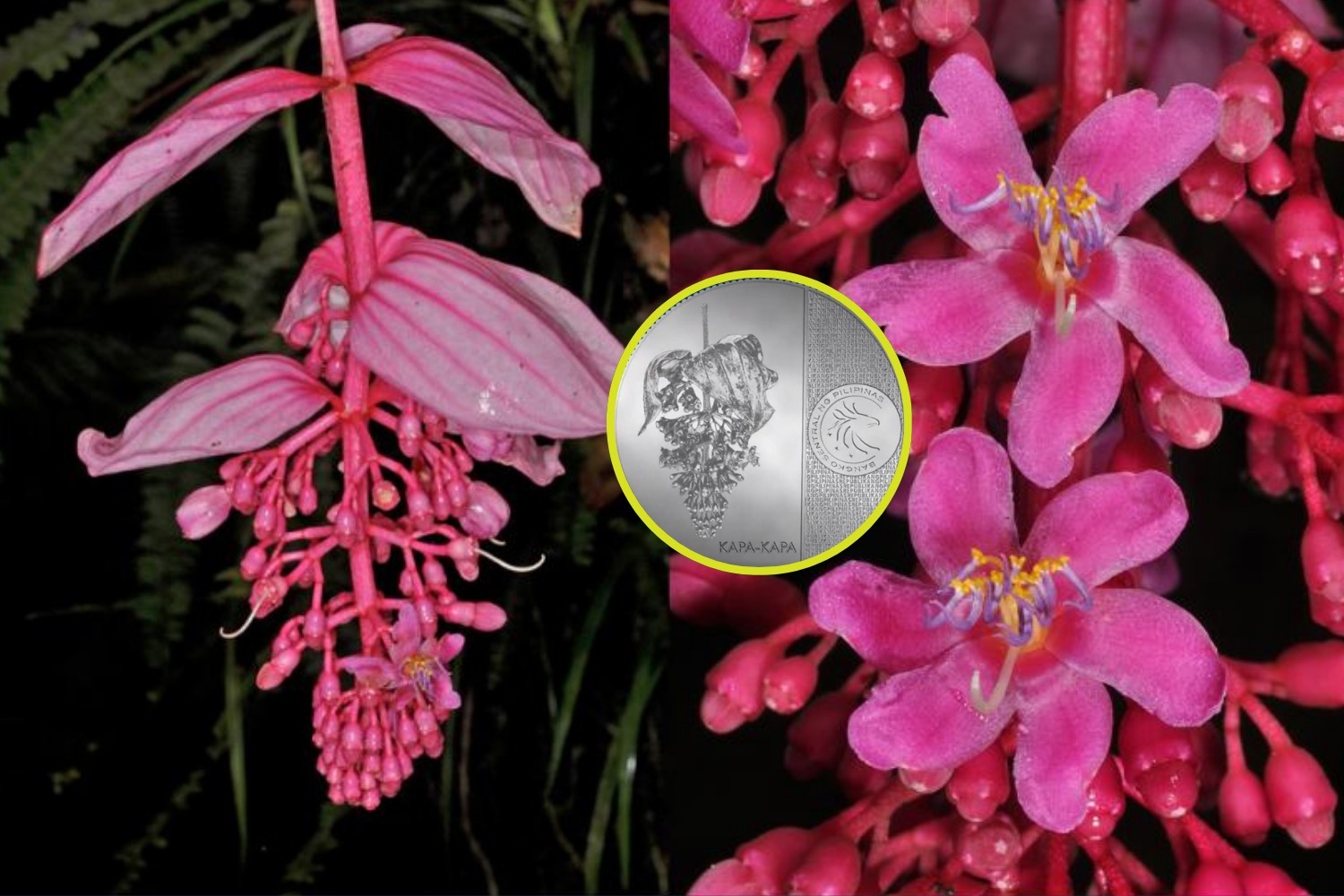
Its inclusion on the BSP’s 10-peso coin is a strategic move to highlight the country's "critically endangered" status under DENR DAO 2017-11, reminding every Filipino that wealth is nothing without a thriving ecosystem. Photographs by National Museum of the Philippines - Bicol / Facebook and Bangko Sentral ng Pilipinas
The nation’s flora.
Did you know that the forest’s pink chandelier is also the flora at the back of Bangko Sentral ng Pilipinas’snew 10-peso coin?
The pink flower is identified and locally called as kapa-kapa, one of the most exquisite flowering plant that thrives in the forests of Luzon, Mindoro, Negros, Panay, Mindanao, and parts of the Bicol Region like Albay and Camarines Sur. It is commonly known as rose grape and bears the scientific name Medinilla magnifica.
In a post from National Museum of the Philippines – Bicol, this native Philippine plant is featured because of its bountiful appearance—having “large, dark green leaves and hanging clusters of tiny, grape-like pink or red flowers.”
It highlighted the following benefits:
The ripe fruit or its berries can be applied to wounds while its leaves and fruits are edible.
Kapa-kapa has natural chemicals like tannins, phenolic compounds, and flavonoids that give biological or anti-weeding properties.
Flora in danger, needs preservation
Moreover, the page cited that the kapa-kapa is “critically endangered” based on the DENR Administrative Order due to habitat destruction and deforestation, also calling for its preservation.
“Cultivating kapa-kapa as an ornamental plant could aid to its conservation. If you’re planning to cultivate this plant, it requires high humidity, well-drained soil, and bright but indirect sunlight. Although it’s not the simplest plant to maintain, the gorgeous blooms make the effort worthwhile,” it said.
More than just a plant that blooms with wonder, looking back at the kapa-kapa from the 10-peso coin serves as a reminder to appreciate its value.
In a post from National Museum of the Philippines – Bicol, this native Philippine plant is featured because of its bountiful appearance—having ‘large, dark green leaves and hanging clusters of tiny, grape-like pink or red flowers.’
Gwyneth Nolasco contributes stories about the latest discoveries, life hacks, personality features, and pop culture. Outside her writing zone, she enjoys watching coming-of-age, romcom, sci-fi, and mystery movies and series. She loves eating peanuts and walking to nature spots.