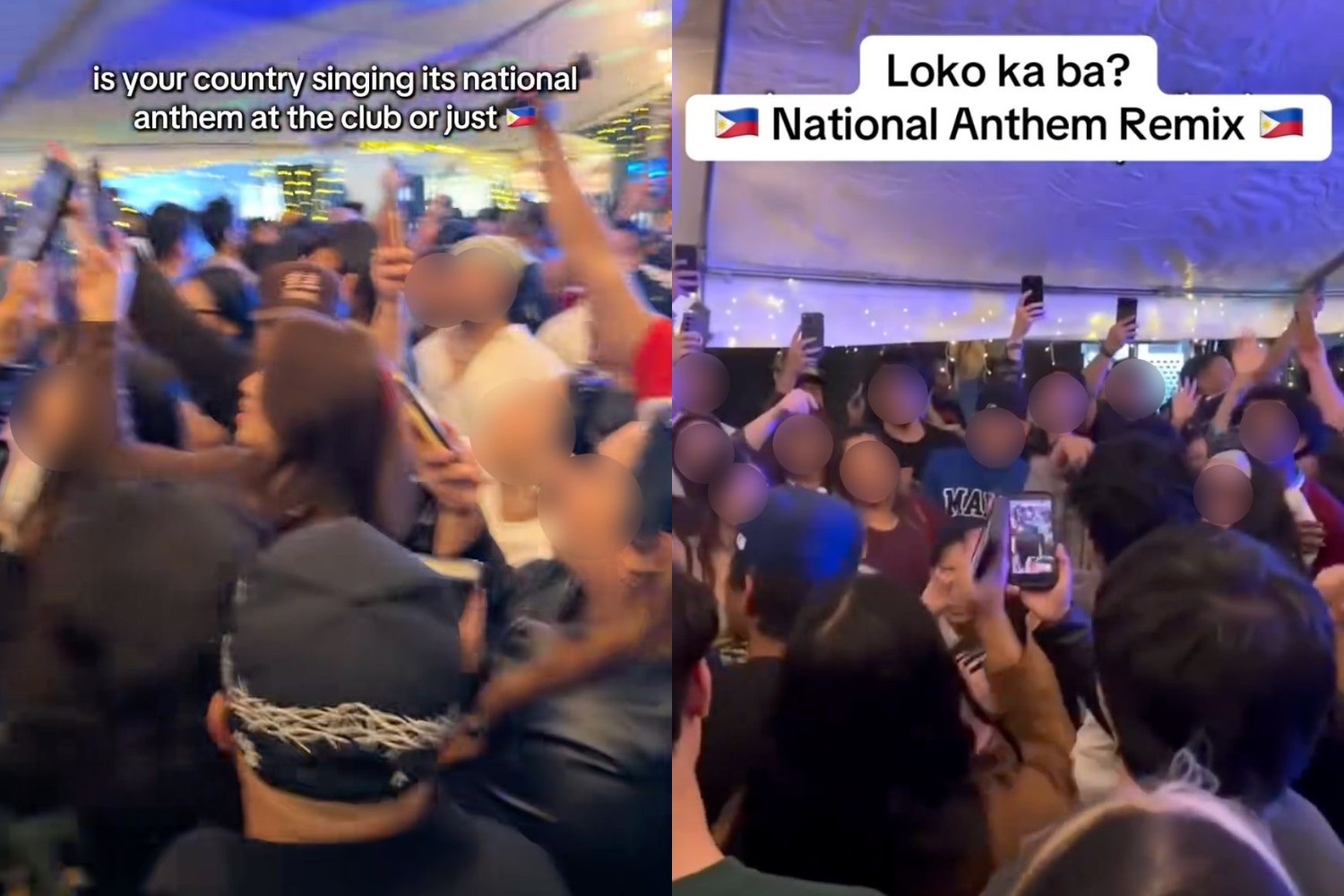
radar traced the clip to an earlier TikTok post dated December 15, 2025, by a Filipino who appears to be based in the United States. The original text overlay read, “is your country singing its national anthem at the club or just 🇵🇭.” Minutes after radar’s investigation, the video appears to have been deleted.
While the act may not be illegal in the US, it raises questions under Republic Act No. 8491, or the Flag and Heraldic Code of the Philippines, back home.
Section 37 states that the national anthem’s rendition must be in accordance with the musical arrangement and composition of Julian Felipe, whether played or sung.
Section 38, meanwhile, states that once the national anthem is played at a public gathering, the attending public must sing it, “done with fervor.” As a “sign of respect,” they must stand at attention and face the Philippine flag if there’s one displayed—if not face the band or conductor. At the first note, they must “execute a salute” by placing their right palms over their left chests.
Moreover, the national anthem “shall not be played and sung for mere recreation, amusement or entertainment purposes,” except during international and local competitions, the “signing on” and “signing off” of radio broadcasting and television stations, before the initial and last screening of films, before the opening of theater performances, and other occasions allowed by the NHCP, then called the National Historical Institute.
The resurfaced video has since drawn mixed reactions. Although it’s not illegal in the US, many commenters pointed out that it’s still done in poor taste.
As for the Threads repost, users were furious. “Hindi namatay ang mga bayani para sa ganto. Have some decency and pride on what they fought for,” one commenter said.
Others, however, had a more nuanced take. A commenter said that while there’s indeed issue with treating the national anthem as “entertainment when it shouldn’t be,” RA 8491 is a “poorly written law.”
Noting that Section 37 must be repealed, the user said, “A National Anthem dance remix can be made reverent. The State has no business dictating to us how we should show our patriotism.”