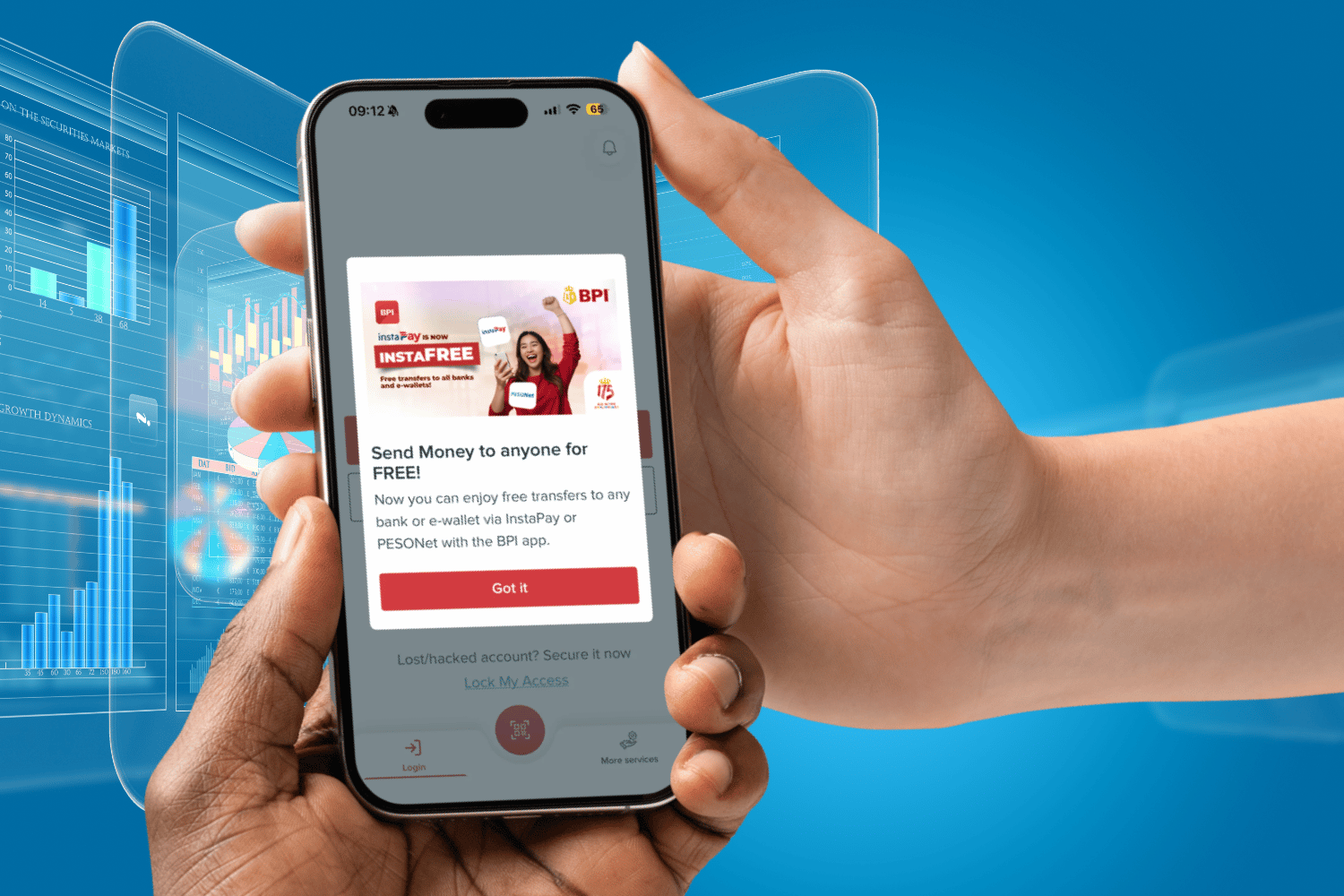
The move removes InstaPay and PESONet fees for millions of users and raises questions on how banks will price digital transactions moving forward.
Digital banking promised convenience. Yet for years, one small inconvenience never really went away. Every transfer to another bank came with a fee. A few pesos here, a few pesos there. It never seemed like much, but over time, those charges added up.
Starting today, July 1, that is no longer the case for millions of BPI customers. The Bank of the Philippine Islands has removed InstaPay and PESONet transfer fees across its app, online banking, VYBE, BanKo, and BizKo, making interbank transfers free for more than 9.5 million users.
The move is welcome news for families sending allowances, friends splitting expenses, freelancers receiving payments, and small businesses that move money several times a day.
Consider someone who sends money through InstaPay just four times a month. At ₱10 per transaction, that comes to about ₱480 in transfer fees over a year. Do the same through PESONet at ₱50 per transaction, and the total reaches ₱2,400.
BPI’s decision could also change expectations around digital banking. Free transfers are nothing new. Digital banks and fintech platforms have offered them for years, often as a way to attract customers. What makes this different is the scale. As one of the country’s largest traditional banks, BPI is making free transfers a permanent feature for millions of users.
That could make charging for bank transfers harder to justify.
Banks still pay to process electronic fund transfers using shared payment systems, so the cost does not disappear just because users no longer see a charge on their screen. In BPI’s case, the bank has chosen to absorb those costs instead of passing them on through per-transfer fees.
This comes after the Bangko Sentral ng Pilipinas called for more market-based pricing for electronic fund transfers under BSP Circular No. 1238. While the circular does not require banks to eliminate fees, it gives them greater flexibility in deciding how to price digital services.
Whether other banks follow BPI’s lead remains to be seen. But customers now know that one of the country’s biggest banks can make free transfers a permanent feature, instead of just a limited-time promotion.
For an industry that has spent years encouraging Filipinos to embrace digital banking, charging extra just to move money may become a tougher sell.
READ: