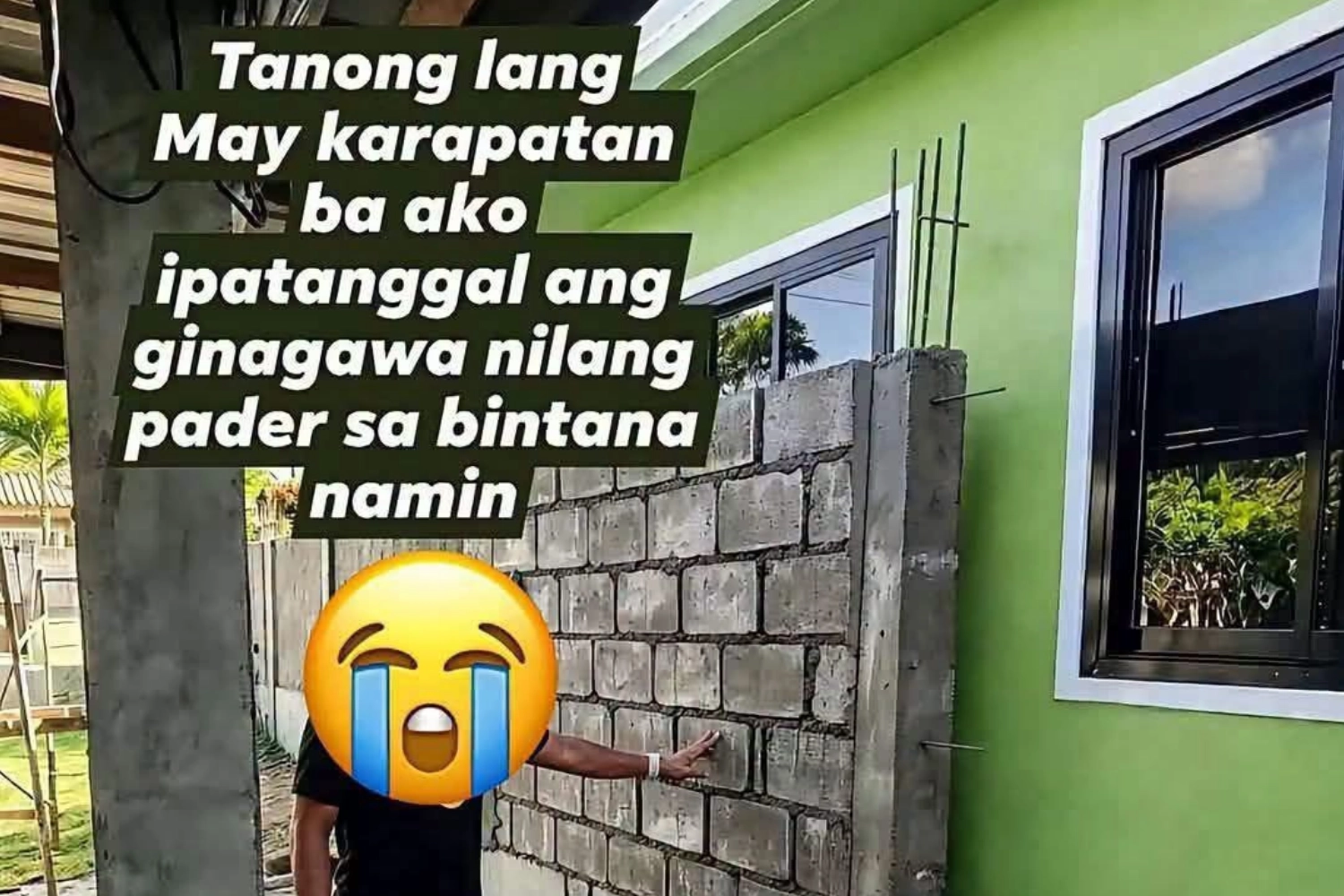
Your neighbor has the right to build
Under Article 430 of the Civil Code, property owners generally have the right to enclose their land with walls or fences, provided they respect existing easements.
Palanan explained that if the wall stands entirely within the neighbor’s property, its construction is generally permissible, subject to applicable laws.
Simply blocking another homeowner’s window does not automatically make the wall illegal.
The two-meter rule
Article 670 of the Civil Code requires windows offering direct views toward adjoining property to be at least two meters from that property. For sideways views, the minimum distance is 60 centimeters.
If the green house was built directly along the property boundary, its windows may violate these requirements.
However, Article 673 protects homeowners who have legally acquired an easement of direct view. In such cases, the neighboring property owner generally cannot construct a building within three meters of the boundary.
When can you demand demolition?
Palanan explained that homeowners may challenge a wall if it encroaches on their property or violates an established legal easement.
The National Building Code also regulates setbacks, firewalls, and construction safety. Required firewalls generally cannot contain ordinary windows.
Unauthorized construction or building-code violations may justify government intervention, although demolition is not automatic.
What should you do?
Homeowners should first verify property boundaries through land records and, if necessary, a relocation survey by a licensed geodetic engineer.
They may request an inspection from the city or municipal Office of the Building Official to determine whether the construction complies with regulations.
Barangay mediation may help resolve the disagreement. If necessary, a property lawyer can assess whether court action is justified.
Ultimately, Palanan’s legal discussion underscores one important principle: Having a window does not automatically give you the right to prevent your neighbor from building on their property.
The deciding factor is whether the construction violates property rights, established easements, or building regulations.