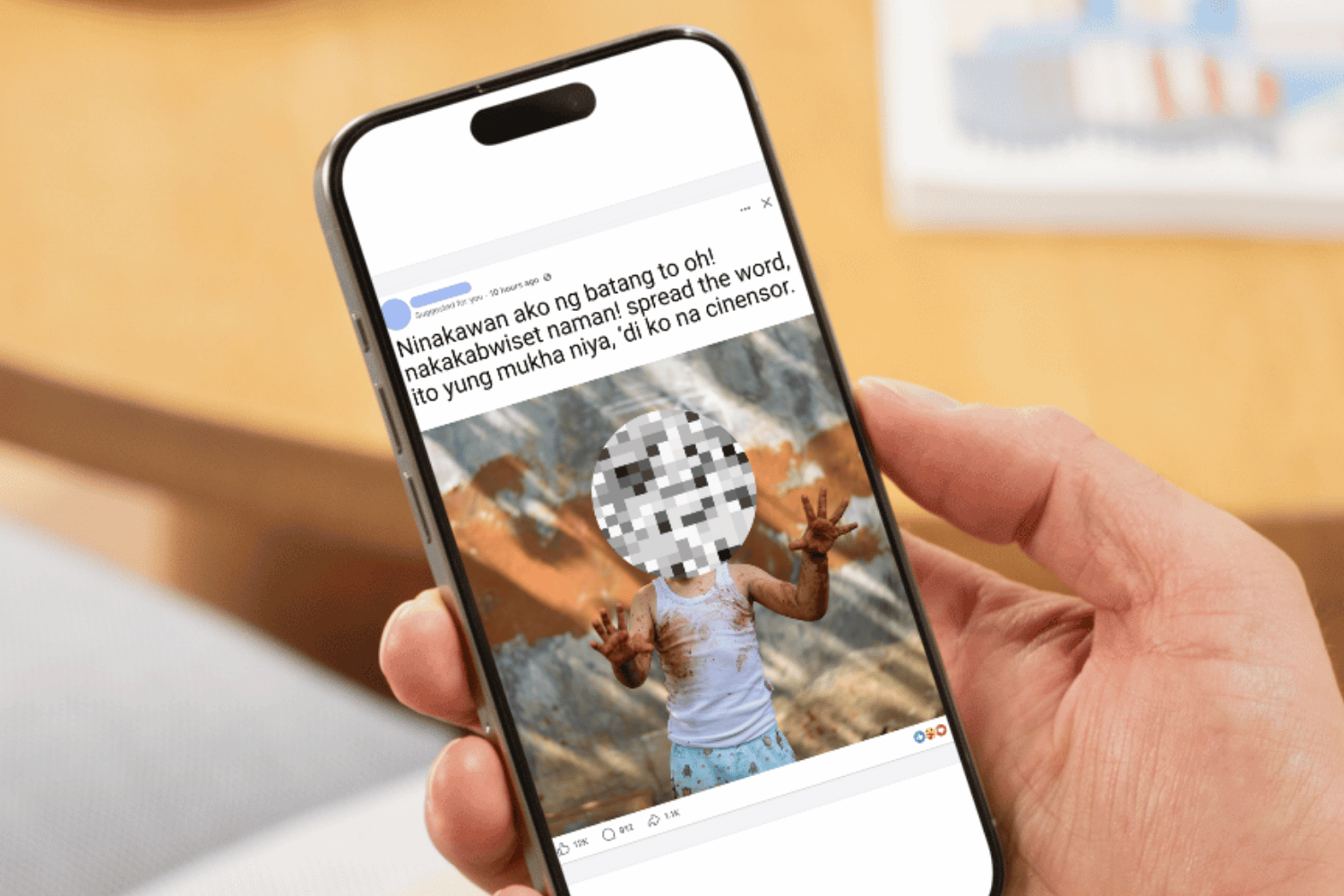
A post in a Rizal subdivision Facebook group sparks debate on public shaming, cyber libel, data privacy.
A member of a public Facebook group for a subdivision in Rodriguez, Rizal, drew mixed reactions after posting photos of two young men believed to be minors and accusing them of taking a lighter from a store during a trick-or-treat activity.
In an Oct. 31 post in the public Facebook group of Eastwood Residences Home Owners Association, Inc., a user with a dummy account named “Magnolia” asked whether the boys were members of the nearly 11,000-member group.
“Taga dito po ba ang mga batang ito? Nag trick or treat po sila kagabi, tumambay sa harap namin sandali tapos maya maya kinuha yung lighter sa tindahan namin around 8PM,” the post read. “Kung sino man po ang nakakakilala sa kanila, pakisabihan na lang po na huwag na nila uulitin kung hindi irereport namin sila sa barangay. Salamat po sa makakapag bigay ng impormasyon.”
The comments section quickly became divided.
Some commenters defended the post as a way to seek accountability, arguing that social media can help reach the necessary people and alert the community to alleged wrongdoing.
One commenter argued the issue was not the lighter’s value but the act of taking something without permission. “Sa tingin ko, hindi naman issue ang value. Ang issue ay ang action na ginawa,” the commenter wrote, warning that tolerating seemingly minor acts of theft could lead to more serious incidents.
Another commenter noted that even inexpensive items have value and that parents should teach their children not to take things that do not belong to them.
Others questioned the decision to publicly expose the children’s faces over the missing item, raising concerns about public shaming and possible legal consequences.
“Hey, alam naman natin mali ang ginawa nila pero ‘di mo kailangan i-post at ilagay sa kahihiyan ang mga batang ‘yan,” one commenter wrote, suggesting that the store owner could have spoken to the children or their parents directly.
Another commenter urged the original poster to delete the photos, warning: “Baka ma-cyber libel ka pa.”
Cyber libel, data privacy act
Posting an accusation on social media can constitute cyber libel, particularly when it makes the accused people explicitly identifiable.
Under Philippine laws, cyber libel involves four elements:
- Defamatory imputation
- An accusation that could damage a person’s reputation.
- Publication
- The accusation is communicated to at least one person other than the person being accused, including through an online post.
- Identifiability
- Readers can tell who is being accused, even if their name isn’t mentioned.
- Malice
- The accusation is made with wrongful intent, or with knowledge that it is false or with reckless disregard for whether it is true or false.
These elements don’t automatically mean that the post is already cyber libel. The accused must file a complaint for the matter to be brought before the courts, which will determine whether the elements are present.
The post also raise a separate question under the Data Privacy Act of 2012.
The law requires the processing of personal information to follow three principles: transparency, legitimate purpose, and proportionality. Simply put, people must have a valid reason to use someone’s personal information and only for a specific instance.
The law also provides exceptions, including for individuals handling personal information in connection with their personal, family, or household affairs. It also excludes certain activities, such as journalism, artistic work, and research, from its coverage.
Whether it applies to the Eastwood Residences post depends on the circumstances and must be determined by the proper authorities.