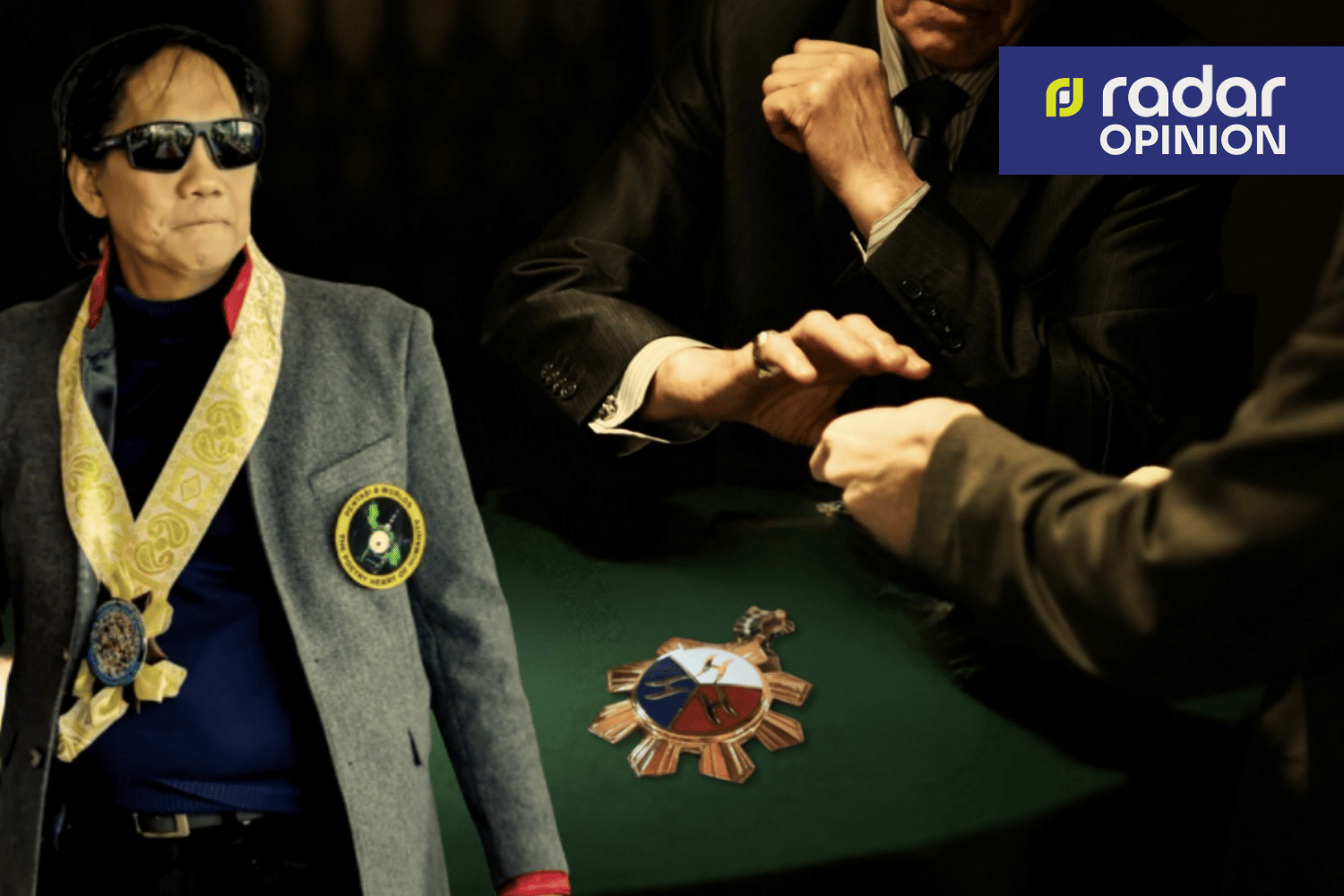

Advocates for Doc Penpen claim a “literary group” is undermining his National Artist bid. But in the literary world, does digital volume equal literary value?
The bid to canonize Dr. Epitacio Tongohan, known as Doc Penpen, as a National Artist has ignited a firestorm, pitting a high-decibel digital promotional machine against a literary establishment that remains unconvinced by his social media chutzpah.
An advertorial for his poetry organization, PENTASI B—published by The Philippine STAR and hosted by Philstar.com on Aug. 12, 2024—quoted the late fictionist Rogelio Ordoñez to suggest that Tongohan’s works carry immense weight. The piece explicitly argues for his inclusion in the order of National Artist for Literature.
However, Philstar.com issued a crucial disclaimer, noting the piece didn’t follow its standard editorial guidelines. It was a promotion—one that seemed conspicuously self-aggrandizing.
The anatomy of an online campaign
Tongohan has repeatedly reposted on Facebook—beginning in August and at least thrice again in November this year—an analysis attributed to Jose Laderas Santos (ex-chairman of Komisyon sa Wikang Filipino), comparing him to five foundational figures in visual poetry: Simmias of Rhodes, George Herbert, Guillaume Apollinaire, Jose Garcia Villa, and e.e. cummings.
It asserts that Tongohan surpasses all five, earning “titles they never did.” As the “Father and King of Visual Poetry,” Doc Penpen “integrates science, philosophy, and aesthetics into a ‘neo-genre’ that is multilingual, multimodal, multiangular, multisensorial, and multidimensional.”
Adjectives multiply. Praise accumulates. Evidence remains elusive.
Volume vs. readership
When repetition isn’t enough, amplification comes. Posts from the Facebook page “Spotlight PHL”—with no clear editorial authority—began releasing pro-Penpen material on Nov. 29. Having exhausted the charm offensive, the script was flipped: A “literary mafia” is supposedly making a “deliberate effort” to “undermine the candidacy” of Tongohan as National Artist “in favor of a preferred colleague.” Screenshots of writer Jerry Gracio’s critical comments, with annotations, were presented as evidence of this alleged campaign.
On Dec. 2, the page doubled down, claiming “an article has sparked a flurry of discussion online,” though it was the only source posting such a thing. Screenshots of comments by other writers, including “Gerry” (Gracio), were presented as further insinuations of coordinated opposition. For the hat trick on Dec. 23, it appropriated opinions—even tongue-in-cheek statements from veteran authors Butch Dalisay and National Artist for Literature Virgilio Almario—that supposedly confirm memberships in a literary “cabal” or “coterie” targeting Tongohan.
Engagement numbers tell the story. Reactions, comments, and shares come mostly from accounts that are locked or have between five and 100 friends. Comments echo each other in content and typing style. Spotlight PHL, boasting at least a million followers, has changed its name 18 times since 2020, including “Jen Alegre,” “IdolJen,” and “JEA.” Its other posts, mostly on Philippine politics, see nearly zero engagement.
Volume masquerades as consensus; Doc Penpen’s kingdom is proving to be largely imaginary.
Tongohan chronicles his political photo ops, titles, awards, global festivals, and his meeting with Indian Prime Minister Narendra Modi, who allegedly gave him a handwritten poem, in his daily posts.
Despite their extensive and detailed nature, these posts fail to garner much attention. None of the 22,000-plus members of his PENTASI B World Friendship Poetry Facebook group displays comparable enthusiasm.
Roland Barthes argued that the author is dead; a work must speak for itself. In Tongohan’s case, explanations of his supposed achievements are far more tangible than his poetry.
Why recognition must follow readership

As an AB Literature graduate and a Master of Fine Arts (MFA) in Creative Writing candidate with a decade of media experience, I have observed that true literary merit is usually forged through the labor of writing and engagement with a critical readership. I have also written several book reviews for a university press.
Suffice to say, I’ve developed a professional eye for quality, inclusive Philippine literature. But Tongohan’s works have yet to appear in classrooms, major bookstores, and even alternative literary spaces. If they have circulated at all, it has primarily been within the echo chamber of Facebook, particularly after Spotlight PHL brought attention to the alleged issue.
The issue is not snobbery or elitism, much less my being a “capo.” It’s a question of circulation and relevance. Literature with a big L, after all, demands to be read.
Even Lang Leav or Rupi Kaur, heavy criticisms aside, reach audiences that Tongohan cannot. They’re widely read, quoted, critiqued, and argued over either way. Doc Penpen’s poetry, by contrast, is eclipsed by his and Spotlight PHL’s online narratives.
Regardless of the outcome, neither coordinated behavior on Facebook nor proximity to foreign politicians is necessary for inclusion in the Order of National Artists. Recognition, at its core, is not manufactured through amplification but earned through readership, debate, and sustained critical engagement.
A castle in the sky
The intensity of Tongohan’s campaign raises a simpler question: Why must recognition precede readership? Writers who endure rarely act as if awards are the be-all and end-all of their writing career. They write, revise, and publish, leaving everything in their readers’ hands before writing anew. They also avoid constantly referencing past achievements, as if they were listed on a curriculum vitae, because they understand that their success is only as good as their most recent work.
What stands out, then, isn’t the mythology of Tongohan as a long-overdue National Artist, but his “supporters” insisting that this mythology be accepted as fact—lest dissent becomes conspiracy and criticism becomes persecution. Recognition is treated not as something earned through readership, but as something enforced through repetition online.
The entire situation reminds me of the Eraserheads’ “Toyang,” especially its famous refrain: “Pen-pen-pen de sarapen, de kutsilyo de almasen.” While nonsense, it’s charming and memorable in its absurdity. Doc Penpen’s kingdom, by contrast, turns nonsense into grand narratives and absurdity into gospel truth. Not charming and not memorable at all.
It’s ironic that someone who claims to push the boundaries of literature relies heavily on self-promotion for relevance, if at all. And if Dr. Epitacio Tongohan is indeed king, he’s probably a king—in a castle in the sky, that is.
A ‘literary mafia’ allegedly undermines his National Artist run. But in the world of letters, volume does not equal value.