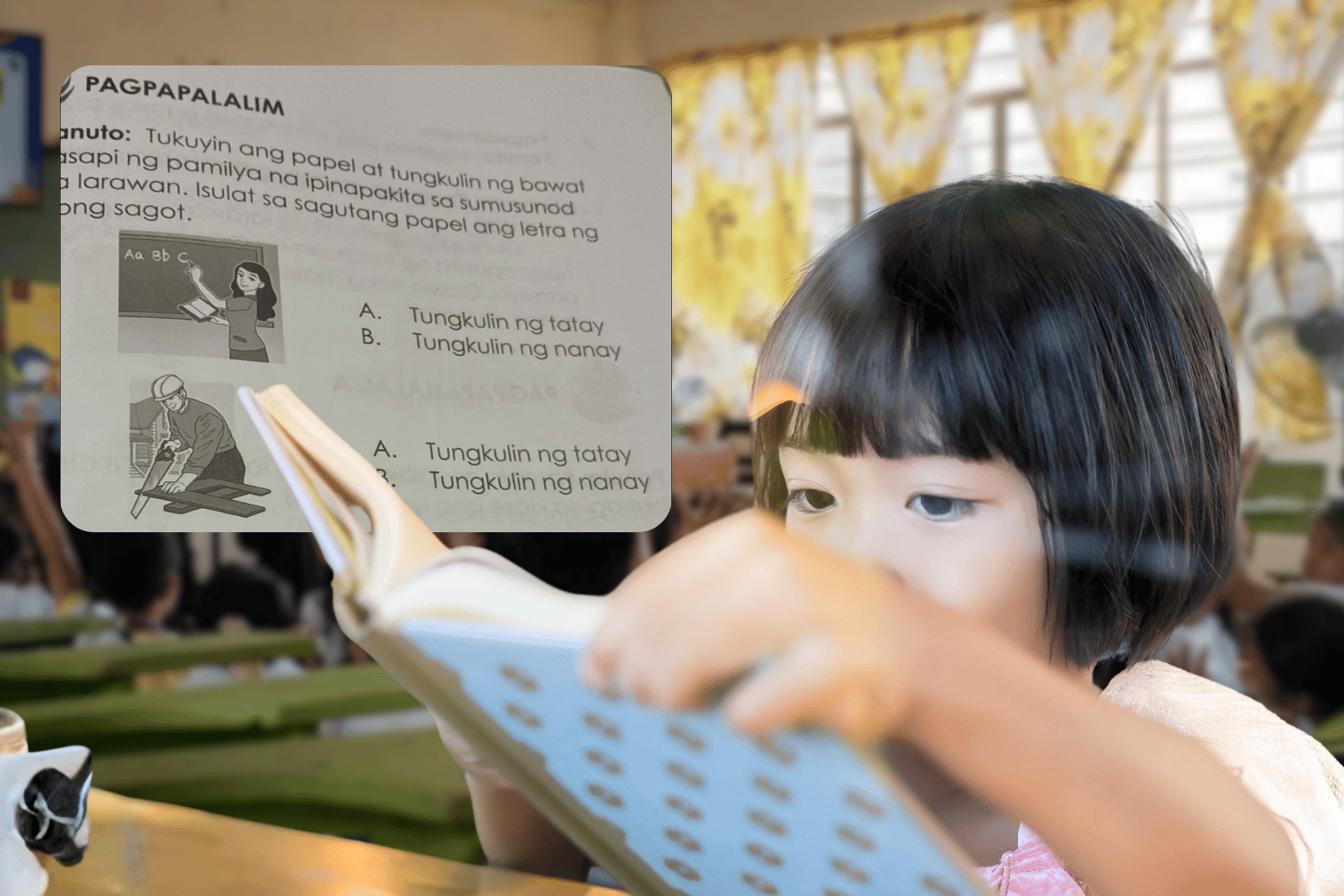
“Tukuyin ang papel at tungkulin ng bawat kasapi ng pamilya na ipinapakita sa sumusunod na larawan. Isulat sa sagutang papel ang letra ng iyong sagot,” the instructions read. The choices are “A. Tungkulin ng tatay” and “B. Tungkulin ng nanay.”
The two illustrations show a woman holding a book and writing on a chalkboard, and a man in construction gear sawing wood.
“DepEd Philippines, why are you saying that being a teacher is the Mom’s job while being an Engineer is a Dad’s job? This is so discriminatory and stereotyping! Kindly check this po,” said the Threads user who shared the textbook excerpt.
The user did not indicate the title of the textbook, its author, or the school that required its use.
The grade level of the activity is also not explicitly indicated. However, it follows the “Tayo Bilang Kasapi ng Pamilya” module under the Makabansa or Araling Panlipunan subject for Grade 1.
The MATATAG Curriculum, launched in 2023, lists three learning outcomes for the module. Based on its recommended activities, learners should be able to explain the concept of family and understand different family structures, including two-parent, solo-parent, and extended families; explain the roles and responsibilities of each family member; and value the role of every family member.
The curriculum does not prescribe any activities or learning outcomes that assign family roles or responsibilities based on gender.
Netizens were outraged over the apparent stereotyping, with parents and teachers sharing similar encounters with what they described as outdated learning materials.
“Nagpamodify ako sa teacher. Kasi ang nakalagay, ‘yung pagtatrabaho ay responsibilidad ng tatay at nanay naman ang naglilinis ng bahay at nagluluto. Dapat tanggalin na ‘yang gender based responsibilities na ‘yan,” said one Threads user who claimed to be a parent.
“I’m a pre-service teacher, and yes na-notice ko rin yan sa subject Araling Panlipunan. Ang sa isip ko ba naman baka [ma-confuse] ‘yung pupils and you could work that job regardless of your gender,” said another user.
The Department of Education (DepEd) implemented the Gender-Responsive Basic Education Policy in 2017 to promote equal access to opportunities across genders and protect learners and personnel against gender-based discrimination.
The policy required the then K-12 Curriculum to integrate “gender equality, human rights, sexuality and reproductive health education, peace education, environmental studies, and child protection.”
Nearly a decade after DepEd adopted its gender-responsive education policy, the textbook exercise shows why having guidelines against gender stereotyping is not enough. Those principles must also find their way into the actual learning materials placed in front of children.