

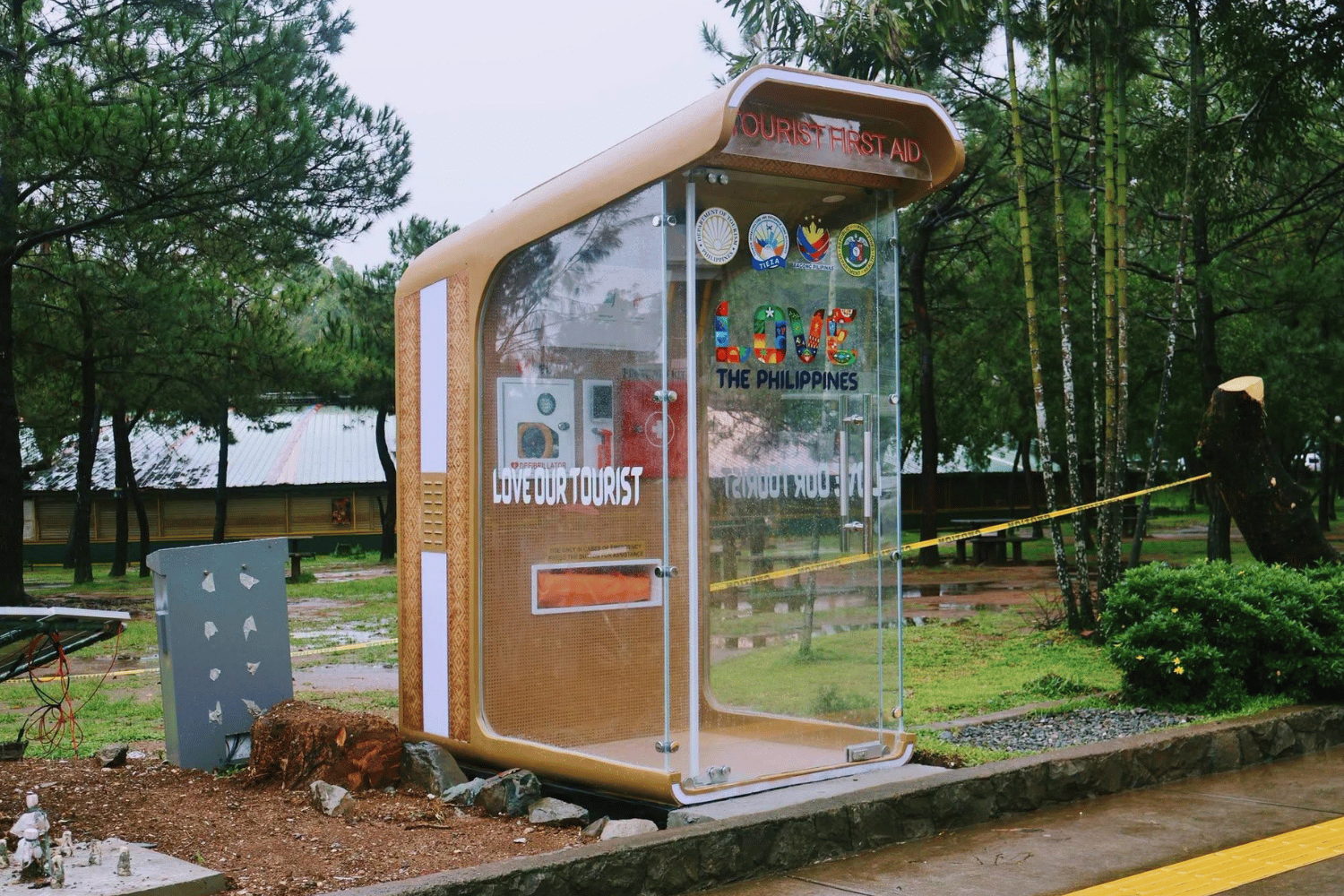
Tourist first aid booths in Baguio City receives online criticism for its “uselessness” and cost.
Calling it a “stupid ₱4.7-million peso idea,” travel content creator Marky Ramone Go has ignited online criticism against the Tourism Infrastructure and Enterprise Zone Authority’s (TIEZA) newly installed Tourist First Aid Booths in Baguio City, with many questioning whether the multimillion-peso project is a wise use of public funds.
In a Facebook post that has since gained traction, Go argued that the money would have been better spent on deploying ambulances rather than constructing fixed first aid booths.
“Might as well just park an ambulance at the three locations where they plan to install these booths,” he wrote, adding that the facilities appeared to contain little more than basic first aid kits that park personnel could easily bring to injured tourists.
He also poked fun at what he believed was the absence of one of the most useful emergency items for tourists suffering from sprains or falls.
“Ni wala nga yung pinaka-importante: ICE/YELO,” he wrote, before concluding: “When we talk about tourism infrastructures, this ain’t it.”
The criticism came after TIEZA announced the turnover of three Tourist First Aid Booths to the Baguio City government during a ceremony on July 9.
Initial reports stated that each solar-powered booth was valued at ₱4.7 million, prompting widespread debate over the project’s cost. TIEZA later clarified that the ₱4.7 million covers all three booths combined, not each individual structure.
The three booths have been installed at Burnham Park, Botanical Garden, and Bayan Park—three of Baguio City’s busiest tourist destinations.
According to TIEZA, the facilities are intended to provide immediate first aid and emergency assistance to both tourists and residents while improving public safety in high-foot-traffic areas.
The booths are equipped with first aid kits, Automated External Defibrillators (AEDs), pullout stretchers, CCTV cameras, and communication systems linked directly to the Baguio City Command Center. Through the integrated network, users can immediately alert emergency responders, allowing medical personnel, rescue teams, and law enforcement units to be dispatched without delay.
TIEZA Chief Operating Officer Mark Lapid said Baguio was chosen as the pilot site because of its strong partnership with the agency and its commitment to tourist safety. He added that similar booths are planned for other major tourist destinations, including Puerto Galera, Siargao, Bohol, and Boracay.
Mayor Benjamin Magalong defended the project, saying the booths are designed to respond to medical emergencies such as hypertension, stroke, fainting, and other urgent health incidents.
He said users can communicate directly with the city’s command center by activating the booth, enabling responders to reach the scene quickly. According to Magalong, police response in Baguio averages around seven minutes, while emergency medical response in tourist areas typically takes 12 to 15 minutes.
The project is a joint initiative of TIEZA, the City Government of Baguio, the Department of Tourism, and the Department of Health as part of efforts to strengthen emergency preparedness in key tourist destinations.
Go’s remarks have since fueled broader discussions online, with many social media users continuing to question whether the project offers good value for taxpayers even after TIEZA clarified its overall cost. Others, however, argued that permanently installed emergency stations equipped with AEDs and directly connected to the city’s command center could prove crucial in life-threatening situations where immediate intervention before the arrival of ambulances can save lives.


