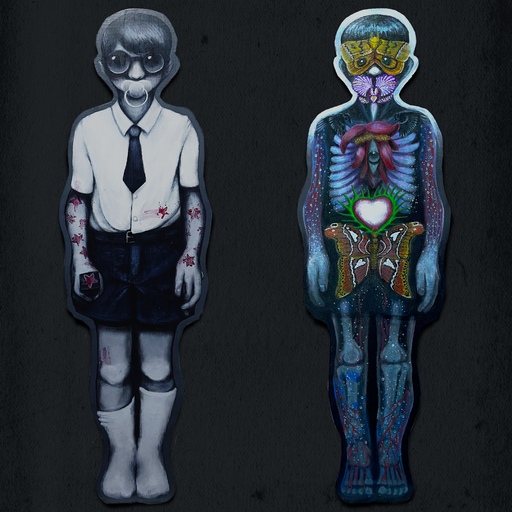
This striking diptych contrasts the external "Genius Boy" (left)—neatly dressed and socialized—with the internal landscape. While “Anatomy of a Dreamer” reveals a thoracic cavity blooming with moths and flora, a poignant metaphor for the "softness" Arroza seeks to protect beneath the surface of expectation.
Allyster Arroza’s charcoal-lit resistance against a loud world.
Allyster Arroza works in a palette of soot and shadow, yet his canvases hum with a strange, bioluminescent joy—a stark contrast from a multidisciplinary toolkit spanning film, digital media, and photography.
A standout from the UP College of Fine Arts, Arroza—known to most as “Aster”—was already haunting Manila’s gallery walls while his thesis was still wet. It’s a bold trajectory for a young artist, but then again, Arroza’s work has always been a study in contradictions: using the heavy, traditional weight of charcoal to draw the lightness of a “fruity” childhood and finding a radical form of resistance in the act of staying soft.
It came as no surprise when he was offered a solo exhibition the moment he stepped off campus. While most artists utilize charcoal to explore the bleak or the depressing, Arroza performs a tonal pivot. He uses a darkling palette to create arresting celebrations of youth. By distilling the musings of a child grappling with a complex reality, his canvases become vessels of hope, play, and wonder.
“Mahikbing Mahimbing.” Arroza explores the intersection of childhood wonder and urban claustrophobia. The figure rests in a dream-state while a miniature, boxy city emerges from the mist, suggesting the heavy architecture of adulthood beginning to weigh on the subconscious.
John, My Beloved: An origin story
His debut solo show at the end of 2025, John, My Beloved at Art for Space in Alabang, served as an origin story. It was an exposition of the “little boy” who haunts his work—an ode to innocence rendered in atypical dark portraiture. Here, school uniforms met pacifiers and trendy sneakers; togas and graduation portraits were submerged in Arroza’s unrelenting blacks. It was a commencement exercise for the artist himself—a transition into a world that is often as scary as it is beautiful.
How does an emerging artist prepare for such a future?
“I start to overthink what [my dream] is,” Arroza admits. “I’m afraid if I declare it, I’ll be doomed to make sure I get it. What if I change my mind midway? It’s easy to say I want to become a great artist; we all do. We sacrifice each day toward this path with no map to guarantee success.”
And yet, despite the fog of uncertainty, his conviction is absolute: he will create “until his last breath.”
“Kaharian ng Kamalayan ng Kabataan.” A cinematic four-panel series that reads like a storyboard for a lost film. Arroza utilizes pockets of bioluminescent light to guide the viewer through a narrative of bunk-bed escapes, secret forts, and the quiet, glowing rebellion of a child who refuses to sleep.
Creation as survival
“As a queer artist in the Philippines, creation is more than a career,” he explains. “It is my way of surviving, remembering, and insisting I exist. It means navigating financial instability and social expectations while still choosing to show up in my work.”
There may be no roadmap, but the stars are aligning for this Caviteño. Between video-editing gigs to pay the bills, Arroza’s 2026 calendar is packed. The first quarter alone has seen him at Modeka Gallery in Makati and the gallery. sort of. in Quezon City, with a steady stream of exhibitions slated for the year.
“Honestly, I dream of being able to protect my softness in a culture that demands queerness be smaller or quieter,” he says. “To create for a lifetime is my form of commitment and resistance.”
If these artworks are the fruit of such resistance, the world is undoubtedly better for it. Given the demand for his vision, it appears the resistance is winning.
“Dandelion.” Featured in his recent group shows, this piece highlights Arroza’s firm grasp of light. The halo effect emanating from the subject’s head transforms a simple portrait into something hallowed, insisting on the divinity and brilliance found within the queer youth experience.
As a queer artist in the Philippines, creation is more than a career. It is my way of surviving, remembering, and insisting I exist