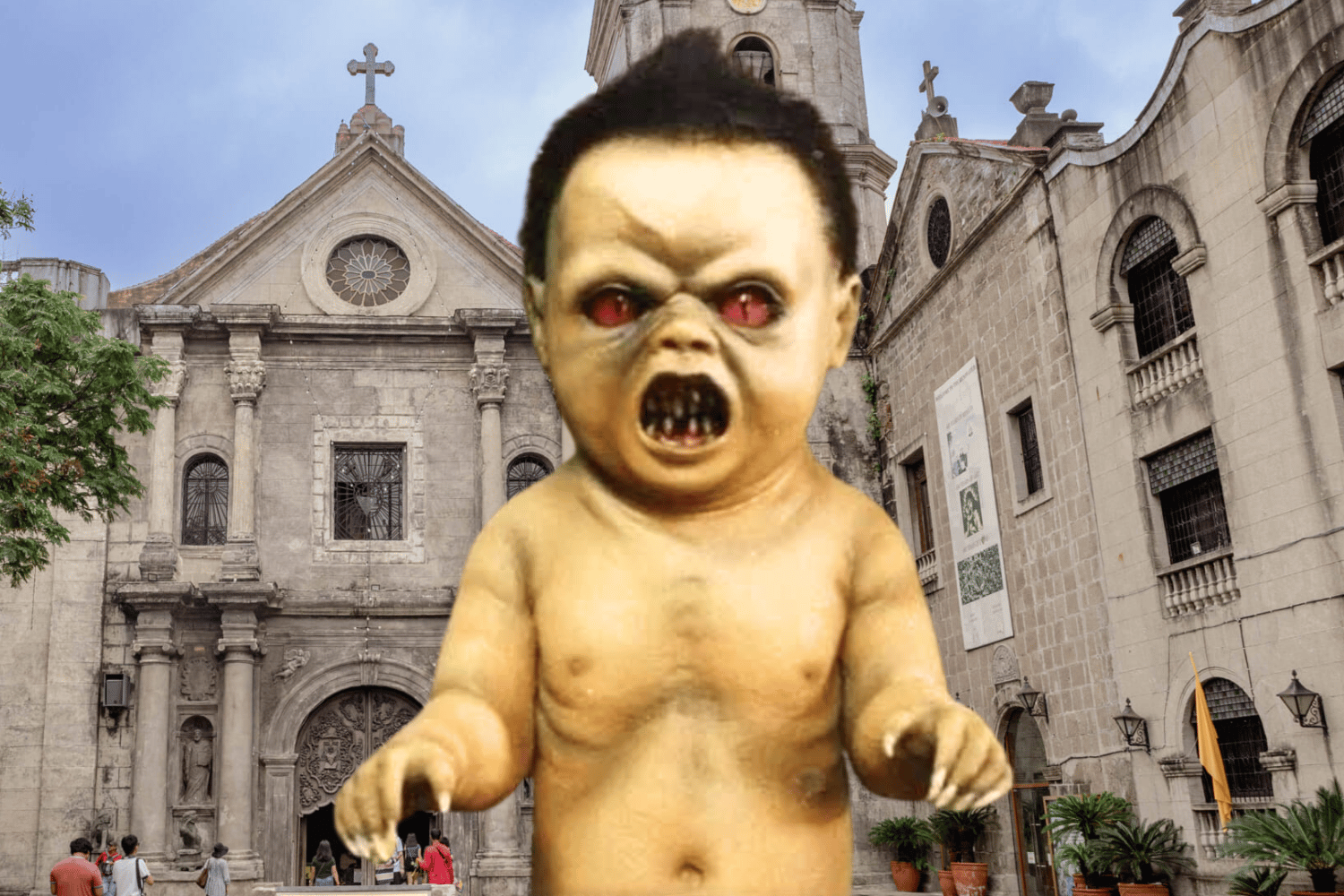
Catholicism gave the tiyanak a reason to haunt us.
You hear a baby crying in the darkness. You pick it up. Then it bares its fangs.
It is the tiyanak—one of the Philippines’ most terrifying monsters, but also a creature whose story reveals how indigenous beliefs changed under Spanish Catholic rule.
The tiyanak did not begin with Christianity.
Before the Spaniards
The creature has been linked to older indigenous traditions, including the Mandaya patianak of Mindanao. In one telling, it was associated with a child whose mother died during childbirth, leaving the baby to die with her and return as a malevolent spirit.
Similar supernatural beings involving women, pregnancy and dead children also appear across maritime Southeast Asia, including the pontianak or kuntilanak traditions of Malaysia and Indonesia.
There was already a monster. Spanish-era Catholicism helped change its origin story.
The unbaptized child
As Christianity spread through the Philippines, another explanation became attached to the tiyanak: it was the restless spirit of a child who died without baptism.
That change was significant.
Baptism was central to Spanish missionary efforts. It formally initiated converts into Catholicism, while Catholic teaching historically connected baptism with cleansing original sin and salvation.
Within that religious world, the tiyanak became a frightening reinforcement of urgency: baptize the child before the child dies.
There is no solid evidence that Spanish friars invented the tiyanak or orchestrated a campaign using the monster to scare parents into baptism.
What the folklore does show is how an older indigenous supernatural being was reinterpreted through Catholic ideas. The tiyanak was no longer merely connected to a child’s tragic death. It became connected to the terrifying fate of the unbaptized child.
Folklore could therefore reinforce a religious lesson even without a priest delivering it from the pulpit.
A monster that kept evolving
The tiyanak continued changing long after Spanish rule.
Modern versions sometimes portray it as the spirit of a miscarried, abandoned or aborted fetus. Philippine cinema then transformed it into the image generations recognize today: an apparently helpless baby that suddenly reveals a demonic face, claws and fangs.
Films such as Tiyanak (1988), Impakto (1996), Tiyanaks (2007) and T’yanak (2014) helped cement that image in popular culture.
But its Spanish-era transformation may be the most revealing.
Colonization did not always erase indigenous beliefs. Sometimes it rewrote them.
An older monster survived—but Catholic influence gave Filipinos a new reason to fear it.
A child had died without baptism.
And somewhere in the darkness, it was still crying.
READ: