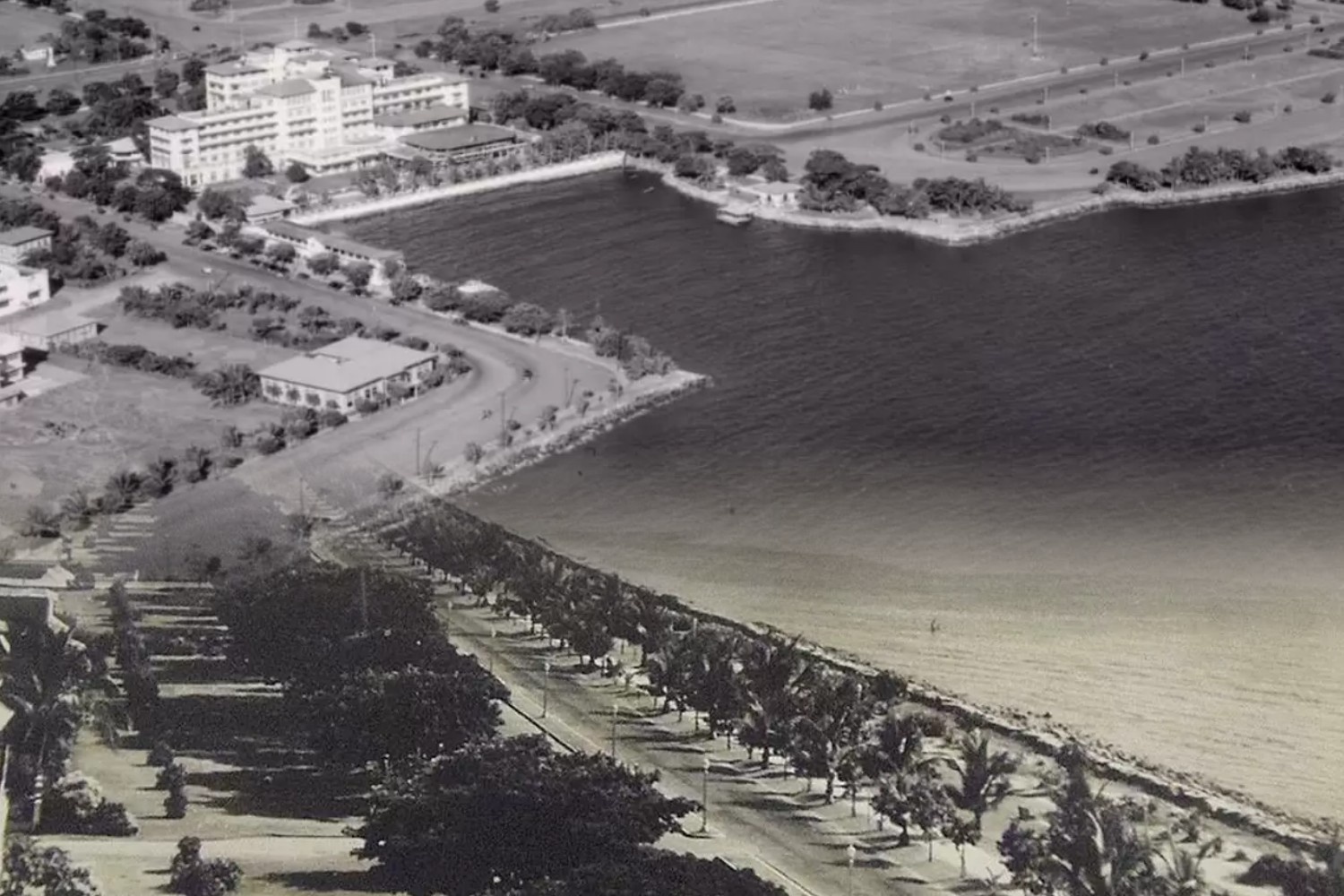
Before the concrete and silt, families escaped the April heat by seeking the crystal clear waters near the former Dewey Boulevard.
Imagine a Sunday afternoon in April 1934. The heat is stifling in the wooden houses of Binondo and Quiapo. There are no air conditioners, only the slow rotation of ceiling fans. The solution? A short trip to Dewey Boulevard (now Roxas Boulevard). Back then, the seaside strip started in Luneta in the area of Manila Hotel on the north, and ended towards, Pasay, Baclaran area on the south.
Back then, the bay wasn’t separated from the people by massive stone barriers. Instead, there were “white rocks” and stretches of dark, fine sand. Families would arrive in calesas or the sleek tranvia, carrying woven mats and baskets of adobo and kanin.
Swimming in the bay was a democratic luxury. Residents of chalet town in Ermita and Malate—home to the city’s well-to-do—simply walked across the street from their mansions to the shore.
Everyday Manileños flocked to the areas near Pasay and Malate, where bamboo bathhouses were erected. These were small structures built on stilts over the water, providing privacy for changing into the modest swimwear of the time.
A lost coastal paradise
“Manila touted as the most beautiful city in Asia then… boasted of a section called Ermita—a wide and well-paved avenue lined with overarching large trees… overlooking the crystal clear water…” writes Luning Ira, Streets of Manila (1977).
Why was Manila Bay so clean then? In the 1930s, the population of Manila was a fraction of today’s 14 million. The esteros (canals) still functioned as natural flushing systems rather than stagnant sewers.
During the American Colonial period, there was an obsession with sanitary Manila. The government invested heavily in urban planning that prioritized the bay as a scenic and recreational asset. This was a pre-plastic era. Trash consisted of biodegradable materials—paper, wood, and food scraps—which the sea could handle.
The swimmable Manila Bay began to fade after World War II. The rapid, unplanned reconstruction of the city led to the neglect of the sewerage system. By the 1950s and 60s, industrial effluents began to darken the water.
The final blow came with the massive reclamation projects in the 70s. While they gave us the CCP Complex and Baywalk, they pushed the shoreline further away, and the once-clear “white rocks” were buried under concrete and urban silt.