TikToker Rasta G made content mocking children—with many quarters even blaming parents.
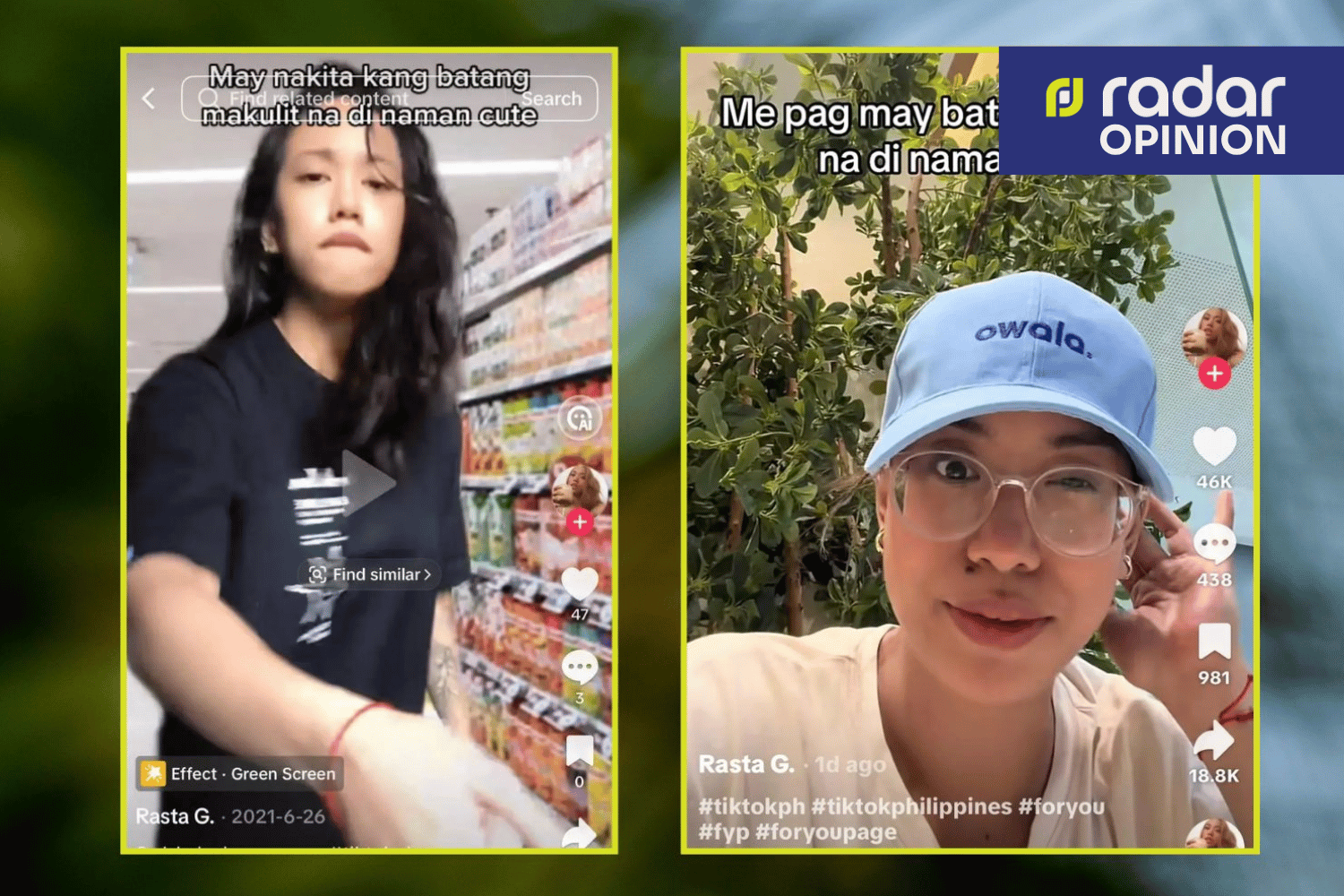
A content creator going by “Rasta G” has sparked backlash for videos that mock children’s everyday behavior.
In a now-deleted TikTok post, she appears to be in a mall, making faces, rolling her eyes, and squinting as a child cries in the background. A text reads: “Me pag may batang maingay na di naman cute.”
The biology of the “kulit”
Apparently, it’s not the first time this grown-up has targeted children. Users resurfaced her 2021 post using a grocery store filter—and she bites her lip and extends her arm as she approaches the camera. A text reads: “May nakita kang batang makulit na di naman cute.”
She may not have used a more explicit, violent language, but let’s be real: it’s hate content aimed at children for being “makulit” and “maingay.” And when a person of mature age builds content around mocking kids, it raises an uncomfortable question: What kind of behavior does this normalize beyond the screen?
The backlash has since sparked debate, and it’s worth putting things into perspective.
Children behave the way they do for a reason. The brain’s frontal lobe is responsible for judgment, self-control, and emotional regulation. It’s not yet fully developed in kids; that’s why they cry, make noises, and throw tantrums—often triggered by teething, lack of sleep, overstimulation, and even developmental conditions like ADHD or autism.
The same goes for “makulit” behavior. For children, the world is new. It excites them as they explore and play. They roll on the floor, frolic, bang objects, shriek, and scream—not out of malice, but out of curiosity. In fact, these are often signs of healthy development. As child psychiatrist and content creator Steven Storage puts it, loud kids feel safe and comfortable—and trust the people and environment enough to express themselves.
Seen this way, being “makulit” and “maingay” isn’t a flaw but a phase, one that’s biological and normal.
The parenting performance
What’s more troubling is how many Filipinos shift the blame to parents. They’re automatically “bad” and “irresponsible” based on a few seconds of public behavior. See, parenting isn’t a controlled performance. We rarely see the full story: the exhaustion, the effort to pacify the child, or the external realities they’re dealing with.
Yes, negligent parents exist. But a sweeping generalization is unfair and says more about our impatience and lack of empathy.
Worse, other parents weaponize comparison, flaunting their “well-behaved” children as if parenting were a competition. Nope. There’s no one-size-fits-all approach—and there’s no Olympic gold medal for being holier-than-thou.
As the issue blew up online, fortunately, some voices pushed back. On TikTok, singer and new father TONEEJAY reminded adults that unlike children, their frontal lobe is already fully developed: “You can suspend your emotions and judgment. You can choose to be understanding and kind.” He also pointed out that even adults make illogical and immature decisions, so children deserve even more understanding.
The inner child hypocrisy
On Threads, actress and mother of two Rica Peralejo pointed out that this mindset runs deep: “KULTURA NATIN TO FOR THE LONGEST TIME. Na tingnan ang mga batang maingay as mali o masama o dapat na pinapatahimik.”
In another post, she highlighted the irony of “healing the inner child”—in which adults now overcompensate in self-care after experiencing neglect or emotional suppression growing up—yet still hate or mock children today: “Kaya tayo healing our inner child is precisely bec nung bata tayo, minaliit tayo ng mga matatanda.”
What gives? Younger millennials and Gen Z often pride themselves on breaking away from the old ways of older generations. But in moments like this, they risk becoming exactly who they criticize.
Someday, these “makulit” and “maingay” children will grow up and take our place. More importantly, they’ll also remember how adults treated them. And if all they remember is being shamed for simply being children, the problem isn’t their “kulit” or “ingay,” but rather the adults who couldn’t act like one.