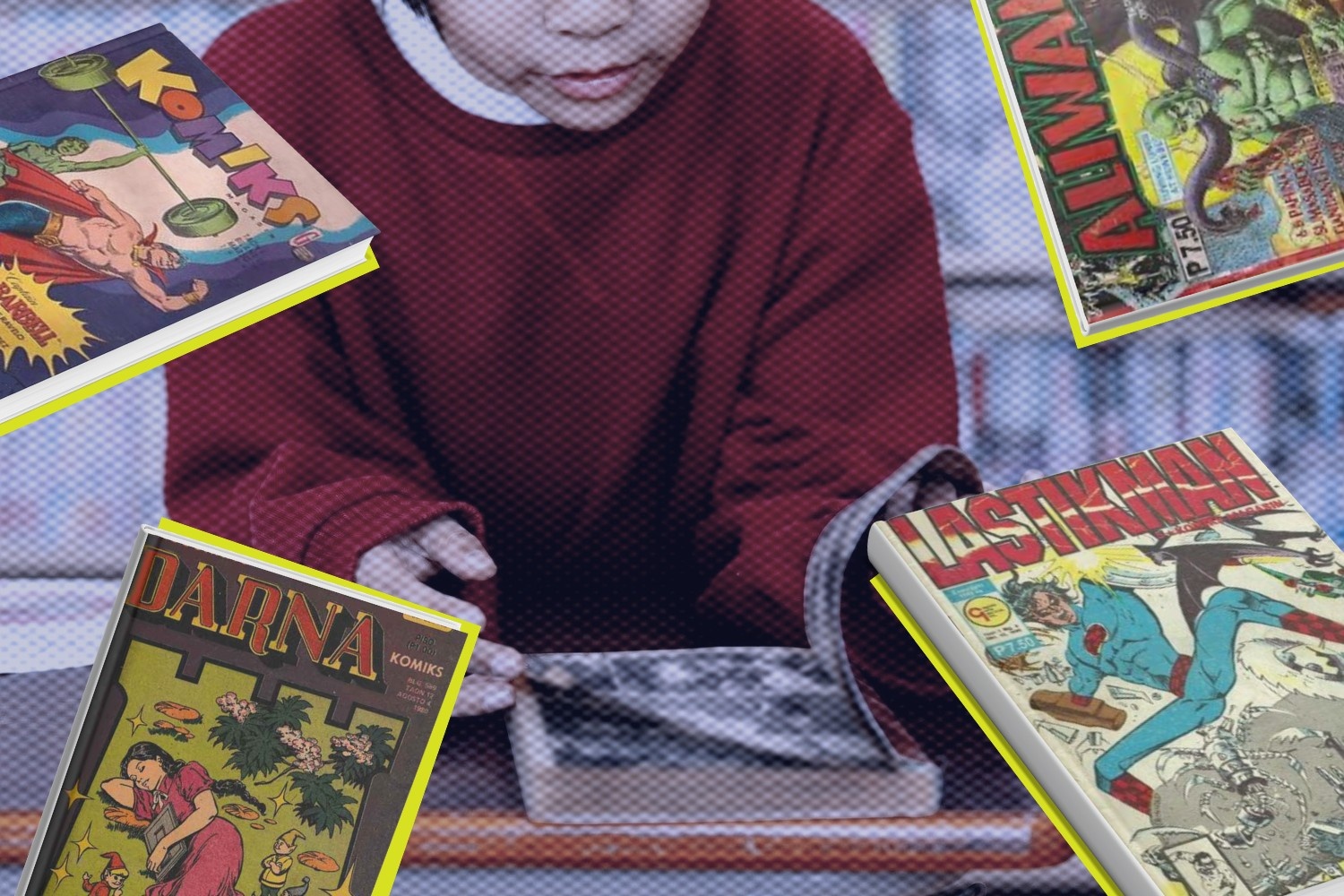
The vibrant panels of Philippine komiks served as the ultimate classroom.
I learned Tagalog not in a classroom but in a cramped komiks stall, elbows brushing strangers, ten centavos in hand, and a story I couldn’t put down.
Growing up in Northern Samar, Tagalog wasn’t the language of our home. My tongue carried the rhythm of Waray, thick and unmistakable. But on those worn wooden benches, flipping through pages of Pilipino Komiks and Hiwaga, I slowly absorbed a different language—panel by panel, dialogue bubble by dialogue bubble. I didn’t realize it then, but I was studying.
The masters of the craft
Those afternoons were sacred. The komiks stall was our tambayan, our escape, and our library. For just a few coins, we could sit for hours, quietly devouring stories while the world passed by. You’d hear the occasional gasp, a stifled laugh, or someone rushing to finish before their rental time ran out. The pages were already soft from use, the ink slightly faded—but the magic was always fresh.
And what worlds they offered.
There was Darna, soaring across the sky with a single shout; Captain Barbel, turning weakness into strength; and Zuma, terrifying and tragic all at once. Then came Lastikman, Dyesebel, and Pedro Penduko—characters so vivid they felt like neighbors, like myths we somehow owned. They didn’t just live in komiks—they lived in us.
Behind these icons were masters of the craft. Mars Ravelo created many of the heroes we grew up with, while Francisco Coching, later declared a national artist, illustrated entire worlds with unmatched detail and dynamism. Alongside them were storytellers like Carlo J. Caparas and Tony Velasquez, whose works defined an era when komiks ruled Filipino pop culture.
Their stories didn’t stay on paper. They became films like Darna, Captain Barbel, and Zuma and later television staples such as Darna, Captain Barbel, and Pedro Penduko. Komiks didn’t just influence pop culture—they were pop culture.
From suspicion to scholarship
Years later, I found myself in a classroom in Manila, far from those komiks stalls of my childhood. My accent gave me away immediately. Every time I spoke, I could feel the room notice. But when the exams came, something unexpected happened—I aced them.
Instead of praise, I got suspicion.
In front of the class, my Filipino teacher questioned my paper—loud enough for everyone to hear—implying that I might have cheated. The room went quiet. I stood there, embarrassed, my answers suddenly feeling like evidence against me.
How do you explain that your teacher was a stack of komiks? That your lessons came from Darna’s dialogues, from Captain Barbel’s monologues, from every caption box you carefully read and reread just to follow the story?
Komiks taught me structure, vocabulary, and rhythm. They taught me how Tagalog sounds when it’s written well—clear, emotional, alive. Long before I could speak it without an accent, I already knew how to write it.
The full circle
Eventually, that quiet, self-taught fluency found its way back to me. I became a poet in Filipino, writing in the very language I once learned from borrowed pages—and went on to pursue a master’s degree in Filipino, majoring in Malikhaing Pagsulat, at the University of the Philippines Diliman.
Today, as screens dominate our attention, those memories feel distant—but never faded. The komiks stall, the ten-centavo rentals, the shared silence of readers lost in the same world—they shaped more than just our imagination. For some of us, they shaped the way we understand language, identity, and storytelling itself.
I may have arrived in Manila with a thick accent, but thanks to komiks, I carried something else with me too: a quiet certainty that I already belonged in the language—even before anyone believed I did.