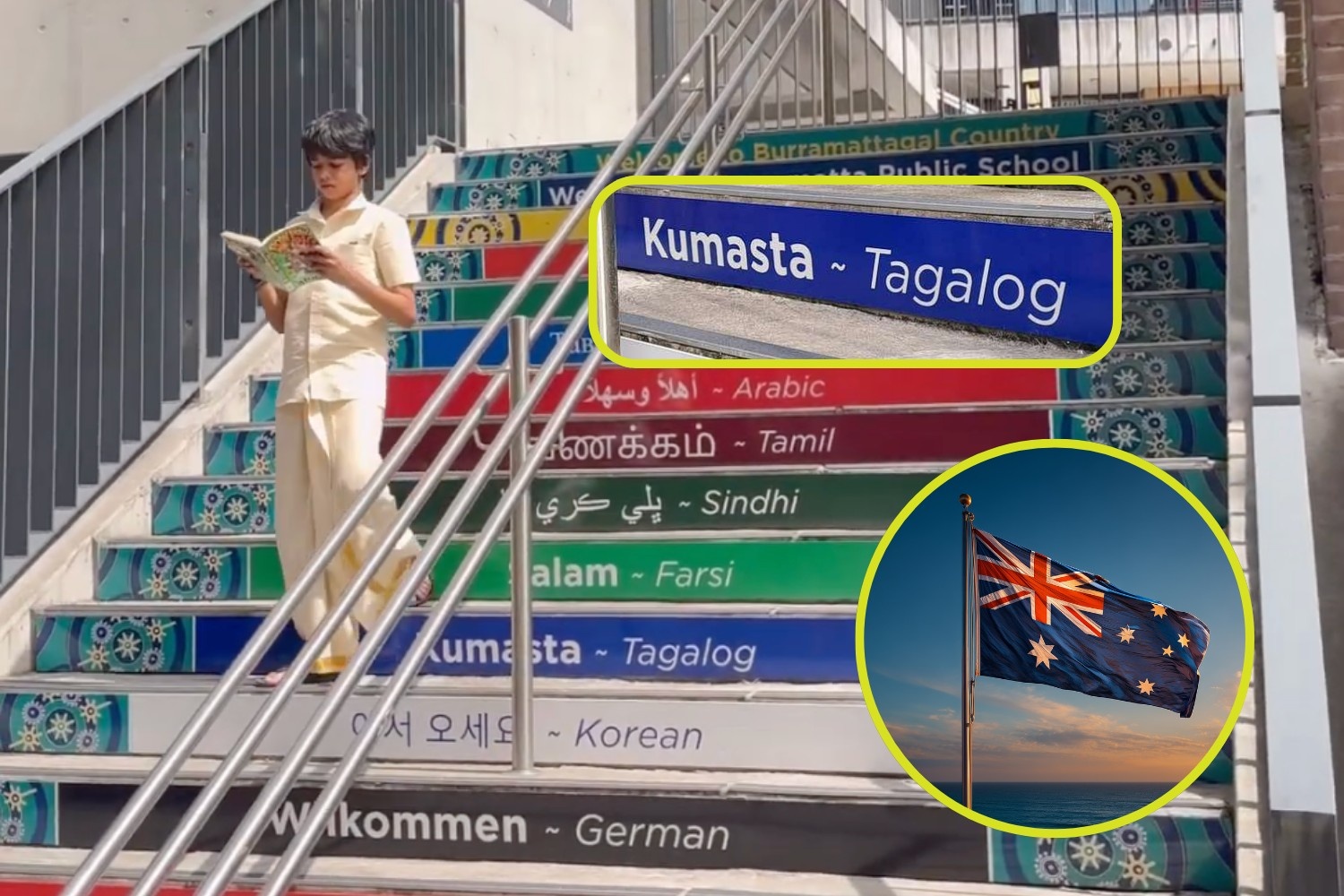
The “Staircase That Speaks” is at Parramatta Public School in Sydney, Australia.
Remember that viral “Kumasta” staircase we shared? We did some digging (and got a friendly tip from our friends at The Straits Times), and we finally have the real story behind the typo that had everyone doing a double take!
While we previously noted that details were unclear, we can now confirm that this staircase isn’t at the Little India MRT in Singapore after all. It turns out the “Kumasta” step is actually located at a public school in Sydney, Australia!
A microcosm of diversity
Parramatta Public School, located in the heart of the Parramatta CBD in Western Sydney, is the home to the “Staircase That Speaks.” Known as one of the most culturally diverse schools in New South Wales, the campus serves as a microcosm of Sydney’s multicultural fabric.
The staircase was designed as a celebration of the school’s identity. With a student body representing dozens of nationalities, the administration installed the greetings to make every child feel “at home” the moment they walked into the building.
The story behind the slip-up
The goal was simple: showcase greetings like “Salam,” “Namaste,” and “Kumusta” as a daily reminder of inclusivity. However, somewhere between the design phase and the final printing, the Filipino greeting was accidentally rendered as “Kumasta” instead of the correct “Kumusta.”
While the spelling may be slightly off, the intention remains clear. The staircase is part of a multilingual art installation that celebrates the global backgrounds of its students, proving that a small spelling slip-up can’t overshadow a message of welcome.
So, to our followers in Singapore: you can stop scouring the MRT stations for this one! And to our followers in Sydney: if you see it, give it a wave (and maybe a quick spell-check).
Whether it’s in SG or Sydney, one thing is for sure—Filipino eagle eyes are everywhere!
Spotting signs of inclusivity
Inspired by the “Staircase That Speaks”? Here is how schools and offices are using environmental graphics to boost inclusivity in 2026:
- The Multilingual Welcome: More public spaces are integrating native scripts (like Baybayin or Arabic) into their architecture to honor local and migrant histories.
- Fact-Checking the Art: To avoid the “Kumasta” conundrum, modern designers are now using community consultants to verify spellings and cultural nuances before installations are finalized.
- Interactive Spaces: In 2026, art isn’t just to look at; it’s to walk on, sit on, and talk about. The Parramatta staircase is a prime example of how functional spaces can double as cultural landmarks.