The untold story of America’s first Filipino settlers.
Long before nurses, Hollywood stars, or second-generation Fil-Ams became part of the American story, there were already Filipinos quietly building lives in the swamps of Louisiana.
For many today, the common narrative of the Filipino-American story begins with the pensionados or the postwar migration wave. But centuries before that, Filipinos, called the “Manilamen,” were already leaving footprints in the American deep south.
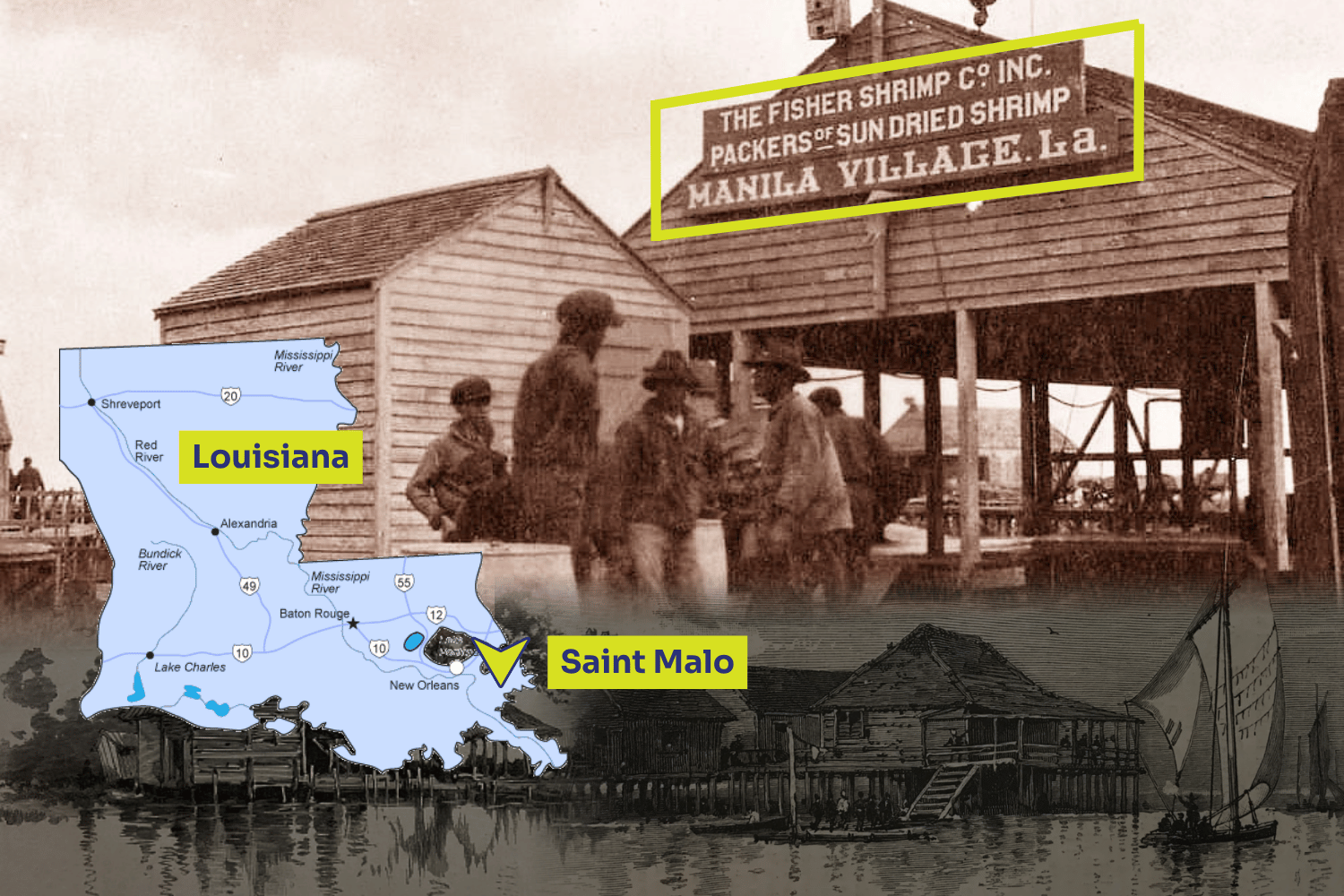
Contrary to popular belief, the Spanish galleons never docked in Louisiana. Instead, these adventurous Filipino sailors jumped ship in Acapulco, Mexico, before traveling by land and sea to settle in the marshes southeast of New Orleans. By 1763, they established Saint Malo, the first permanent Asian settlement in the continental United States.
Popular historical narratives often claim these men fled “brutal colonial conditions aboard the ships.” But historians point out a simple flaw in that logic: Filipino sailors vastly outnumbered the Spanish officers on those vessels. If conditions were truly that unendurable, the crew could have easily taken over the ship.
The Manilamen arrived through the Manila-Acapulco Galleon Trade, the massive Spanish trade route connecting Asia to the Americas. Many worked as sailors under harsh colonial conditions. Some jumped ship once they reached ports along the Gulf Coast, fleeing forced labor, discrimination, and abuse. Hidden deep in Louisiana’s wetlands, they created their own world far from colonial authorities.
What they built looked surprisingly familiar to Filipinos.
Their homes stood on stilts above the water, resembling bahay kubo structures back in the Philippines. Using cypress wood and palmetto leaves, they adapted Southeast Asian coastal architecture to the Louisiana marshlands. Entire villages floated above the swamp, accessible only by boat.
Isolation became both protection and identity.
Because anti-Asian immigration policies later prevented Asian women from entering the United States, the settlements became largely male communities. Over time, many Manilamen married local Cajun, Creole, Indigenous, and Isleño women, creating generations of descendants whose bloodlines still trace back to the Philippines centuries later.
But the Manilamen were not simply survivors hiding in the wetlands. They helped shape Louisiana itself.
Historians credit them with transforming the local seafood industry through shrimp-drying techniques brought from the Philippines, preserving seafood long before refrigeration existed. Their methods helped build what would eventually become part of Louisiana’s thriving shrimp economy.
Even their labor practices carried traces of home. One famous technique called the “Shrimp Dance” involved workers trampling boiled shrimp in circles to separate shells from meat — a communal process that reportedly became part of local fishing culture.
Their impact extended beyond economics.
During the War of 1812, many Manilamen reportedly fought alongside pirate-turned-war hero Jean Lafitte and General Andrew Jackson against British forces during the Battle of New Orleans.
And yet, despite all this, their story remained largely forgotten.
The settlements themselves eventually disappeared. Saint Malo suffered massive hurricane destruction in 1915, while Manila Village — another nearby Filipino settlement — was wiped out by Hurricane Betsy in 1965. The physical communities vanished beneath Louisiana’s harsh coastal weather.
But their legacy survived in quieter ways: in family histories, in local culture, in seafood traditions, and in the descendants who still carry Filipino surnames and stories generations later.
Today, historical markers in Louisiana finally recognize the Manilamen’s contribution to American history, restoring a chapter long erased from mainstream narratives.
Perhaps the most remarkable part of the story is this: centuries before the word “Fil-Am” even existed, Filipinos were already proving something that still feels true today. No matter how far they travel, Filipinos build community wherever they land.
Even in the middle of a swamp.
The Manilamen arrived through the Manila-Acapulco Galleon Trade, the massive Spanish trade route connecting Asia to the Americas. Hidden deep in Louisiana’s wetlands, they created their own world far from colonial authorities.
READ:
Tequila, the iconic spirit from Mexico, wouldn’t exist without Filipino sailors
Rei Marquez
May 2, 2026

Jollibee’s New York expansion is attracting a wider US audience
radar Business
May 21, 2026

The one-man quest to archive every native Filipino ingredient
Rei Marquez
March 17, 2026