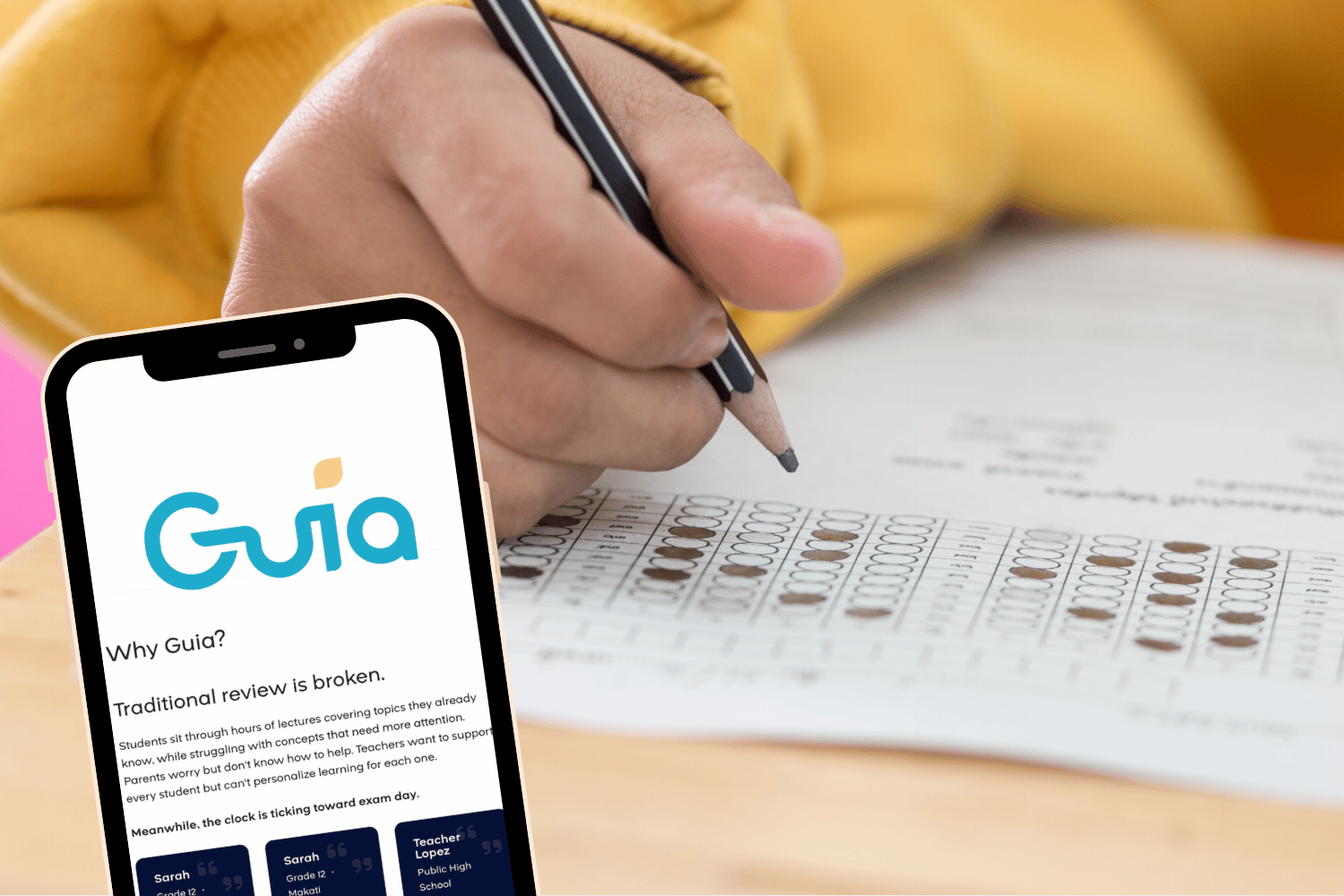
Web-based platform built by veteran educators uses AI to personalize review for UPCAT, ACET, DCAT preparation.
Across classrooms in the Philippines, teachers and schools continue to face a problem that is hard to solve at scale—measuring what students actually know, and how ready they are for high-stakes exams that shape their academic future.
That challenge is what the team behind Guia hopes to address.
Guia is a web-based, AI-assisted review platform designed for students preparing for major college entrance examinations such as the UPCAT, ACET, and DLSCAT, among others. It was developed by a team of veteran educators, with artificial intelligence and data systems used to support the generation and analysis of assessments.
“Education has always been uneven when it comes to access to structured review,” said CEO Marc Joseph Cruz. “We wanted to build something that helps students understand where they really stand before they walk into the exam room.”
Rather than focusing only on scoring, the platform builds structured practice tests and diagnostic assessments that simulate actual entrance exam conditions. According to co-founder Simon Villalon, the system was designed with both discipline and adaptability in mind.
“We worked with educators first before we even built the tech layer,” Villalon said. “The AI is there to support the process, not replace the thinking that goes into building good assessments.”
Everything is delivered online, allowing students to use Guia on mobile phones, laptops, or desktop computers, as long as they have a stable internet connection. Assessments are timed and structured to mirror actual test conditions, giving students a clearer sense of pacing and pressure ahead of exam day.
Built for real test conditions, not casual practice
Unlike standard online quizzes, Guia places emphasis on simulation-based learning. Students are exposed to timed exams that reflect the structure of actual college entrance tests, while the system tracks performance patterns across different subject areas.
The platform then breaks down results into specific competencies, identifying whether a student is struggling in algebra, reading comprehension, scientific reasoning, or other core areas. This allows for more focused review instead of broad, repetitive studying.
“Sometimes students do not fail because they do not know the lesson, but because they are not familiar with how the question is asked,” Cruz said. “That is something we wanted to solve at the level of experience.”
Villalon added that early data from pilot users showed how familiarity with question structure alone could change performance outcomes over time.
“It becomes less about guessing and more about recognition,” he said. “Once students start recognizing patterns, their confidence changes, and that affects how they perform under pressure.”
A supplement, not a replacement
Guia is positioned as an additional tool rather than a replacement for traditional learning methods. The company said it is designed to complement teachers and review centers, particularly for students who prefer independent learning or cannot physically attend review classes.
It also targets students in provinces and remote areas who may not have easy access to major review centers in urban hubs.
“Not every student can travel to a review center in Metro Manila or pay for full prep programs,” Cruz said. “We wanted to create an option that is more accessible while still maintaining structure and discipline.”
Villalon said the platform was intentionally designed to avoid replacing human instruction.
“We are not trying to remove teachers or review centers from the equation,” he said. “This is another layer of support that students can use depending on their situation.”
Everything runs through a subscription model, with plans starting at ₱875 per month. By comparison, traditional college entrance exam review programs can cost several thousand pesos for a single review cycle, depending on the institution and duration.
Access, affordability, and expansion plans
Affordability is a key part of its strategy as it looks to scale access to more students nationwide. It is also exploring institutional partnerships, bundled access programs, and sponsored models that could support students who cannot afford subscriptions.
“Access is one of the biggest considerations for us moving forward,” Cruz said. “We are looking at ways to make it sustainable while also expanding reach.”
Villalon noted that the system is built with scalability in mind, including the potential to support other standardized assessments beyond Philippine college entrance exams depending on demand.
“At the core, it is a structured assessment engine,” he said. “It can be adapted to other testing systems as long as there is a clear framework for evaluation.”
The company has set an initial target of 10,000 paid users as its early milestone, which it sees as a key validation point for both product performance and student engagement.
As competition for college admissions continues to intensify, tools like Guia are entering a space long dominated by traditional review centers and printed materials.
The goal is not to change how students study overnight, but to offer another path in an already demanding academic process, one that is more flexible, data-driven, and accessible to a wider range of learners.
READ:
Is Brigada Eskwela bayanihan—or just masking government failure?
radar Lifestyle
May 30, 2026

Filipino bartenders set for world-class service training through TESDA and Diageo masterclass
radar Business
June 5, 2026
Engineering education in the Philippines faces a new test as industries demand job-ready graduates
Jinji Quiambao
May 4, 2026