LGBTQIA+ individuals in pre-war Manila are known as “binabae.”
Long before Pride marches, anti-discrimination campaigns, and LGBTQIA+ representation entered the mainstream, queer Filipinos were already building communities and creating spaces where they could express themselves.
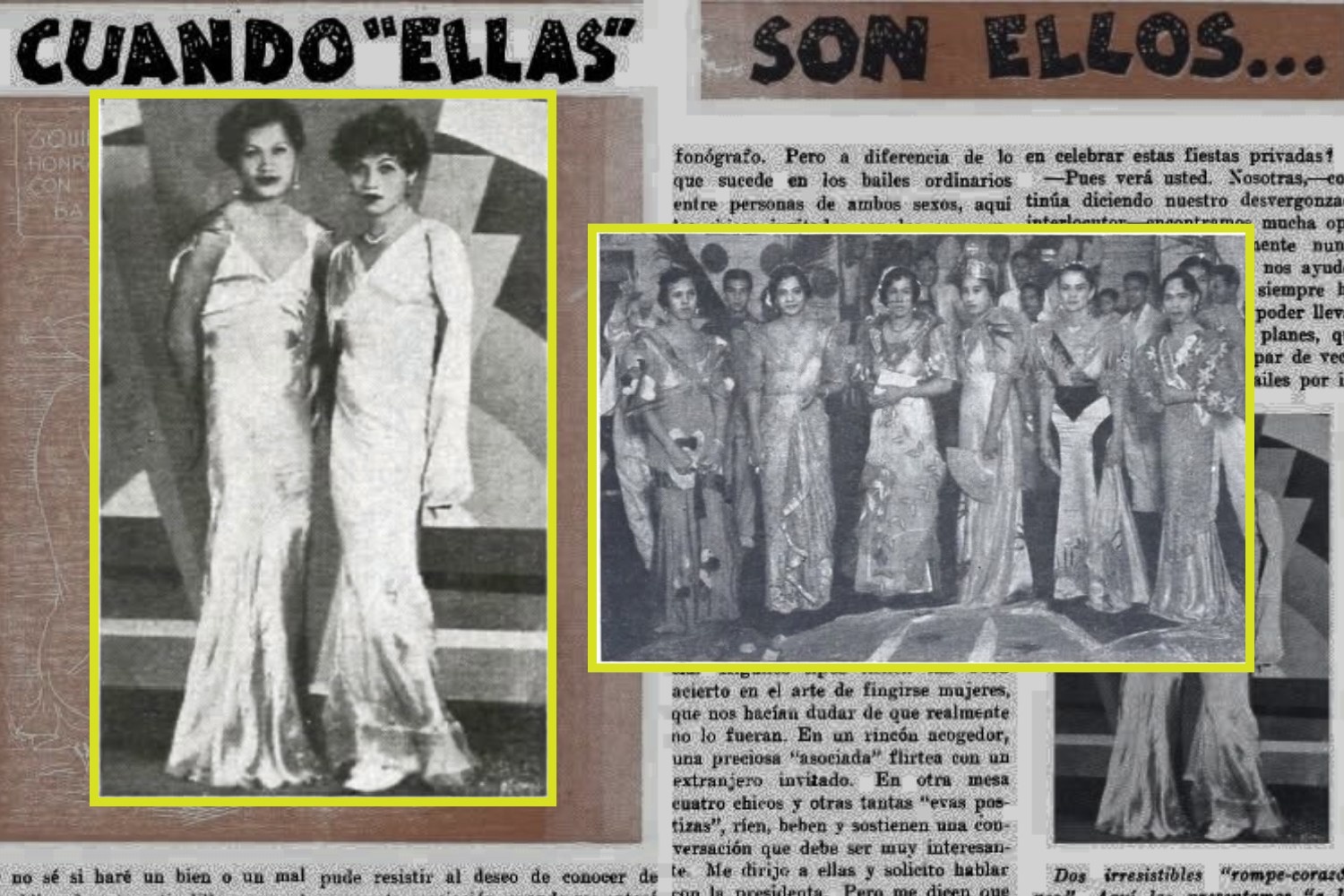
A recently resurfaced article from the September 1936 issue of Philippines Free Press is now shedding light on that largely forgotten chapter of Philippine history.
The article was shared by heritage researcher Davrie Caro in the Facebook group Philippine Heritage Costume and Dress as part of Pride Month observances. According to Caro, the Spanish-language feature documents the lives of LGBTQIA+ individuals—particularly people then known as “binabae”—in pre-war Manila.
Published under the headline “Cuando ‘Ellas’ Son Ellos…” (“When ‘They’ Are Men…”), the article describes a private social club and dance hall where queer individuals gathered, socialized, and held beauty contests and parties.
The writer observed that many attendees arrived in elegant ternos and evening gowns, remarking that some guests appeared so convincingly feminine that “they made us doubt that they were not really women.”
The article also documented beauty pageants within the community. One caption reads: “También los ‘hermafroditas’ tienen sus concursos de belleza. Aquí vemos a los elegidos ‘Srtas.’ Visayas, Luzón y Mindanao” (“Even the ‘hermaphrodites’ have their beauty contests. Here we see the chosen ‘Miss Visayas,’ ‘Miss Luzon,’ and ‘Miss Mindanao.’”).
Another caption introducing two participants states: “Dos irresistibles ‘rompe-corazones.’ Aquí las presentamos ‘a la europea’” (“Two irresistible heartbreakers. Here they are presented in European style.”).
For historians, the article is a rare and valuable record of queer life in the Philippines before World War II. But it is also a reminder of how society’s understanding of gender and sexuality has evolved.
The article repeatedly uses terms such as “maricones” and “hermafroditas” and describes LGBTQIA+ people through a lens that would be considered offensive, stigmatizing, and unacceptable today. While such language reflected mainstream attitudes of the 1930s, many of the terms used in the article are now regarded as derogatory and harmful.
Caro himself acknowledged this in his post, writing: “Disclaimer: This is a mainstream newspaper article from the 1930s, so it should be noted that they will use terms and tone that can be considered derogatory.”