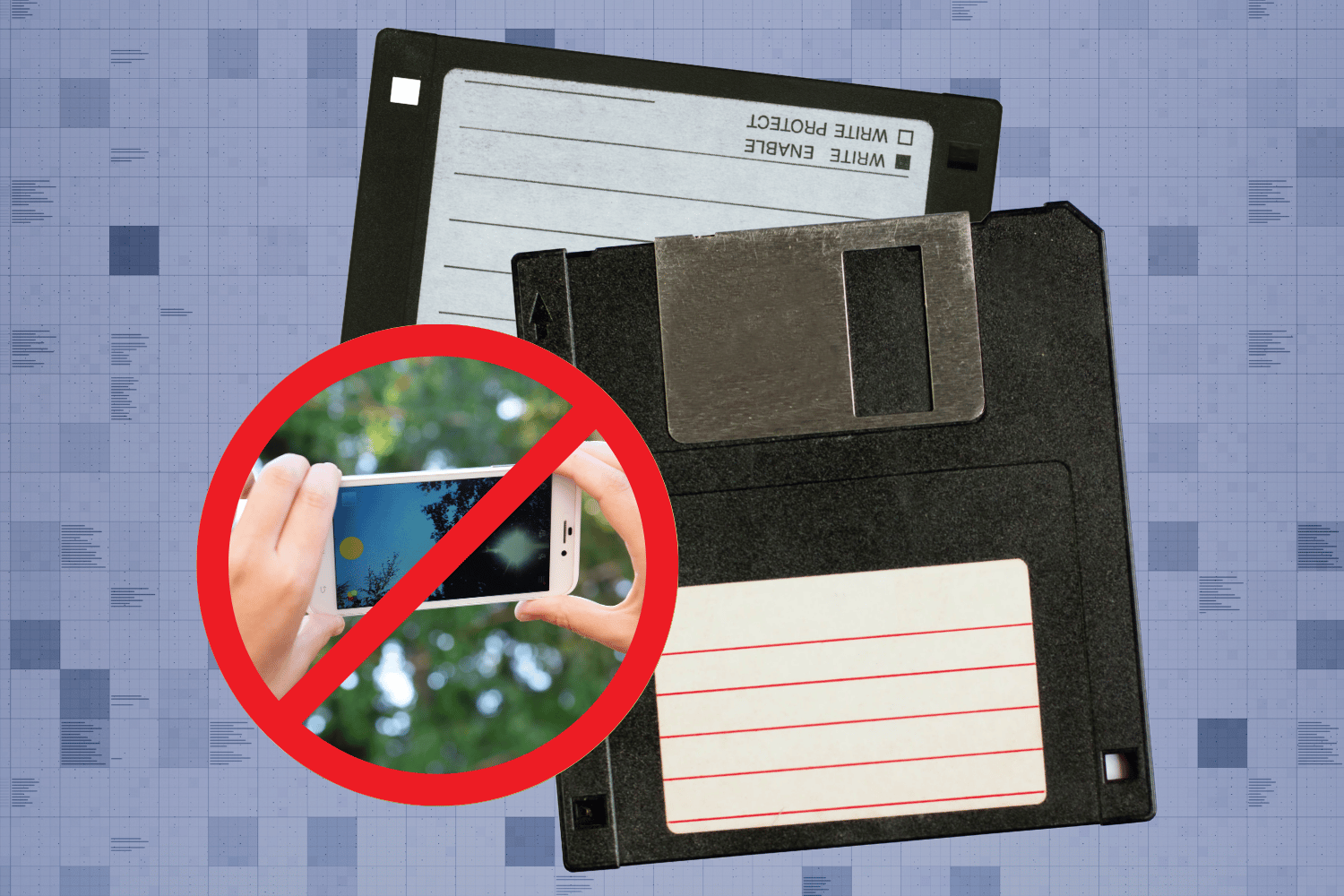
The iconic 1.44 MB storage device shows just how much technology has changed in the age of digital files.
You probably remember that satisfying click as you pushed a floppy disk into your computer. Back then, that tiny square of plastic felt almost magical. School reports, computer games, family photos, and important files all fit inside a single disk that held just 1.44 MB of storage.
Fast-forward to 2026, and that same floppy disk has become a fascinating reminder of just how far technology has come.
A single modern smartphone photo can already fill up more than its entire capacity.
Here’s how the legendary floppy disk stacks up against today’s digital files.
Photos
A standard photo taken on a modern smartphone is about 4 MB in size, nearly three times the capacity of an entire floppy disk.
That means one floppy disk can only hold about one-third of a single photo. To save one uncompressed smartphone picture, you’d need at least three floppy disks.
The only way to make a photo fit is to shrink it to a tiny, heavily compressed image with noticeably lower quality.
Music
Love listening to Spotify or Apple Music?
Forget about storing your favorite songs on a floppy disk.
A standard four-minute MP3 is roughly 4 MB, meaning a floppy disk can only store about one-third of a song. High-quality audio files are even larger, making them nearly impossible to store.
At best, a floppy disk could hold a few minutes of heavily compressed, low-quality audio similar to an old voice recording.
Videos
Videos are where the floppy disk truly falls apart.
A single one-minute 1080p smartphone video can easily exceed 100 MB, while a short 4K clip can occupy hundreds of megabytes or even gigabytes.
You would need dozens or even hundreds of floppy disks just to save one short video.
A full-length HD movie? That would require thousands of floppy disks.
Documents
Surprisingly, this is one category where the floppy disk still performs reasonably well.
Plain text files are incredibly small. A typical text document occupies only around 20 KB, allowing a floppy disk to store roughly 70 text files or hundreds of pages of plain text.
The moment you add images, charts, logos, or heavy formatting, however, file sizes quickly balloon. A typical Microsoft Word or PDF document with graphics can already exceed the floppy disk’s 1.44 MB capacity.
Games
In the 1990s, many PC games shipped on floppy disks. Some required just one disk, while larger titles came in boxes containing 10 or even 20 floppy disks.
Today, that sounds almost unbelievable.
Modern PC and console games routinely occupy 50 GB to more than 150 GB. Installing one blockbuster title would require tens of thousands of floppy disks just to store a single game.
The flash drive comparison
The comparison becomes even more dramatic when placed beside today’s storage devices.
A cheap 64 GB USB flash drive can hold roughly the same amount of data as 44,444 floppy disks.
In other words, something that now fits comfortably in your pocket would have filled an entire room with stacks of floppy disks just a few decades ago.
A piece of digital history
The 3.5-inch floppy disk was once the gold standard for portable storage. Introduced in the 1980s, it powered schools, offices, and homes for nearly two decades before CDs, DVDs, USB flash drives, and cloud storage made it obsolete.
Ironically, while almost nobody still uses floppy disks to save files, their image refuses to disappear. The floppy disk icon remains the universal symbol for “Save” in countless software programs around the world, a digital fossil that younger generations recognize even if they’ve never held one.
The next time you tap that familiar save icon, remember that it represents a storage device so tiny by today’s standards that it can’t even fit a single smartphone photo without compression.
READ:
Makeshift Betamax theaters started my love for cinema
Matahari
May 14, 2026

ISP Bonanza and the years of slow pre-paid internet access
radar Lifestyle
April 12, 2026

mIRC pioneered online dating and hook up in the 2000s
Top Dagohoy
August 6, 2026