San Miguel points to longstanding geographical factors and ongoing cleanup efforts,
The chairman spoke with broadcaster Anthony Taberna in an interview uploaded to the YouTube channel Tune In Kay Tunying on Sept. 14, 2023.
Three years after San Miguel Corp. chair Ramon Ang promised that Bulacan would have no flooding problems by 2024, his words have resurfaced as severe floods hit the province and neighboring Pampanga, with critics and some residents pointing to the Bulacan Aerotropolis as a possible factor in the worsening situation.
Ang made the promise in a 2023 interview while discussing the Bulacan Aerotropolis—a massive airport and mixed-use development in Bulacan—and its potential impact on flooding in Bulacan and Pampanga.
To be clear, Ang was speaking as a businessman, not a government official. He was under no government mandate to solve the provinces’ flooding problems. But he offered the assurance himself, confidently and with a specific timeline.
That is why the old interview is getting a second look now.
Ang spoke with broadcaster Anthony Taberna in an interview uploaded to the YouTube channel Tune In Kay Tunying on Sept. 14, 2023. The discussion covered several of San Miguel’s business ventures, including the Bulacan Aerotropolis.
At the time, Ang was responding to claims that the airport project had worsened flooding in neighboring Pampanga. He rejected the connection, saying flooding had already been a problem before construction began.
But while distancing the project from the flooding, Ang also said San Miguel would help address the problem.
“’Yung pagbabaha sa malalayong lugar, wala naman kaming kinalaman diyan. Pero sa gayunpaman, nangangako ako… dahil ’yung mga kababayan nating ordinaryong tao [ay] affected, ’yung buong Bulacan na ’yan, itotodo namin ’yung paglilinis na ’yan. Siguro ’yan next year, 2024, wala na silang problema,” Ang said.
He extended that commitment to Pampanga, saying residents there would also benefit from the airport and that San Miguel would help clean and maintain the rivers in both provinces.
“Kapitbahay nating Pampanga, kailangan tulungan din natin, na travelers or peoples of Pampanga coming to the airport will have no problem. Kahit bumabagyo, kahit umuulan nang malakas, wala na problema ’yan, kasi nilinis na, eh. And we will maintain it. Hindi lang minsan lilinisin tapos na. Hindi. Lilinisin nang husto ’yan and imamaintain ’yan every year, Bulacan rivers and Pampanga rivers,” he told Taberna.
Now the reality is more complicated.
Longstanding causes
Bulacan remains vulnerable to flooding because of its low-lying geography, limited river capacity, upstream water flows, land subsidence and heavy rainfall, among other factors. San Miguel Aerocity Inc. has also pointed to rising sea levels and continued development across the province as additional pressures on the interconnected watershed.
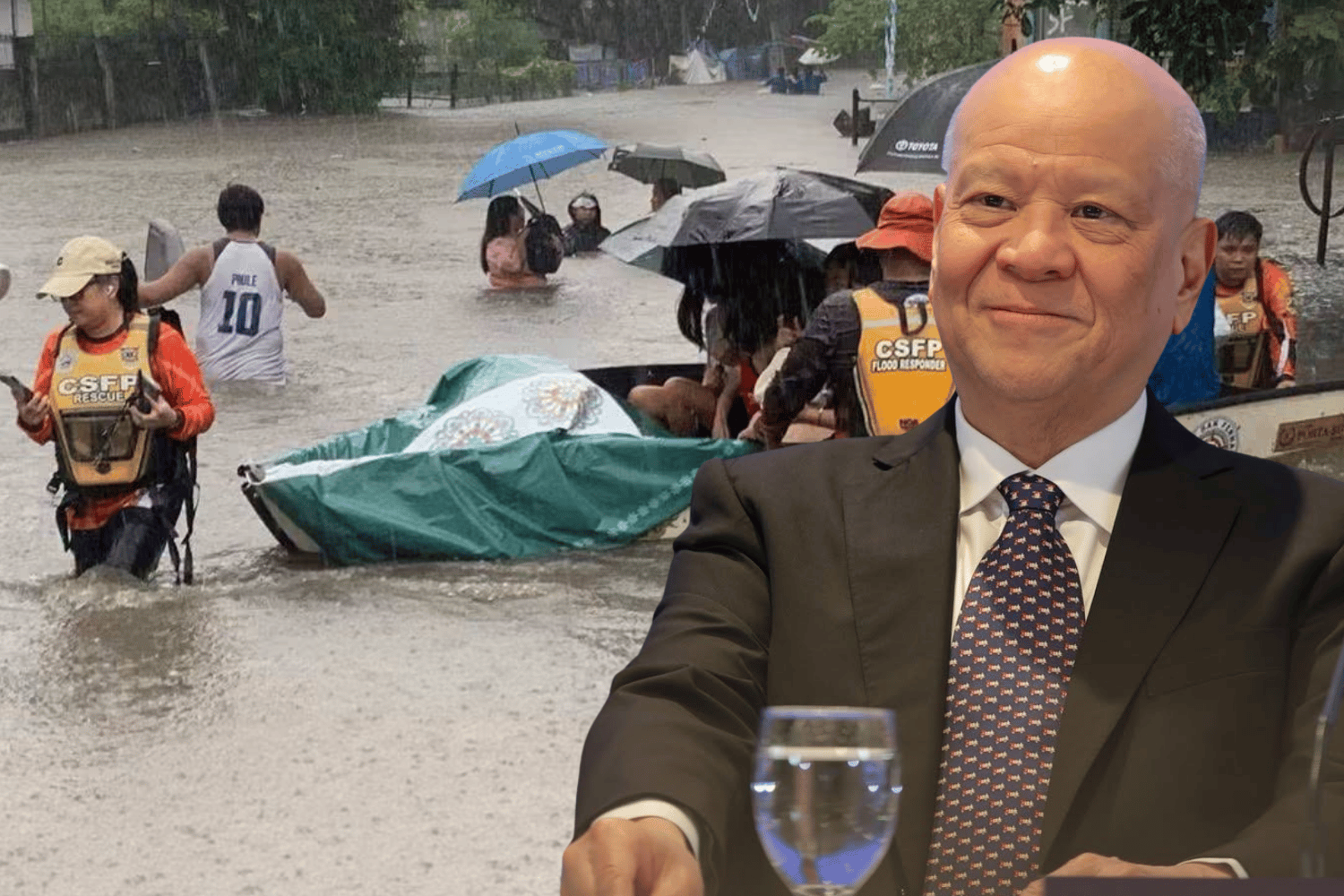
On Aug. 29, portions of the North Luzon Expressway in Bulacan and Pampanga were flooded, with motorists and commuters reporting trips that stretched for several hours as they tried to reach or leave Metro Manila.
For ordinary residents and commuters, the question is therefore bigger than whether an airport project can single-handedly solve a province’s longstanding flooding problem.
It is also about what happened to the measures Ang said would address it.
San Miguel says it has been working on flooding concerns, including through river dredging and clearing efforts. The company said it removed more than 1 million metric tons of silt and waste from three rivers near the airport from 2022 to 2024, while its broader river-cleanup program in Bulacan had removed more than 4.3 million metric tons of silt and waste as of Aug. 18, 2026.
Ang has also recently pointed to clogged and constricted waterways as contributors to flooding and offered to help clear a suspected blockage near Tulaoc Bridge in San Simon, Pampanga. He said the blockage could be preventing water from Pantabangan Dam from flowing toward the Pampanga River.
Ang has pushed back against the idea that the airport caused the flooding.
At a Sept. 1 briefing, he pointed to Bulakan’s low elevation, narrow and winding rivers and low bridges as factors behind flooding in the area. He also rejected claims that the airport blocked river systems.
San Miguel Aerocity Inc. said on Sept. 3 that the New Manila International Airport project did not involve reclamation and reiterated that its construction did not cause flooding in the areas concerned. The company said the airport was designed around Bulacan’s longstanding flood risks, with studies examining river systems, coastal waters, rainfall, storm surges and land subsidence.
Risks flagged before construction
Critics of the project have made a different case.
Before development began in 2021, experts had already warned about potential environmental and geological risks associated with building on the site.
During a 2020 Senate hearing on the airport’s franchise, then-Phivolcs director and current Science and Technology Secretary Renato Solidum Jr. warned that the area was vulnerable because of its soil and shallow water table.
“The area is mainly underlain by sand and the water table is very shallow (…) This environment would require special engineering intervention to make building and infrastructure resilient to hazards due to earthquake events or to other related activities such a heavy rainfall,” Solidum said.
The People’s Network for the Integrity of Coastal Habitats and Ecosystems also warned in 2020 that reclamation associated with the project could cause coastal erosion and worsen flooding in nearby areas.
San Miguel has maintained that the airport project did not involve reclamation.
The debate became more heated on Sept. 1, when Ang offered ₱1 million to anyone who could identify alleged anonymous critics making accusations against the Aerotropolis.
Ang did not specify the allegations covered by the offer but described the criticism as “paninira.”
Human rights lawyer Tony La Viña said the threat could constitute a strategic lawsuit against public participation, or SLAPP, intended to suppress criticism and public debate.
So what happened?
The evidence available today does not establish that the Aerotropolis caused the flooding. But neither does the continued flooding make Ang’s 2023 promise disappear.
Bulacan’s flooding has longstanding causes, and this year’s widespread flooding came after weeks of heavy rain. San Miguel says it has been dredging waterways and incorporating flood-mitigation measures into the airport project. Critics, meanwhile, continue to question whether the development has altered how water moves through the area.
What is harder to dispute is what Ang himself said three years ago.
He did not merely say San Miguel would study the flooding problem or try to help. He said the company would clean up Bulacan’s rivers, extend the effort to Pampanga and maintain the waterways every year. Most notably, he said that by 2024, residents would have no problem with flooding.
Today, Ang’s explanation is that flooding in Bulacan is tied to conditions that predate the airport, including its low elevation and constrained waterways.
That may help explain why flooding persists. But it also puts his 2023 assurance in a different light.
The airport may not be the sole answer to Bulacan’s flooding problem, and the evidence presented so far does not establish it as the cause of the latest floods.
But Ang made the promise himself.
Now, as residents wade through flooded communities and commuters endure hours on major roads, they have every reason to look back at those words and ask a very simple question:
What happened to the solution promised by 2024?
READ:

SMC seeks ₱30 billion from preferred share offering to fund Bulacan airport project
Kiara Gorrospe
June 2, 2026

San Miguel Corp. revenues surge 34% in H1, but net income plunges 43%
Kenneth M. del Rosario
August 18, 2026

ABS-CBN denies Ramon Ang and Manny Pangilinan takeover, investment rumors
Denchelle Castro
August 3, 2026
Tags: Anthony TabernaBulacanBulacan AerotropolisDepartment of Science and TechnologyNew Manila International AirportNorth Luzon ExpresswayPampangaPampanga RiverPantabangan DamPeople’s Network for the Integrity of Coastal Habitats and EcosystemsPhilippine Institute of Volcanology and SeismologyRamon AngRenato Solidum Jr.San Miguel Aerocity IncorporatedSan Miguel CorporationSan SimonTony La ViñaTulaoc Bridge