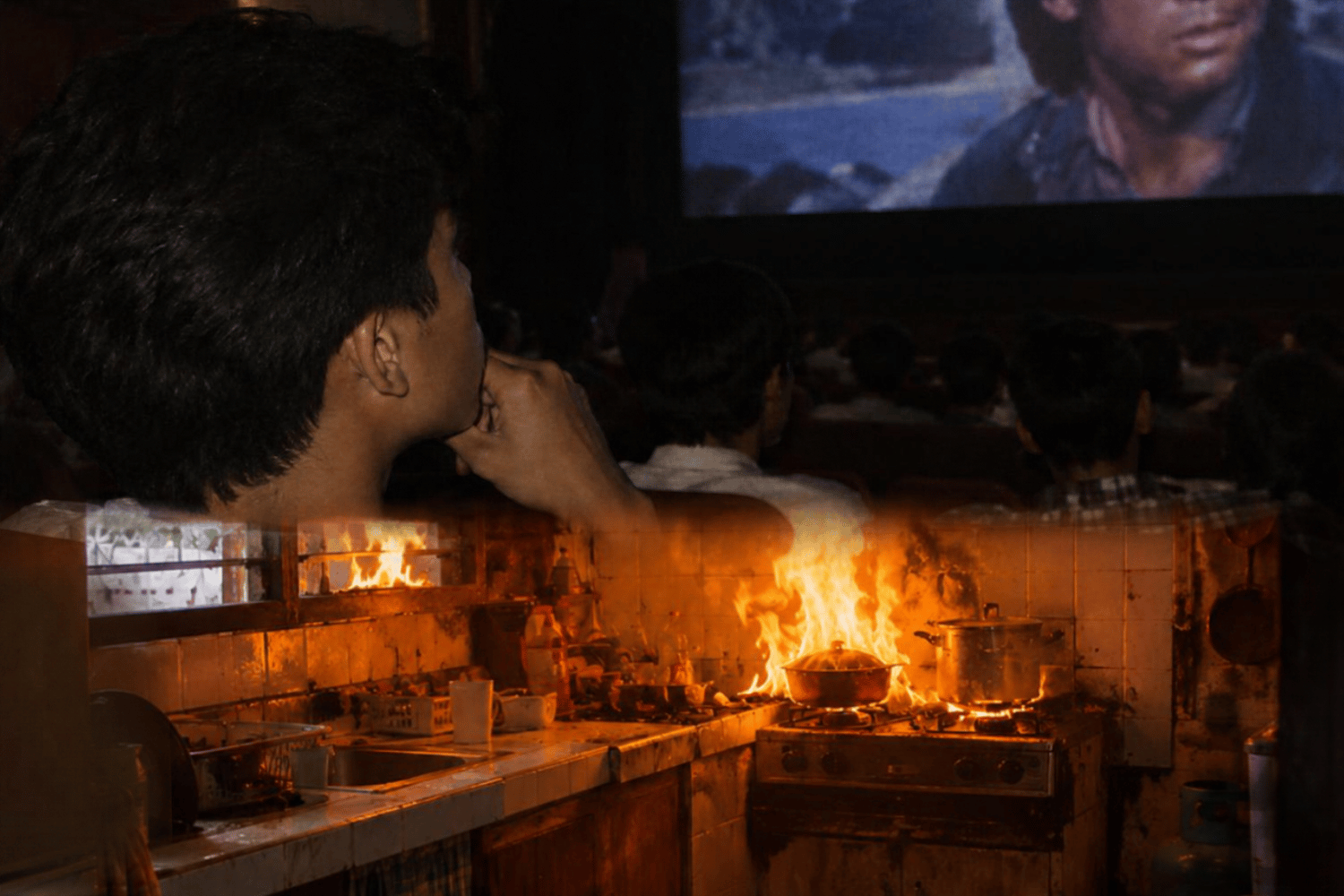
I can never know what would have happened had I gone home.
I was 10 when I arrived in Manila from Samar in 1988, a provincial boy who already knew the movies but had never really known the cinema.
Back home, movies came through makeshift Betamax movie houses. A television set, a player and a darkened room were enough to take us somewhere else. Then I came to Manila and discovered how big a screen could be.
The first movie I saw in a theater was “Kumander Bawang,” starring Herbert Bautista, at ACT Theater along EDSA in Cubao. By 1988, ACT was already a little rundown, napabayaan na. But to a 10-year-old from Samar, it might as well have been the grandest theater in the world.
The screen was huge. The room went dark. The sound came from everywhere. I was hooked.
Mat Ranillo III played a vampire in “Kumander Bawang.” Soon after, I saw him in “Lorenzo Ruiz,” playing the Filipino martyr who became a saint. One week, the man was a vampire. The next, he was a saint.
Maybe that was my first lesson in the magic of movies.
We lived in West Crame, where one of our neighbors had some connection to show business. Celebrities occasionally appeared at their parties—I remember Richard Gomez coming to our neighborhood—and the family always seemed to have movie passes. Sometimes, those passes found their way to me.
For a boy whose family did not have much money, those little pieces of paper were gold.
My two elder sisters once took me to Cubao to watch “Nagbabagang Luha.” They were big Lorna Tolentino fans. We first went to Fiesta Carnival, where I had a hotdog sandwich and a drink. But at the cinema, the woman at the ticket counter asked my age.
I was only 10 or 11. We tried to pass me off as 13.
She didn’t believe us.
My sisters were not about to give up the movie, so they sent me home. Alone. I took a jeepney from Cubao to Crame by myself for the first time while they stayed behind to watch Lorna Tolentino and Alice Dixson. Decades later, I would work with both actresses on advertising campaigns I produced.
By high school, I was going to the movies alone. Cubao was one jeepney ride away. I watched blockbuster movies of Fernando Poe Jr., Rudy Fernandez, Maricel Soriano, Snooky Serna, Joey de Leon, Rene Requiestas, and Aga Muhlach.
The problem was money. So I learned to gamble.
I played bingo and 41, a card game, hoping to win enough for my next movie. Twenty pesos could finance an afternoon in Cubao. An orchestra ticket was around P12, and jeepney fare was only a peso or P1.50.
“I learned to gamble so I could watch Tagalog movies” may not be the most respectable origin story for a lifelong love of cinema.
But it is mine.
At the University of Santo Tomas, movies became more than entertainment. I joined the campus paper and found friends who loved cinema as much as I did. One of my closest college friends and editors wrote about movies, and whenever something new opened, local or foreign, I often went with him.
Movies were cheap enough for students then. In the mid-1990s, my ₱100 allowance could take me to school, buy lunch, get me to Megamall or Robinsons Galleria, pay for a movie and a Jollibee dinner, and still leave enough for the ride home.
That ₱100 bought me an education beyond the classroom.
I saw serious Filipino films, foreign films and plenty of ST movies. I remember laughing at “Anakan Mo Ako,” never imagining that its writer, Jerry Gracio, would someday become a friend. Back then, the names in the credits belonged to another world.
Two professors brought that world closer. One was an art and film critic, another an entertainment editor. They would sometimes invite me to premieres. Slowly, I became curious not just about what was happening on the screen but how it got there.
Still, filmmaking seemed beyond my reach. Film school was expensive. I came from a poor family. Loving movies was one thing; making them seemed to belong to people with money, equipment and connections.
Then I saw “Tuhog.”
The late Mario Hernando invited me to a screening at the University of the Philippines. It was my introduction to Jeffrey Jeturian’s work, and something shifted.
For the first time, I became conscious of all the pieces working together. Color could create a world. Music could change the temperature of a scene. A camera could make something beautiful or deliberately ugly. Dialogue could be gritty one moment, campy the next.
“Tuhog,” with its gritty reality set against the movie being made inside it, showed me that cinema could lie and tell the truth at the same time.
I walked out wanting to make something.
I was then taking my master’s degree at UP and regularly going to Cine Europa at Shangri-La Plaza. I would spend entire days there, sometimes watching three or four films in succession.
For one graduate subject, I decided to write a screenplay as my final requirement. I had never studied screenwriting. My main qualification was that I had watched too many movies and somehow believed that was enough.
So I read Ricky Lee’s “Trip to Quiapo” and wrote a family drama set in my hometown in Samar. I worked on it for three days and three almost sleepless nights.
Cine Europa happened to be running at the same time.
After submitting my paper, I had a choice: go home and finally sleep, or go to Shangri-La and watch another movie.
I chose the movie.
During the screening, a message appeared on my pager.
There was a fire.
It had started in the kitchen of our closest neighbor, beside our own kitchen. Next to it was my room—the room where, after three sleepless nights, I would almost certainly have been sleeping had I gone home.
The fire spread to our house.
I lost practically everything that night.
I can never know what would have happened had I gone home. Maybe someone would have awakened me. Maybe the smoke would have.
But I know where I would have been.
Instead, I was inside a cinema.
For years, movies had already been saving me in smaller ways. They gave a poor boy from Samar worlds he could enter for ₱12. They took him beyond Crame, introduced him to writers and artists, and made him imagine a life larger than the one he knew.
That night, cinema may have saved me literally.
Strangely, after the fire, I stopped dreaming about becoming a filmmaker. Life took over. I had lost almost everything. I took two jobs, eventually went into business and concentrated on rebuilding. Filmmaking became one of those dreams quietly set aside when survival asks for your attention.
For years, I thought that was the end of my story with cinema.
It wasn’t.
I eventually found my way back—not as a filmmaker, but in another role, helping Filipino filmmakers bring their stories to the screen.
Sometimes I still think about that night. After three sleepless days, I had two choices: go home and sleep, or watch one more movie.
I watched the movie.
And I am still here.
READ:
PH cinema needs another ‘Tinimbang Ka Ngunit Kulang,’ says FDCP
Marinel Cruz
September 4, 2026
Cinemalaya films ‘The Hearing,’ ‘Cinemartyrs’ secure major int’l festival screenings
Marinel Cruz
August 31, 2026
Horror-drama ‘Poon’ survives three turbulent years to reach cinemas
Top Dagohoy
August 31, 2026