The Philippines began 2026 with 10 regular holidays and eight special non-working days on the national calendar, with Eid’l Fitr and Eid’l Adha proclaimed separately.
Filipinos see long weekends. Many employers see something else: How much will this holiday cost us?
For workers, another non-working day can mean rest, family time or travel. For businesses, it can mean lost production, disrupted deadlines—or substantially higher payroll.
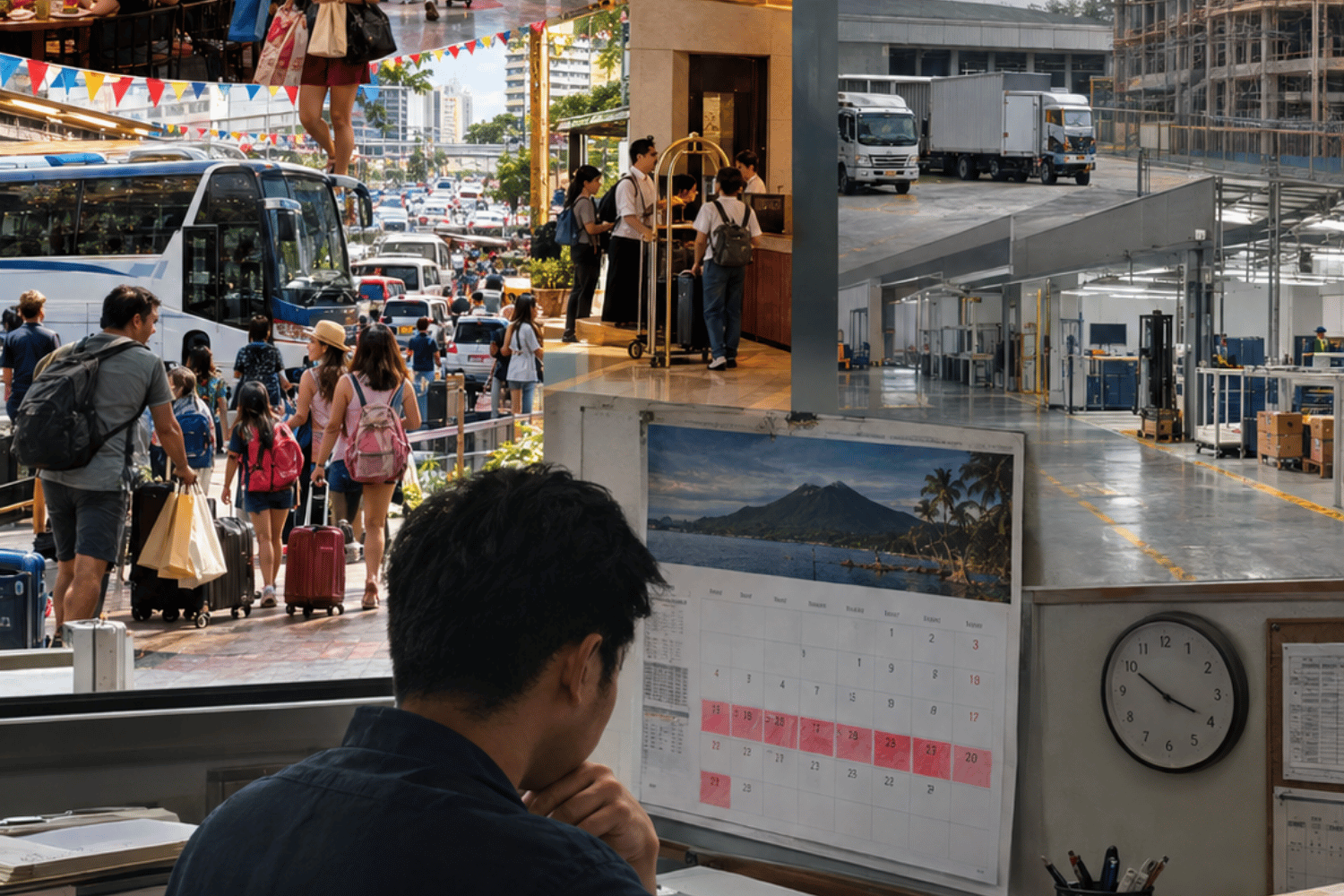
Welcome to Philippine “holiday economics,” where hotels, malls and restaurants can win while many other businesses absorb the cost.
The winners
There is serious money behind the long-weekend argument.
Filipino household consumption reached ₱21.4 trillion in 2025.
Tourism demonstrates how days off can translate into spending. Domestic tourism expenditure hit ₱3.26 trillion in 2025, while tourism directly generated ₱2.27 trillion, equivalent to 8.1 percent of GDP. Tourism industries employed about 7.7 million people.
More leisure time creates opportunities to travel, eat, shop and book hotels.
But what is good for tourism, restaurants and retail is not automatically good for every business.
When a holiday becomes a business expense
A factory’s production target does not shrink because there is a holiday. Neither do rent, loans, utilities or client deadlines.
Close and lose production time. Stay open and labor becomes more expensive.
Under DOLE rules, an eligible employee who works on a regular holiday receives 200 percent of the basic wage for the first eight hours. If the regular holiday also falls on a rest day, the rate rises to 260 percent.
Work on a special non-working day generally pays 130 percent.
A packed restaurant may recover that premium through additional customers. A manufacturer, logistics company, construction firm or BPO servicing foreign clients may simply pay more to keep operations running.
There is no free long weekend
Holidays have real value. Workers need rest. Families get time together. Tourism creates jobs and consumer spending keeps money circulating.
But holidays do not erase economic costs. They redistribute them.
Retail, food and tourism can collect the windfall. Production-dependent businesses can absorb downtime or higher payroll.
So while Filipinos celebrate another long weekend, somewhere a business owner is staring at payroll, deadlines and production targets.
For consumers, a holiday is a break. For many businesses, it is another bill.
READ: