Edgar Jopson’s neglected marker raises questions about how Manila preserves the memory of Martial Law resistance.
There is something painfully wrong with this picture.
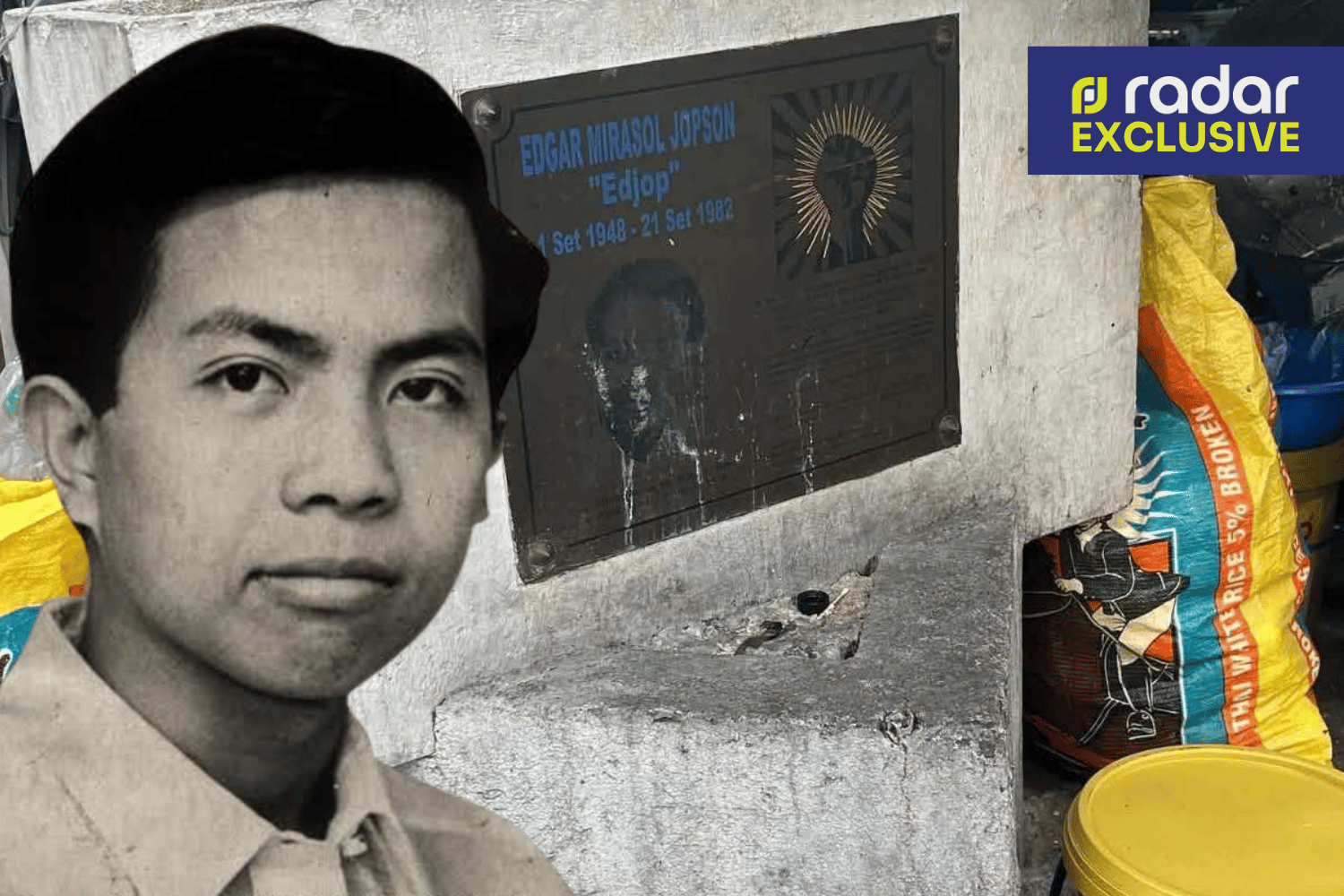
At a street corner in Sampaloc, Manila, a commemorative marker honoring Edgar “Edjop” Jopson stands almost swallowed by the everyday clutter around it.
Sacks are piled beside the concrete monument. A yellow plastic bucket sits nearby. Tarpaulin and makeshift coverings loom over it. Trash and other objects are scattered around its base. The plaque itself appears stained and weathered.
Without knowing what to look for, a passerby could easily walk past without realizing that this neglected structure commemorates one of the best-known young activists killed during the Marcos dictatorship.
And that should concern the government agencies responsible for Manila’s public spaces and historical memory.
The marker, located around Bustillos in Sampaloc, bears the name of Edgar Mirasol Jopson, better known as Edjop. Born in 1948, Jopson rose to national prominence as president of the National Union of Students of the Philippines and became an important figure in the protest movement of the early 1970s.
His political journey was complex. Coming from a relatively comfortable family, Jopson initially pushed for constitutional and nonviolent reforms before eventually joining the underground movement during the dictatorship.
Jopson was killed in Davao City in September 1982 at just 34 years old. His name is now inscribed on the Wall of Remembrance at Bantayog ng mga Bayani, which honors people who resisted the Marcos dictatorship.
More than four decades later, photographs circulating on social media raise a much simpler question: Who is taking care of his memorial?
The issue is not the presence of ordinary vendors by itself. Sidewalk vending is tied to livelihood, poverty and the chronic shortage of properly managed public spaces in Metro Manila.
The bigger question is why a historical memorial has apparently been allowed to reach a condition where it can be obscured by commercial activity and surrounding clutter in the first place.
Historical markers do not preserve themselves.
If the government chooses to put up a monument or commemorative marker, stewardship cannot end with an unveiling ceremony and photographs. Maintaining the site, keeping it visible and ensuring that people understand why it exists are part of preserving public memory.
The timing makes the images even more striking.
A new generation is currently being introduced to Jopson through “Edjop,” the Katski Flores film starring Elijah Canlas that opened in Philippine cinemas in September 2026. The film revisits Jopson’s transformation from student leader to revolutionary during the Marcos dictatorship.
Young Filipinos are watching his story on cinema screens while, in the neighborhood connected to his life, his physical memorial appears barely distinguishable from the clutter surrounding it.
That contrast should prompt action from the City of Manila and the agencies responsible for the marker: determine who is accountable for the site, clean and restore it where necessary, keep it visible, and work with vendors so that preserving history does not simply mean depriving people of their livelihoods.
Whatever one’s politics today, Edgar Jopson is part of documented Philippine history. His name remains on the Wall of Remembrance, and his life continues to be studied and retold decades after his death.
A country does not preserve history simply by putting names on bronze plaques.
It preserves history by making sure people can still see them.
READ: