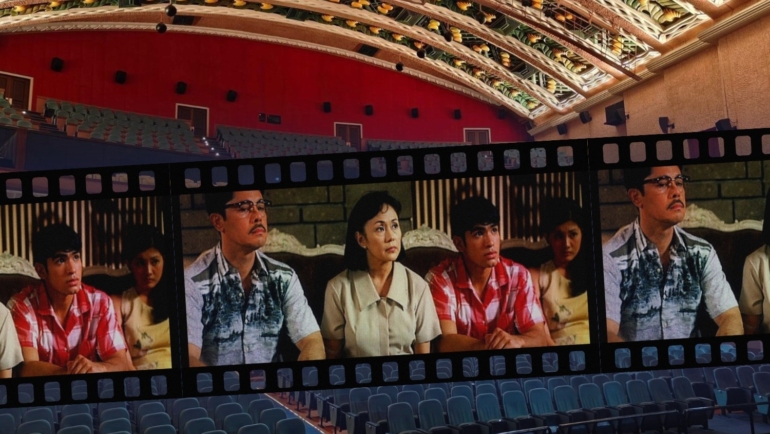
From titillating film star to award-winning actress, Osang redefined Filipina stardom and captivated an entire nation.
Crucible Gallery was a small exhibition space inside SM Megamall, but when it mounted an exhibit of nude paintings of Rosanna Roces, word spread that Osang herself was coming. Thousands gathered around the gallery, while others positioned themselves along the railings of different floors just for a glimpse. The press waited outside with the fans. Security guards struggled to keep a perimeter as the crowd grew.
Then Roces arrived. The mall erupted. People screamed “Osang!” as the sound of rushing feet echoed through the corridors. Fans pushed forward, people leaned over railings and guards strained to contain a crowd seemingly delirious over the chance to see her in person.
You did not need box-office figures to understand what was happening. Rosanna Roces was a superstar.
From sexy star to phenomenon
Born Jennifer Adriano, Roces first appeared under the screen name Ana Maceda before becoming Rosanna Roces and emerging from the Seiko Films stable.
The 1990s were the age of the so-called ST and titillating films, when sex became a major commercial force in Philippine cinema. Seiko was one of the genre’s prime movers, and Roces became its most formidable female star. Film scholar Patrick Flores would later identify her frankness as characteristic of the era’s shift toward titillating cinema.
“Patikim ng Pinya” became one of Seiko’s biggest and most controversial hits. Producer Robbie Tan would later recall just how commercially powerful the film was.
But while many sexy stars came and went, Osang refused to remain inside the category that created her.
She had something more difficult to manufacture: personality.
Roces was funny, street-smart, confrontational and startlingly candid. At a time when female stars were often expected to be polished and carefully managed, Osang could be vulgar, mischievous, angry, sexual and completely unfiltered.
Her nickname became a brand.
She was not simply Rosanna Roces anymore.
She was Osang.
Then came ‘Ligaya’
The transformation became undeniable with “Ligaya Ang Itawag Mo sa Akin” in 1997.
Playing a sex worker hoping to escape her circumstances, Roces suddenly forced critics to reconsider the woman they had associated with titillating movies.
Sociologist Randy David wrote at the time that Roces had “re-invented herself,” praising the texture she brought to Ligaya. Director Marilou Diaz-Abaya, meanwhile, described her as “a very intelligent actress.”
It was a remarkable crossover.
Instead of running away from the sexuality that had made her famous, Roces began using it in more complex films about women, desire, exploitation and survival.
“Ang Lalaki sa Buhay ni Selya” followed, then “Curacha, Ang Babaing Walang Pahinga,” in which Roces played another woman existing at society’s margins. She also appeared in “Mapusok,” “Ang Babae sa Bintana,” “Katawan” and other films during an extraordinarily prolific period.
By then, dismissing her as merely a sexy star had become increasingly difficult.
From Osang to Best Actress
The ultimate validation arrived with “La Vida Rosa” in 2001.
Her performance as Rosa earned Roces the Gawad Urian for Best Actress, completing one of the most remarkable transformations of her generation: from an actress marketed through her body to one recognized for her acting.
Yet the transition did not require her to become respectable in the traditional showbiz sense.
That was precisely what made Osang different.
She remained Osang.
She conquered television, too
By the late 1990s, Roces had also crossed into mainstream television.
She became a fixture on GMA Network’s “Startalk” beginning in 1997 and appeared in the sitcom “1 for 3,” bringing the personality audiences had encountered in interviews into Filipino living rooms.
Her candor was perfect for showbiz television.
You watched because you never quite knew what Osang would say.
Her romances, feuds, opinions and controversies became entertainment stories themselves. The woman once marketed as forbidden entertainment had become mass entertainment.
And that crossover mattered.
The anti-Maria Clara
There had been bold stars before Rosanna Roces. But Osang represented something different culturally.
The traditional Filipina celebrity was often expected to project restraint: beautiful but modest, desirable but respectable, opinionated but never too loud.
Osang demolished that template.
She talked openly. She laughed loudly. She owned her sexuality. She fought publicly. She could be glamorous one moment and completely ordinary the next.
A later assessment of the era described Roces as a true star whose late-1990s appeal came not only from box-office power and acting ability, but from her street smarts and confidence in her own power as a woman.
That may be the key to understanding why she became so enormous.
Audiences were not merely attracted to Rosanna Roces.
They recognized something liberating in Osang.
When everyone knew Osang
Her peak also belonged to a different era of celebrity.
There was no TikTok, Instagram or YouTube. Audiences were concentrated around a handful of television networks, cinemas, tabloids, radio stations and magazines. When someone became truly famous, that fame could become almost universal.
Roces occupied practically every corner of that ecosystem.
She had the movies. She had television. She had the tabloids. She had critical recognition. And she had something even harder to measure: the ability to walk into a public place and cause chaos simply by appearing.
Which brings us back to that small gallery inside Megamall.
The paintings may have been the reason for the exhibition.
But thousands came hoping to see the woman.
That was how big Rosanna Roces had become.
She entered Philippine cinema as a sexy star.
She emerged as an actress, an award winner and one of the defining pop-culture personalities of her generation.
But to the public, one name was enough.
Osang.
READ:

The TV commercial that made the Power Boys overnight stars
Top Dagohoy
July 18, 2026

When Weng Weng became the highest-exported film of its time
radar Entertainment
May 23, 2026

Makeshift Betamax theaters started my love for cinema
Matahari
May 14, 2026