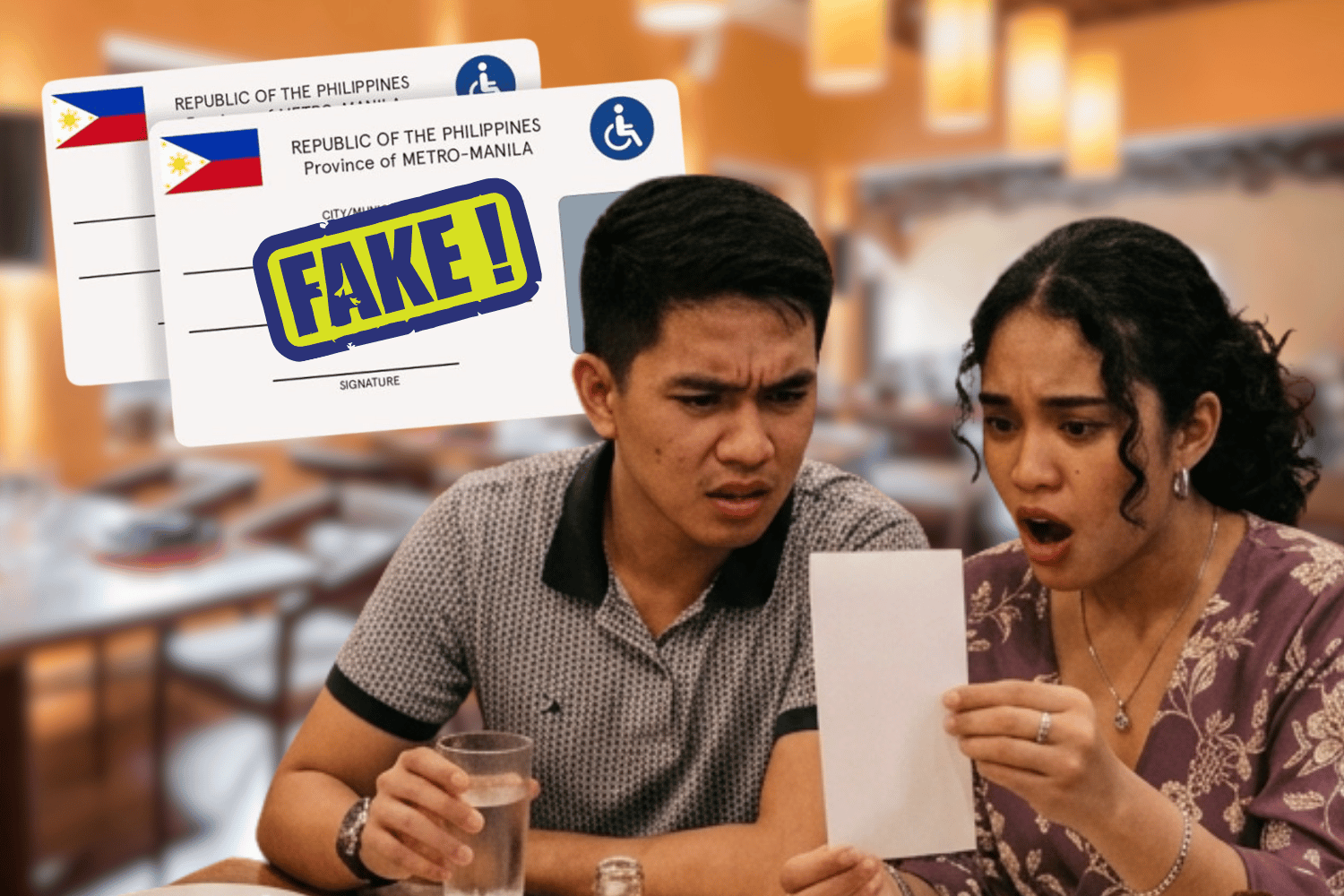
Fake PWD card abuse eats into restaurant profits, forcing businesses to raise menu prices for honest customers.
Imagine walking into your favorite restaurant and discovering that your usual ₱250 meal now costs ₱280. You blame inflation, rising food costs, or higher wages. But another factor may be quietly pushing menu prices upward: customers using fake Persons with Disabilities (PWD) IDs to obtain discounts they do not deserve.
Restaurant operators across the Philippines have warned that fraudulent PWD cards are eating into their earnings. And when businesses can no longer absorb the losses, ordinary diners may end up paying more.
Millions of questionable IDs
On October 8, the Department of Justice (DOJ) expressed alarm over reports that approximately six million Filipinos could be using fake PWD cards.
Figures attributed to the National Council on Disability Affairs (NCDA) showed approximately 2.8 million registered PWDs against 8.5 million reported ID holders.
The discrepancy of 5.7 million is alarming, although it does not automatically mean every unmatched card is fraudulent.
How restaurants lose money
Under Republic Act No. 10754, qualified PWDs receive a 20% discount and VAT exemption on eligible restaurant purchases.
Businesses shoulder the immediate discount, although they may claim an income-tax deduction.
For example, a VAT-inclusive meal costing ₱1,120 becomes ₱800 after the VAT exemption and 20% discount. The restaurant receives ₱200 less than its original VAT-exclusive selling price.
If 20 customers fraudulently claim that discount daily, the restaurant loses ₱4,000 in revenue. Over 30 days, that becomes ₱120,000 before tax effects.
This hypothetical example illustrates how fraudulent transactions can erode profits.
Billions in questionable discounts
During a December 2024 Senate investigation, Senator Sherwin Gatchalian presented estimates suggesting that fraudulent PWD discounts reached ₱166.1 billion in 2023, compared with ₱42.3 billion in legitimate discounts.
The estimated government revenue loss was ₱88.2 billion.
These figures are estimates, not independently audited totals.
Restaurant operators also reported that PWD-discounted transactions had increased from approximately 5% to as much as 30% of sales in some establishments.
While not every discounted transaction is fraudulent, the increase has raised concerns within the industry.
Why everyone may pay more
Restaurants still have to pay for ingredients, rent, electricity, and salaries regardless of how many discounts they grant.
When fraudulent claims become excessive, businesses may respond by reducing expenses, accepting smaller profits, or increasing menu prices.
This means ordinary customers could indirectly shoulder the cost of discount abuse.
However, no comprehensive study has established how much fake PWD cards contribute to restaurant price increases compared with inflation and other operating costs.
The DOJ has acknowledged verification difficulties and warned that fraudulent cardholders could face criminal complaints.
Meanwhile, legitimate PWDs risk greater suspicion and discrimination because of widespread abuse.
The issue is not whether PWDs deserve their legally mandated benefits. They do.
The real problem is that people exploiting those benefits may be making restaurants less profitable and dining out more expensive for everyone.
READ:
Child PWDs require nearly twice the financial support as other kids
Kiara Gorrospe
October 1, 2026
OPINION: Fake PWD IDs continue to cost restaurants billions
Nikko Miguel Garcia
May 8, 2026
‘Anong logic behind PWD IDs na may expiration date?’
Allyson Capati
July 24, 2026