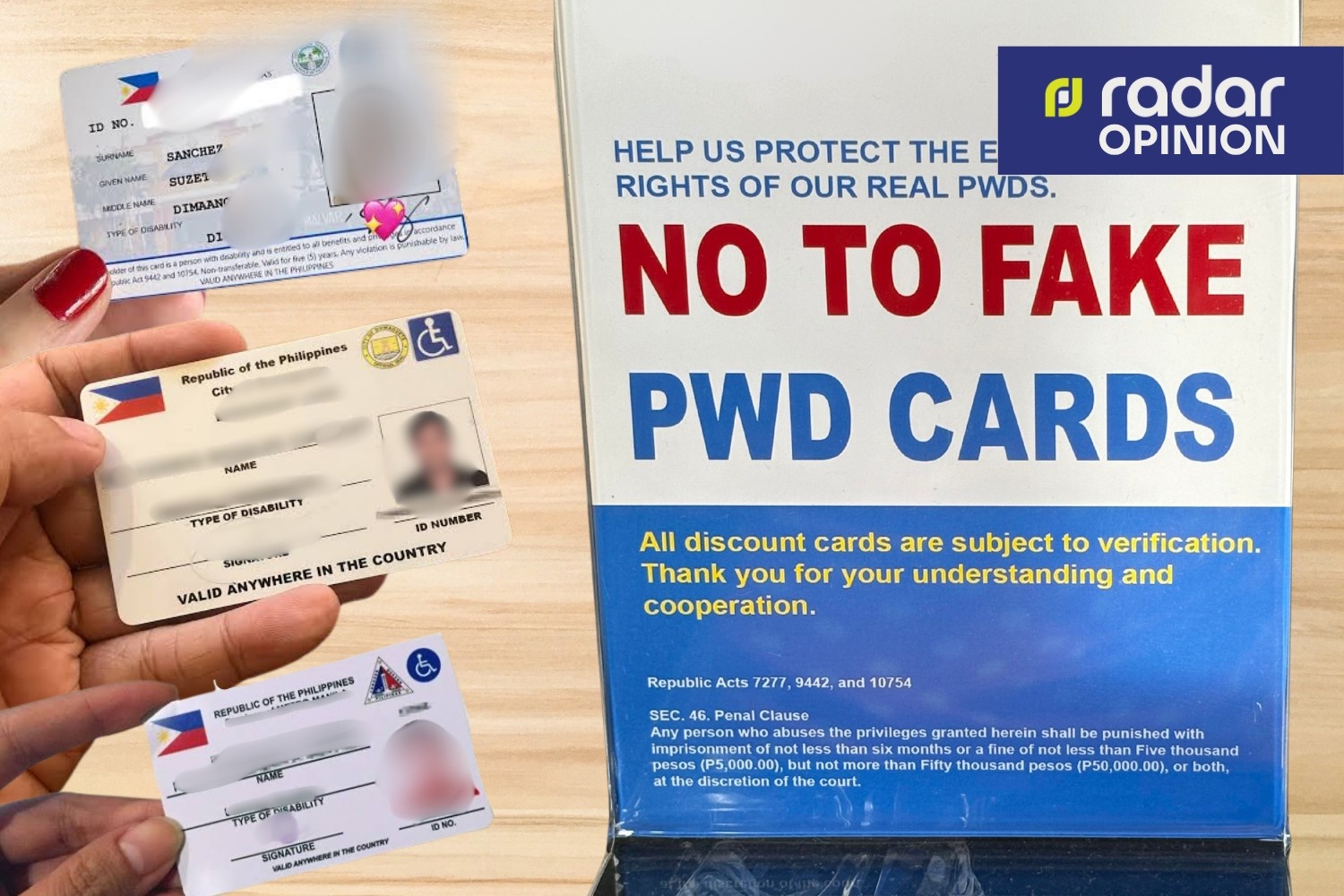
Businesses only rely on warnings while a unified PWD ID system is being rolled out.
Fake PWD identification cards for restaurant discounts remain widespread despite a strong pushback from businesses last year—costing the industry tens, if not hundreds, of billions of pesos over time.
Filipino consumers have long been drawn to discounts or freebies—often out of necessity. Being sulit, wais, or madiskarte has become an understandable survival mindset amid rising fuel costs, a weakening peso, and persistently high prices of goods. Saving up is no longer optional but expected.
One of the most generous perks is the 20% discount—plus exemption from value-added tax—granted to persons with disabilities. Under Republic Act No. 10754, it’s meant to support their “improvement of well-being and integration into mainstream society.”
But alas, the system is being gamed.
Fake PWD IDs and booklets remain a shortcut to savings, used even by those with no qualifying condition, such as those living with diabetes, cancer, stroke, and bipolar disorder, among many others. Some have gone further, openly selling counterfeit IDs and booklets for profit.
Restaurants have borne the brunt of the abuse. Restaurant Owners of the Philippines (Resto PH)—which represents over 300 brands with thousands of physical outlets nationwide—have flagged shady cases: individuals claiming visual impairment as licensed pilots, physically fit gym goers claiming disability, a couple with similar serial numbers, and a group of 10 people who all happen to be PWDs. In some cases, discounts are applied to premium steaks, wine, and other high-end purchases.
Beyond the obvious abuse, the lack of a reliable verification system has disrupted operations, forcing establishments to second-guess transactions and absorb questionable discounts anyway.
The losses are staggering. In a December 2024 Senate committee hearing, lawmakers cited 8.5 million fake PWD ID users—far exceeding the legitimate 1.8 million holders. Resto PH reported a 25% increase in sales tagged as PWD transactions over two years, translating to at least ₱166 billion in discounts.
The Bureau of Internal Revenue added that about ₱88.2 billion in tax revenue was lost in 2023 alone due to fake PWD IDs, calling it a form of tax evasion.
In turn, businesses are forced to raise prices and be stricter even toward legitimate PWDs. It also affects other customers and even the restaurant workers themselves.
Many establishments have put up notices against fake PWD IDs. It’s not a strong deterrent, but rather a Hail Mary for Filipinos to still feel hiya.
The government’s long-term fix is a unified PWD ID system—anchored on QR codes for real-time verification. A pilot rollout began in select local government units in August 2025, with gradual expansion nationwide. As of January, about 572 local government units have registered and undergone training. A full integration across all 1,600 is being targeted this year.
No full data exists for 2024 and 2025 yet. But if the problem persists—even beyond non-Resto PH establishments—the true cost likely runs far higher than official figures.
And while the unified PWD ID system rolls out, abuse doesn’t wait.