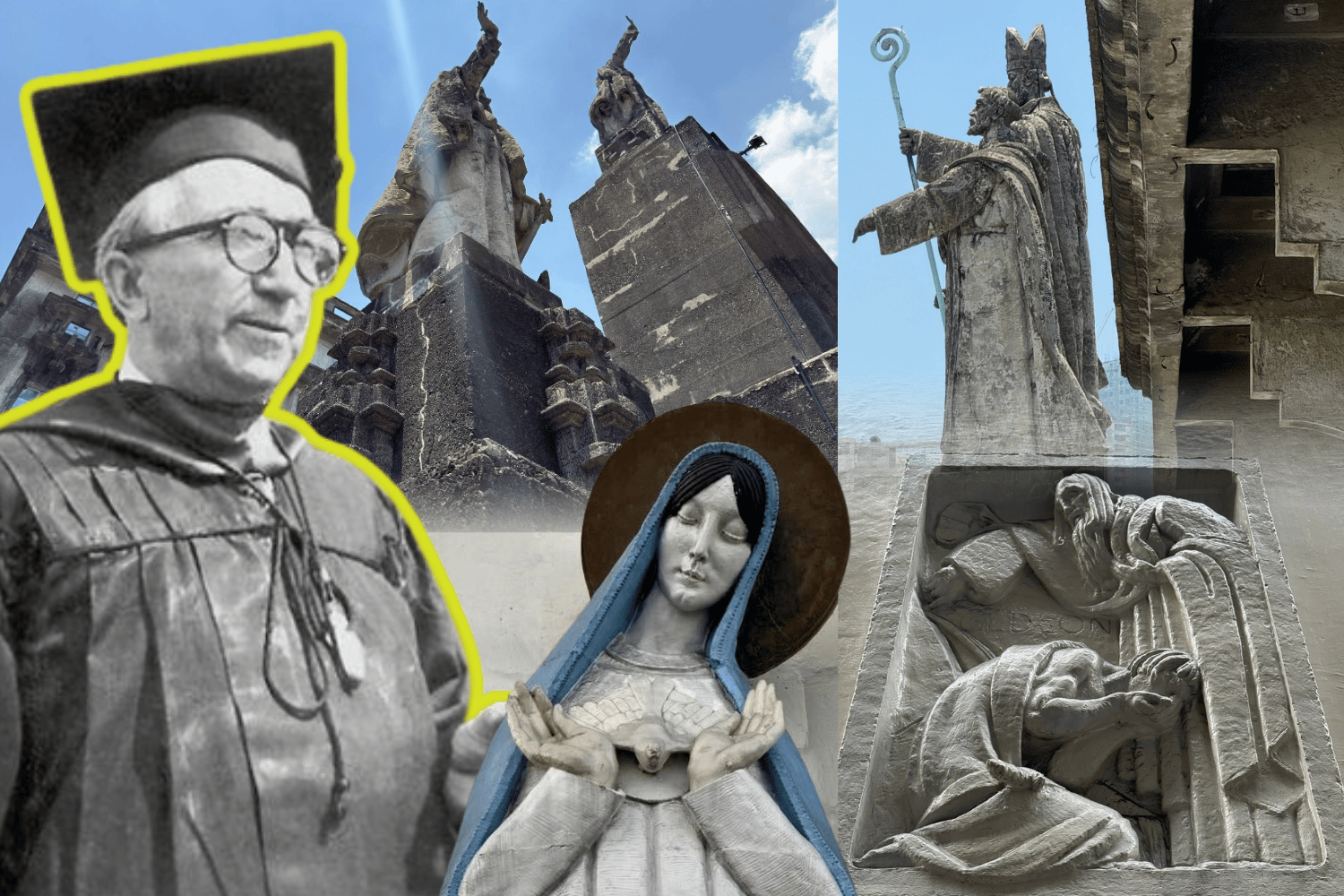
He created classic sculptures that defined major Filipino architectural landmarks and public monuments.
You’re walking across the University of Santo Tomas campus when you look up at its Main Building and notice the statues crowning its roof.
On another day, you’re visiting the Archdiocesan Shrine of Espiritu Santo along Tayuman when you spot sculpted figures that look straight out of the Renaissance.
Both are works by Francesco Riccardo Monti, an Italian sculptor who spent nearly three decades in the Philippines.
His sculptures were recently featured by the Manileños for Heritage Facebook page, drawing renewed attention to his contribution to the country’s artistic landscape.
From Italy to Manila
Born in Cremona of northern Italy in 1888, Monti trained at the Institute of Ponzone for Decorative Arts and Technology and the Academy of Fine Arts.
According to a 2005 feature by The Varsitarian, UST’s official student publication, Monti’s career took an unexpected turn in November 1928, when he entered a competition for a monument commemorating Austro-Hungarian soldiers who died during World War I.
A local newspaper reportedly announced his design as the winner—only for organizers to reverse the result and withdraw the commission. The article cited alleged “political maneuvering” as reason behind the decision.
Monti left Cremona the following December and eventually reached New York, where he met Filipino architect Juan Arellano.
Arellano invited him to the Philippines. Monti initially had a commission planned in Cebu, but a cholera outbreak reportedly prevented the project from proceeding. He stayed in Manila instead, bringing with him 170 quintals, or about 17,000 kilograms, of clay.
Sculpting in the modern city
Monti’s collaboration with Arellano brought his work to one of Manila’s architectural landmarks: the Metropolitan Theater. Its Art Deco design incorporates Monti’s sculptures, including “Siamese Dancer” and “Oriental Dancers” on the exterior, as well as “Adam” and “Eve” in the main lobby.
His work extended beyond the theater. In a monograph on Monti’s career, Ma. Victoria Herrera, a University of the Philippines professor of art history, identifies collaborations with Arellano on the Iloilo City Municipal Hall and the Meralco head office in Manila. The latter featured Monti’s relief sculptures known as “The Furies.”
Monti also worked with architect Pablo Antonio on Far Eastern University’s administration building, where relief murals depict scenes from Philippine history.
His work with National Artist for Sculpture Guillermo Tolentino on the Bonifacio Monument in Caloocan further connected his art to the country’s public memory.
Teaching in UST
In 1948, UST appointed Monti to teach at the then College of Architecture and Fine Arts, tasked with developing its sculpture program. (To date, it’s been split to two: College of Architecture and College of Fine Arts and Design.)
The university’s rector at the time, Fr. Angel de Blas, O.P., commissioned him to create statues for the Main Building, representing fields such as literature, philosophy and religion. The figures included Aristotle, St. Augustine and William Shakespeare.
The project was intended to feature 30 statues, but only 15 were completed before work stopped in 1953, according to The Varsitarian.
Monti also received government commissions while teaching at UST. For the 1953 Philippine International Fair, held during the Quirino administration, he created five allegorical statues, including “Filipinas” and the “Four Freedoms.” The sculptures were later installed at Malacañang.
At the time of the Varsitarian feature, the Four Freedoms statues were reportedly broken into pieces and awaiting restoration, while “Filipinas” remained intact.
Religious sculptures
But if there’s anything Monti is best known for, it’s his religious sculptures. In collaboration with architect Jose Zaragoza, he contributed sculptures to Santo Domingo Church in Quezon City. These included a relief depicting Our Lady of La Naval and the Battle of La Naval, as well as a cast of St. Dominic de Guzman.
He also worked on statues of Don Bosco and St. Dominic de Savio for the Don Bosco Technical Institute in Mandaluyong. After completing their casts, he figured in a car accident and suffered internal injuries. He died on Aug. 11, 1958.
In a March 1953 issue of The Varsitarian, Monti expressed his hope of training a Filipino sculptor who could continue his work. He also spoke of his gratitude to the country that had welcomed him.
“I will die happy that in my humble way,” he is quoted as saying. “I could have reciprocated the hospitality this beautiful country has given me for the last 25 years.”
READ:
UST moves inaugural Ophelia Dimalanta memorial lecture to February 2027
radar Lifestyle
October 15, 2026
Kenneth Cobonpue’s new chair looks more like a sculpture than a seat
Top Dagohoy
August 19, 2026
St. Frassati draws Filipino Gen Z Catholics to Manila Cathedral festival
radar Lifestyle
June 22, 2026
Tags: Academy of Fine ArtsArchdiocesan Shrine of Espiritu SantoBonifacio MonumentCollege of Architecture and Fine ArtsCollege of Fine Arts and DesignCremonaDon Bosco Technical InstituteElpidio QuirinoFar Eastern UniversityFr. Angel de BlasFrancesco Riccardo MontiGuillermo TolentinoIloilo CityInstitute of Ponzone for Decorative Arts and TechnologyItalyJose ZaragozaJuan ArellanoMa. Victoria HerreraMalacañang PalaceManila CityMeralcoMetropolitan TheaterO.P.Pablo AntonioSanto Domingo ChurchUniversity of Santo TomasWorld War I