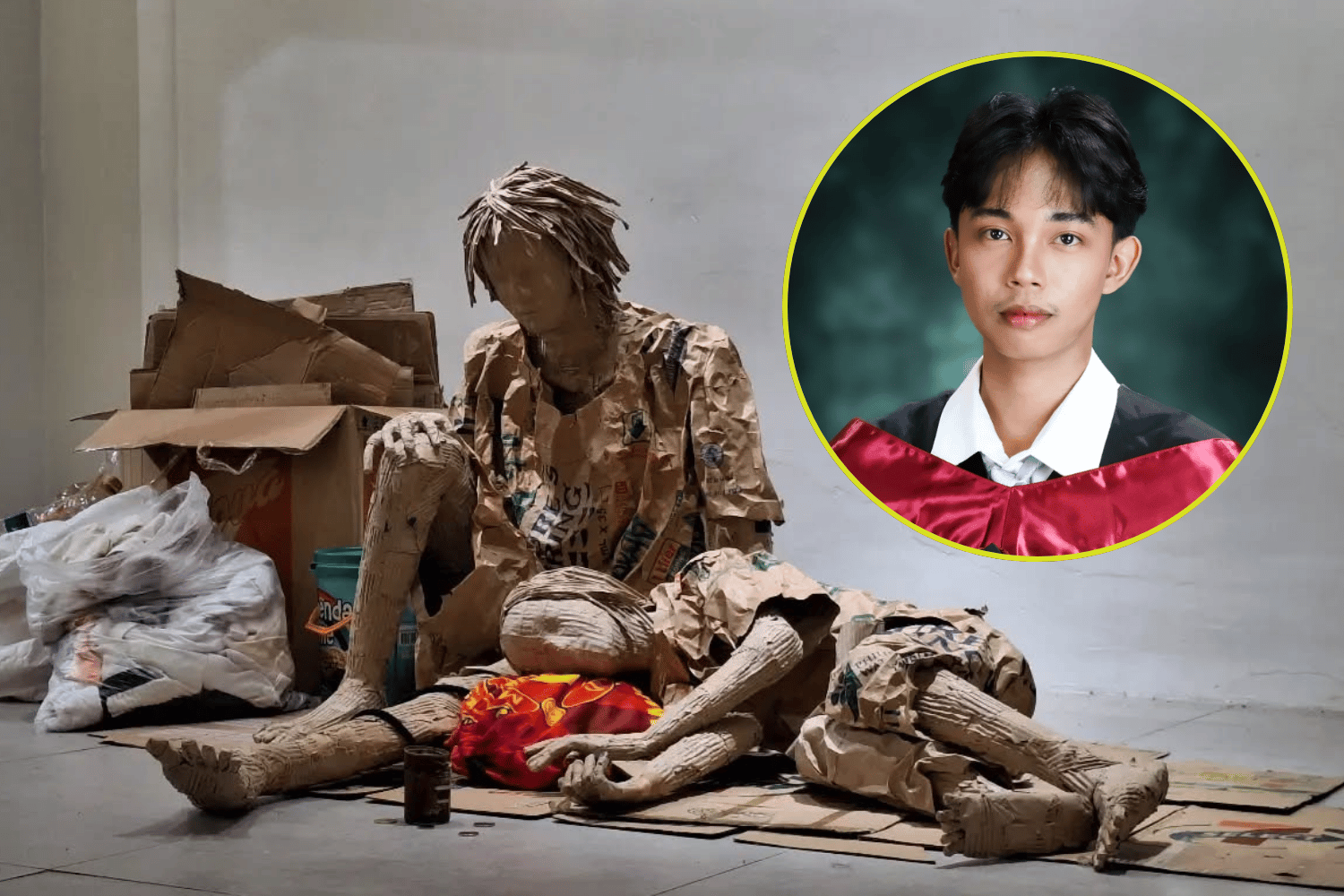
“Ang KARTON ay madaling mahanap at madalig masira pero hindi natin ito binibig yang halaga,” he wrote.
For Serador, the material carries a significance beyond its availability. He pointed to how people experiencing homelessness use cardboard as protection from the sun, bedding, and makeshift shelter.
“Nagsisilbi ito upang maging panangga sa init ng araw, higaan upang maging kumportable sa pagtulog, kumbaga ito lamang ang nagiging shelter nila sa araw-araw na hamun ng buhay!” he added.
College thesis
In an interview with radar, Serador said that as part of his thesis as a painting major, he sought to experiment with a medium that could also communicate a social issue.
“We tried to explore other medium to make art,” he said. “Natutunan kong mahalin ang mga bagay na alam natin na sa mundong ito walang pakinabang, at ito ay ang karton. Kinailangan ko ring i-connect sa social issues para mas may kabuluhan ang aking artwork.”
In a Reel posted on Oct. 27, Serador documented how he brought the figures to life.
He began by shaping chicken wire into the sculpture’s base, a process he described as the most time-consuming part because the wire had to be carefully folded to hold its form. He wore gloves while working with the material for safety.
He then attached large quantities of torn and crumpled cardboard to the wire using glue sticks and a glue gun. For the figures’ clothing, he peeled away the outer layers of cardboard boxes to achieve the desired texture.
“Di mo akalain na sa karton, makakagawa ka ng ganitong art,” he said.
The result transforms a familiar street-side material into a detailed human scene. Cardboard is no longer simply something to discard: in Serador’s work, it becomes part of the story itself.
Commissions
Although this is his first venture into sculpture, Serador said he’s been taking commissions for charcoal drawings since senior high school. He has also received painting commissions and sold his works.
He said his experience selling art has generally been positive, although there are a few challenges when it comes to negotiating prices.
“Okay naman ang naging experiences ko,” he said, “but sometimes, hindi natin maiiwasan ang mga client na tumawad kasi hindi nila ma-meet ‘yong demand.”
He urged fellow young artists to explore unfamiliar approaches and remain true to their own stories.
“Let’s make art in a way na kinakausap tayo ng ating mga obra kasi, when you share your art, you also share your story.”
For now, Serador hopes his work will encourage other aspiring artists to keep creating, particularly those who doubt their abilities.
“Masaya ako araw-araw na mayroong nakaka-appreciate ng work ko at nagsisilbing inspiration,” he said. “That’s my first and last goal, at marami pa.”
READ: