UP Fine Arts graduates Shannah Orencio and Ayka Go spark conversations on creative ethics.
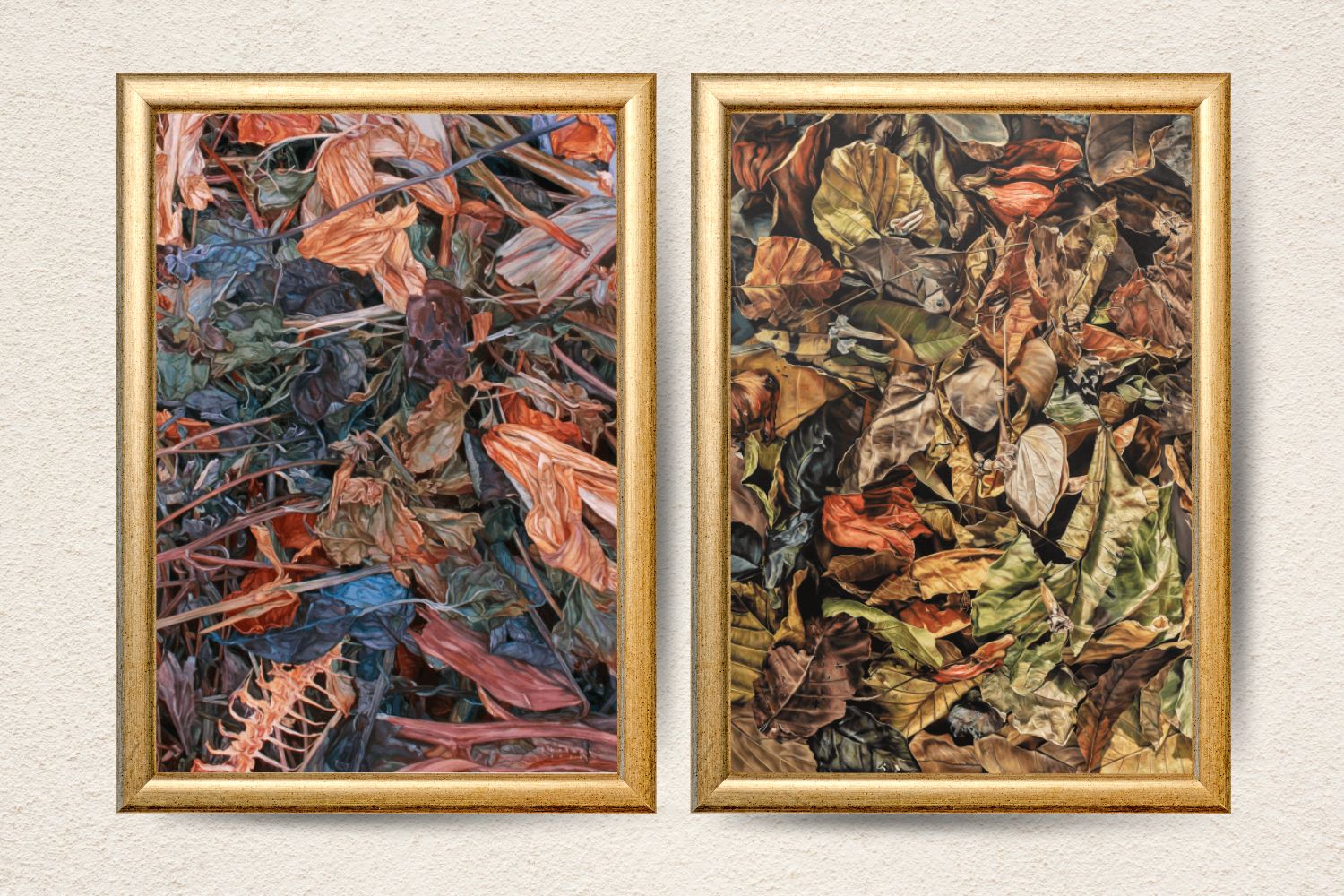
In 2019, Shannah Orencio began developing what would become one of the defining elements of her practice: oil paintings of withered flora and organic fragments arranged in dense, border-to-border flat-lay compositions—a visual language rooted in memory and mourning.
Through her Flower Box series, first mounted at the Pinto Art Museum, Orencio focused not on the “thick, fragrant blossoms in their prime,” but on “shriveled up remnants of a once happy time.” The series would become one of the bodies of work most closely associated with her practice.
But before Flower Box, there was Vase Life. The 2018 exhibition at Art Verité Gallery featured oil-on-canvas monochromes of decaying petals, leaves, and stems, hinting at the visual language Orencio would refine in the years that followed.

Those same elements continued to appear in later works, including Rituals of Recovery at Vinyl on Vinyl Gallery in 2024.
As that trajectory took shape, that visual approach became the center of a striking comparison: Ayka Go’s “turning season,” a centerpiece of her small vast things exhibition at the Silverlens Galleries, on view from July 25 to Aug. 22.
From paper to foliage
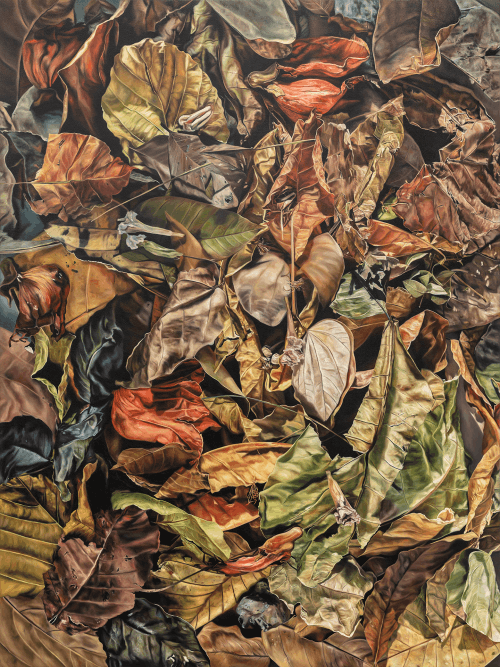
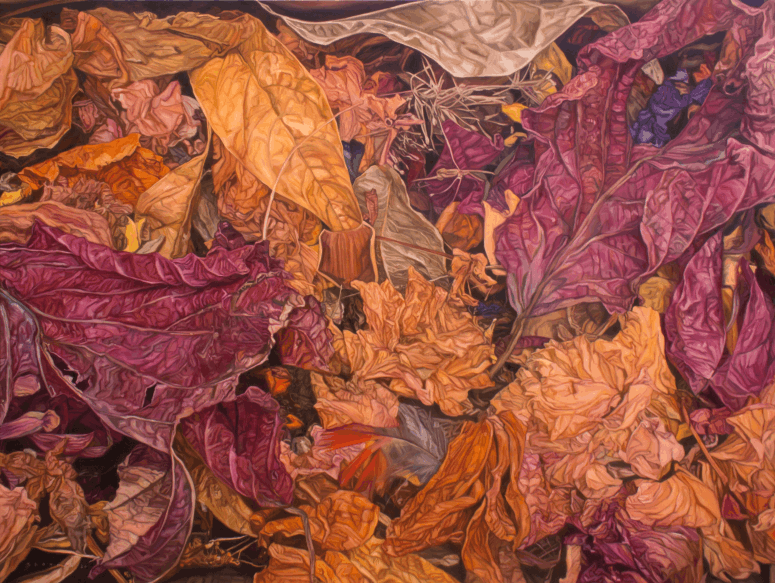
Measuring 96 by 72 inches, “turning season” presents an expanse of dead leaves and organic fragments.
While the official exhibition notes don’t explicitly name the work, they read, “One canvas responds to the textures and tonalities of fallen leaves associated with the dry season (tag-araw).” It’s the only apparent reference to a leafy composition in a show otherwise centered on paintings of butterfly wings and a “second canvas that explores the visual effects of sunlight filtering through foliage during the wet season (tag-ulan).”
“turning season” uses a flat-lay composition, presenting layers of withered foliage, forest litter, and scattered dried petals across the canvas. Rendered in ochres, browns, olive greens, and other muted earth tones, the composition turns decaying plant matter into a field of interlocking textures.
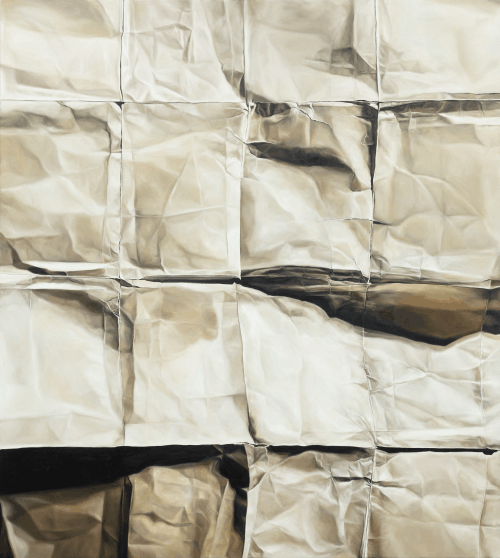
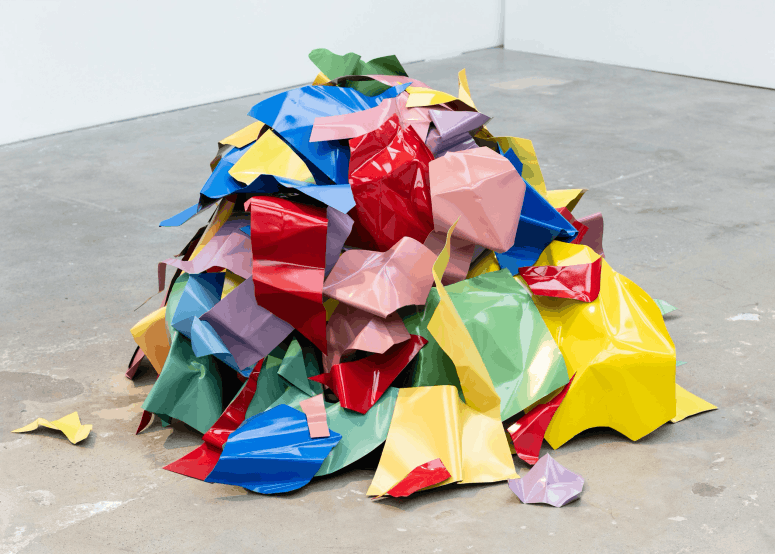
The work also represented a new direction for Go, whose hyperrealistic oil paintings have long focused on the illusion of folded and layered paper, recreating its textures and dimensionality through trompe l’oeil techniques.
Her works have explored themes of girlhood nostalgia, memory, domestic spaces, womanhood, loss, and resilience.
‘Significant departure’
According to its exhibition notes, small vast things is a “significant departure” from the creased, folded, and worn paper forms that “have become emblematic” of Go’s practice.
The notes trace this departure to a “period of relative quietude in 2025,” when Go “devoted considerable time to cultivating a garden at her studio.” As the garden “gradually developed” into a small ecosystem inhabited by butterflies, caterpillars, and dragonflies, she “became increasingly attentive to subtle cycles of growth, decay, and renewal,” including “the falling of leaves” and “the delicate traces they leave behind.”
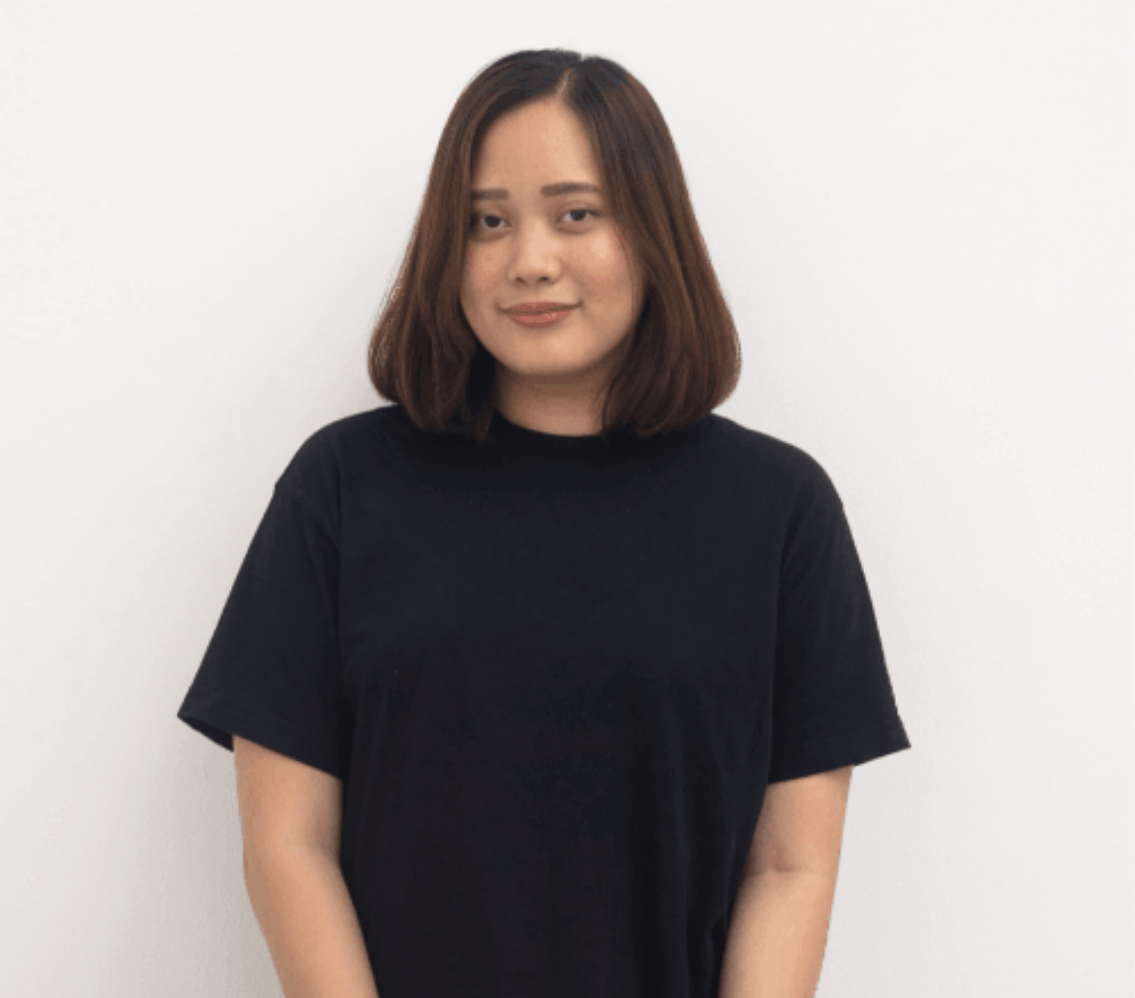
The transition extended beyond subject matter. Go experimented with smaller brushes, including needle brushes, and expanded her palette beyond the neutrals and warm whites associated with her earlier works, incorporating “cooler whites and vivid colors like cadmium greens, lemon yellows, amethyst, and other blues and violets.”
Yet paper remained present in the exhibition through her cocoon sculptures, constructed from paper cut into stringlike strips and knit using standard crochet tools. The exhibition notes describe them as symbols of Go’s “latent identities and unrealized potentials.”
The period also led Go toward fiction, which the exhibition notes describe as a source of “refuge and self-recognition” and a way to explore interconnectedness.
‘May show ka ba?’
When small vast things opened, “turning season” became a point of surprise for Orencio.
In an interview with radar, she recalled receiving messages from people who thought the painting was hers, wondering whether they had missed an announcement for a new exhibition.
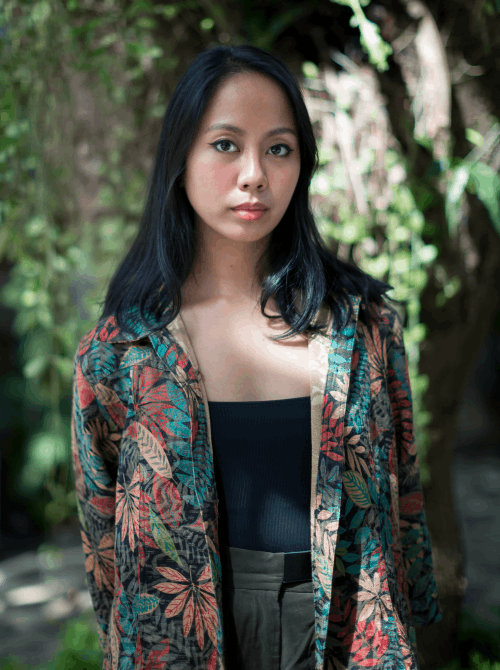
One message captured the confusion behind the reactions: “May show ka ba?”
The question was made more striking by the fact that Orencio and Go weren’t unfamiliar with each other’s practices. The two first crossed paths as students at the University of the Philippines College of Fine Arts, with Go in Studio Arts and Orencio in Visual Communication.
“We’ve been acquainted ever since,” Orencio said, adding that she and Go remained cordial over the years and would congratulate each other on exhibitions.
What made the comparison difficult to overlook, she said, was that it involved not a stranger, but a fellow Iska and peer. “We are very much aware of each other’s body of work, and there was mutual respect in each other’s practice,” she said.
Unsure how to process “turning season” when she first encountered it, Orencio said she still congratulated Go via Instagram DM—and received a thank you in response.
At the time, Orencio said she thought “turning season” might only be a “supplemental piece” within the exhibition’s larger concept. But realizing it had become one of the exhibition’s central pieces, Orencio said she was “surprised and very much disappointed.”
“I reached out to [Ayka] on Instagram to try to address the similarities in our work, and received no response from her,” she said.
Orencio said she’d never had to address “this kind of problem” in her years of painting. “I’m just trying to contain my frustrations na lang din,” she said.
Despite the experience, Orencio said she remains focused on her practice. “Tuloy-tuloy pa rin magtrabaho regardless,” she said.
Orencio said she is now preparing for her next solo exhibition, scheduled for 2027.
Across different periods
Artists all over the world have long turned to flowers, leaves, and the natural world as subjects. Wilting blooms, dried leaves, and organic remains can be seen in canvases across different periods and traditions.
Within Philippine contemporary art, flora has been explored through many distinct visual approaches. Silverlens itself has represented artists who engage with botanical forms, including Yvonne Quisumbing’s Apothecary: Prelude (2020) and Sanctuary (2025), and Geraldine Javier’s A Tree is not a Forest (2023). Elaine Roberto-Navas, also represented by Silverlens, explored vegetation in “Bahay Kubo,” mounted at Giant Art Dwarf Space in 2025.
The artistic fascination with decay and organic remains, meanwhile, has its own long history.
Swipe or click arrows to see photos
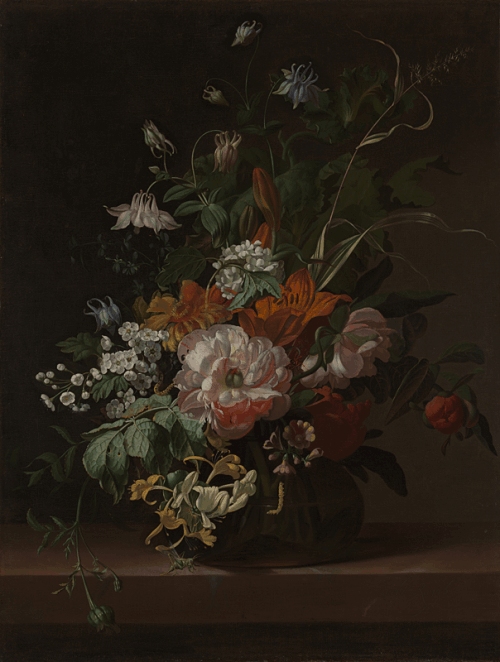
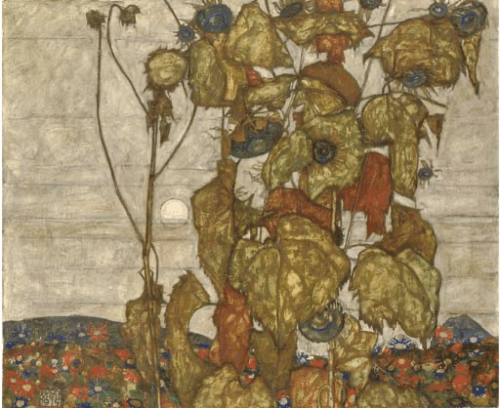
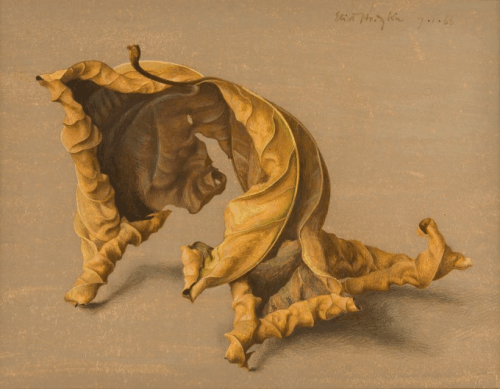
Dutch Golden Age painter Rachel Ruysch captured flowers at the edge of wilting in works such as “Flowers in a Vase” (about 1685)—drawing from the vanitas tradition, where beauty served as a reminder of impermanence and mortality.
Austrian Expressionist Egon Schiele also turned flowers into symbols of decline. Works like “Sunflowers” (1911) and “Herbstsonne” (1914)—also known as “Wilted Sunflowers” and “Autumn Sun II”—recast the sunflower as an image of decay rather than vitality.
English painter Eliot Hodgkin devoted much of his career to botanical studies, producing dozens of paintings of dead leaves.
The long and the short of it: No artist can claim ownership over dead leaves, flowers, or the natural world as subjects. What becomes distinctive is the way an artist transforms these shared elements into a recognizable visual language.
And that distinction is where Orencio’s discomfort lies.
“I understand that I don’t own painting about nature, gardening, dried leaves, flowers,” she said. “Anyone can paint and feature these readily available elements with no issues, in any form of art.”
She said the issue begins when another work becomes “undeniably and inexplicably the same as a peer’s existing body of work.”
“There should always be room for delicadeza in this kind of situation,” she added.
Copyright
The distinction between a shared subject and a specific artistic expression is central to copyright law.
Section 175 of the Republic Act No. 8293, or the Intellectual Property Code, states that no protection shall extend to “any idea, procedure, system, method or operation, concept, principle, discovery or mere data as such, even if they are expressed, explained, illustrated or embodied in a work.”
In an email to radar, the Intellectual Property Office of the Philippines explained that based on this provision, artistic style—which may fall within ideas, concepts, and methods or operations—”can be copied.”
However, the IPOPHL pointed out that copyright protection applies to the resulting work or expression rather than the underlying idea or concept. It cited the case of Joaquin v. Drilon, where the Supreme Court ruled that a television program’s format itself (i.e., a dating game show) isn’t protected by copyright, but its recorded episodes are.
Applied to visual art, copyright draws a line between the subject and the expression. Wilting blooms, dried leaves, and organic remains may be freely used by artists. What the law examines is how these elements are shaped into a specific work—and whether that expression was copied.
In the case of Orencio and Go, the issue isn’t who gets to paint dried flora. It’s whether the particular creative choices that define their respective works have crossed the line between influence and imitation.
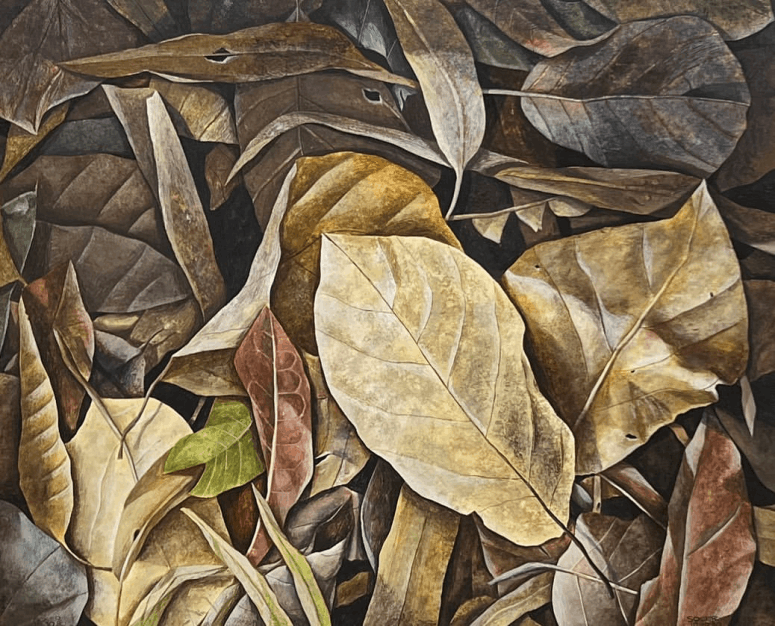
That discussion also brought earlier Filipino botanical works into the conversation. One of these was Soler Santos’ “Leaves” (1980), first exhibited at Luz Gallery in 1981. Executed in tempera on board, the 20-by-24-inch painting presents a dense arrangement of whole tropical leaves rendered with crisp lines, sharp shadows, and meticulous texture.
While both Santos and Orencio draw from botanical remains, their approaches differ. Santos focuses on the structure and physical presence of intact dead leaves, while Orencio builds her compositions around rotted, fragmented floral forms arranged in a uniform, diffused flatness—making deterioration itself part of the image.
For Orencio, then, any comparison with Santos misses the point. Her concern isn’t ownership over dried flora as subject matter, but the particular way those elements are arranged, treated, and transformed into a recognizable visual language.
It’s in this context that “turning season” drew comparisons—and confusion—over its treatment of botanical decay and organic fragments.
For Orencio, the concern was not limited to a single series, but to a visual language she had continued developing across multiple bodies of work.
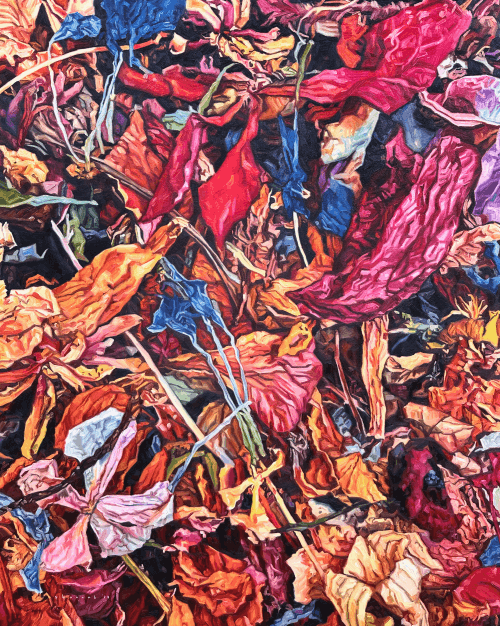
“That specific imagery and the evolving concept are something that I worked hard to develop in the years I’ve been active in the industry,” Orencio said. “And [Ayka] is well aware of that fact.”
Under copyright law, however, the duration of that development doesn’t create ownership over an art style.
“Style as such is not protected by copyright law no matter how long it has been employed,” the IPOPHL said, though warned that an individual may still be found liable if they copied the protected artistic elements of an original work.
Similarity alone, the IPOPHL stressed, doesn’t establish copyright infringement. What matters is whether the work itself was copied.
“What needs to be original,” it added, “is the work. Not the idea, concept, or manner of operation.”
Beyond copyright
The law may draw a line between an unprotected style and a protected work, but Orencio’s concerns extend beyond whether a claim can succeed in court.
For her, the issue is also about artistic responsibility: how artists engage with influences, acknowledge existing practices, and create space for the work of their peers.
“It’s okay to be inspired. It’s alright to come from a mentorship and retain influences from the people who taught you,” Orencio said. “But with whatever material you feel inspired by, you do your due diligence: review similar works, ask for permission, credit the source. ‘Yan naman ang unang itinuturo sa ‘min sa UP College of Fine Arts.”
Beyond the legal question, Orencio said the issue also raises questions of artistic ethics—an area copyright law doesn’t determine.
“Many spoke up in my favor,” she said. “Kaya nga naging issue ito to begin with, kasi maraming nag-react na in-the-know sa Philippine art scene.”
Orencio noted that the issue also raises concerns for younger artists who may not yet have the platform to defend their work.
“What happens if may ibang taong gumamit ng idea mo habang hindi ka pa nabibigyan ng bigger breaks?” she said. “Sa mga young talent na hindi pa nabibigyan ng malaking platform for them to speak up?”
She questioned what message silence could send to emerging artists.
“Do we sweep it under the rug?” Orencio asked, warning that doing so could normalize the use of others’ ideas without proper acknowledgment.
The IPOPHL pointed out that its mandate is limited to administering the legal provisions of the Intellectual Property Code.
“[The agency] cannot make pronouncements on ethical issues,” it said, “except to promote and encourage respect for authors’ moral rights of attribution and integrity relative to their artistic works or expressions.”
radar reached out to Go for comment. During the reporting period, she remained active on social media but had not responded to our inquiries as of press time.
radar also reached out to Silverlens for comment, but the gallery has likewise not responded as of press time. Comments on its Instagram posts about Go’s exhibit—dated July 13, July 22, and July 25—were also turned off.
For Orencio, the issue ultimately reflects a wider concern among artists.
“We discredit hours of hard work and research,” she said. “We fail to be good examples of creatives working with proper ethics and integrity.”