A flowering plant that had apparently been hiding in plain sight for more than a century has finally been recognized as a new species in the forests of Apayao, Northern Luzon.
Named Medinilla bulutiorum, the plant was documented in Barangay Eva Puzon, Calanasan, and formally described in the international scientific journal “Phytotaxa” on November 18, 2026.
What makes the discovery remarkable is that the plant is reportedly common in its documented locality. Yet, despite its presence in the area, it had escaped formal scientific recognition for more than 100 years.
The research team includes Jiro T. Adorador and Zhereeleen D. Meneses-Adorador, curators of the Botanical Herbarium at the University of the Philippines Los Baños (UPLB) Museum of Natural History.
A relative of the familiar kapa-kapa
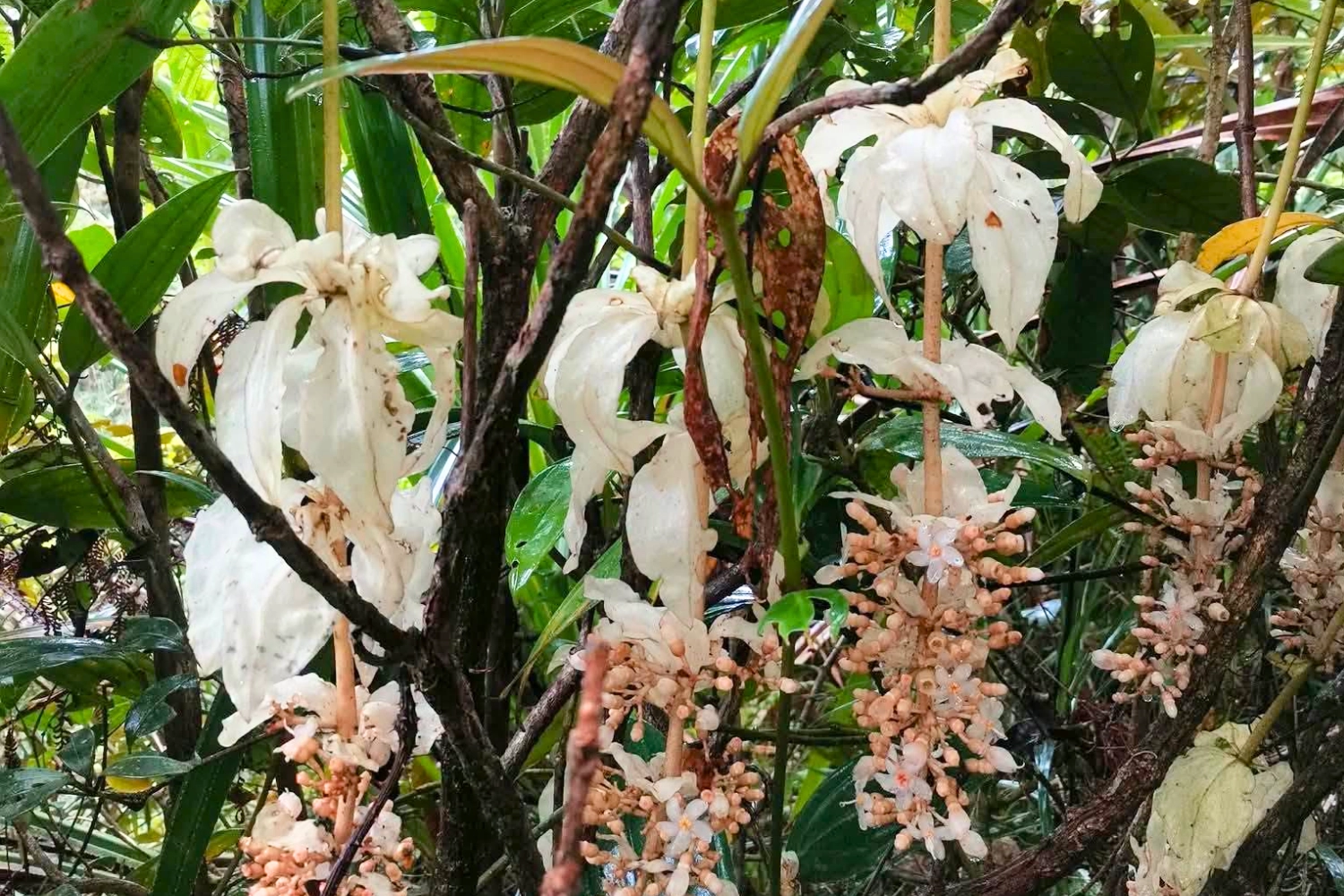
The newly identified plant closely resembles kapa-kapa (Medinilla magnifica), an ornamental species known for its spectacular hanging flower clusters.
Both plants produce long, drooping inflorescences with large, showy bracts, which are modified leaves surrounding the flowers.
However, researchers identified several characteristics that distinguish the new species.
These include rounded branchlets, smaller stalked leaves with five to seven prominent veins, densely arranged flowering branches, and a distinctive brown, scaly covering on its whitish floral structures.
These differences establish Medinilla bulutiorum as a species distinct from its better-known relative.
Mamed after Apayao’s founding father
The species was named in honor of the Bulut family, particularly the late Elias K. Bulut Sr., widely recognized as the founding father of Apayao Province.
According to the researchers, the name acknowledges the family’s leadership and stewardship of ancestral lands.
The tribute connects the scientific discovery to the province’s history and the importance of protecting its natural heritage.
Hidden in plain sight for over a century
The discovery raises an intriguing question: How could a flowering plant reportedly common in its locality remain scientifically unrecognized for so long?
The answer highlights how much of the Philippines’ biodiversity remains insufficiently studied, particularly in remote forest ecosystems.
Medinilla bulutiorum is at least the third plant species newly described from Calanasan since 2025, following Vaccinium kilangensis and Medinilla calanasan.
Its identification demonstrates that discovering a new species does not necessarily mean finding an extremely rare organism. Sometimes, it means recognizing something that has been growing in a forest for years without receiving scientific attention.
Why this discovery matters
The discovery underscores the ecological importance of the Apayaos Biosphere Reserve, a UNESCO-recognized site considered one of the Cordilleras’ last remaining forest frontiers.
Researchers also updated the known distributions of five related Medinilla species and reinstated M. vanoverberghii as a distinct species.
For now, Medinilla bulutiorum has been preliminarily classified as Data Deficient under the International Union for Conservation of Nature (IUCN) Red List criteria.
This means scientists still lack sufficient information to determine how threatened the species may be.
The scientific paper was authored by Jiro T. Adorador, Zhereeleen D. Meneses-Adorador, Breiden Dela Cruz, Sarah Mae C. Batil, Jayson C. Ibañez, and J. Peter Quakenbush.
The discovery delivers an important reminder: Philippine forests may still harbor countless species that science has yet to document.
And some of them may have been hiding in plain sight all along.