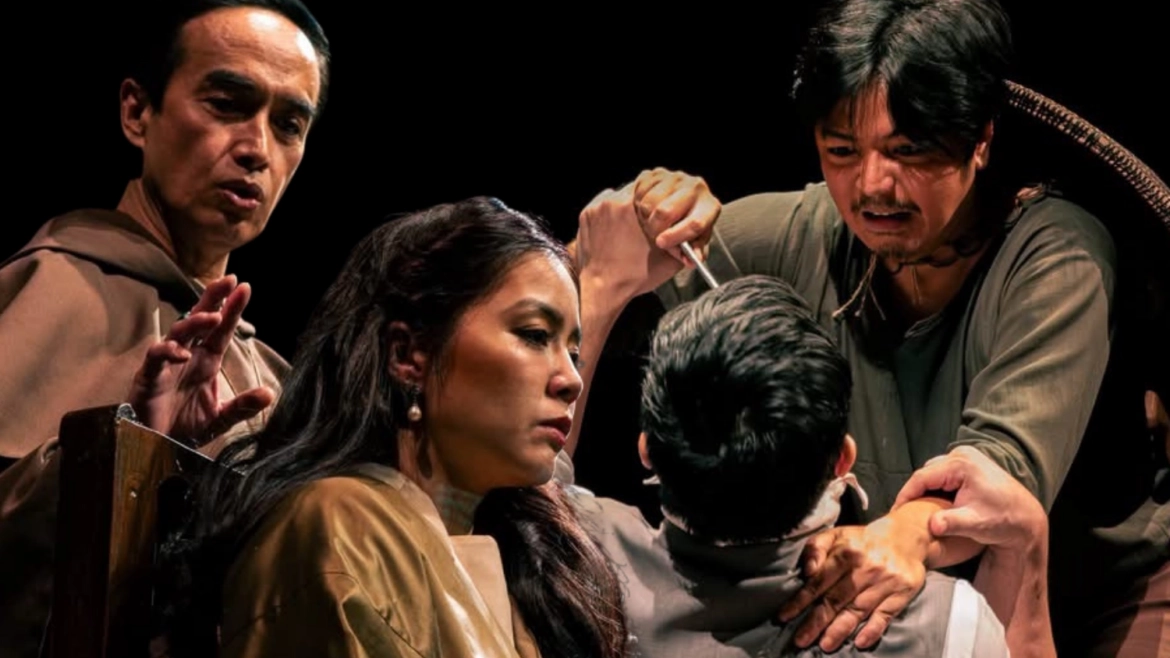
Palanca Hall of Famer Joshua Lim So’s adaptation of Sophocles’ classic play interestingly transposes plague-ridden Thebes into a mythical Tebes inundated by severe monsoon rains.
Eddie (a competent Martin del Rosario) and Jaja (Eula Valdez, partly regal and mostly jologs) stand in for Oedipus and Jocasta, respectively—caught in the middle of trying to resolve a political crisis that involves killing and political intrigue. In the process, they discover a long-lost family connection.
In this adaptation, So takes the beginning and end of the play as an inspiration and then creates a new set of characters and deviations in the plot to retell a classic tale. The hero and his wife are turned into dishonorable politicos.
Tiresias is now Tom/Teresa, a transwoman who heads an assassination group. Creon is Atty. Crey (the reliable Bong Cabrera). There’s the introduction of a union leader. The shepherd who reveals what happened to the baby Oedipus is a wise-cracking Yaya Cora (hilarious Sheryll Ceasico, who I was hoping would have remained comic until the end).
A short scene with the children is added, where we see the PWD-ness of Paul, the couple’s child (hint, hint). Then there’s the Greek chorus in the form of enjoyable wailing spirits.
When viewed as an adaptation, some of the plot transpositions are awkward. How, for example, does one contemporize the prediction of an Oracle? I caught the term “sabi-sabi,” which waters down the implication that “prophecy” in Greek drama: that which is something foretold and yet cannot be avoided. Or the narrative about solving the riddle of the Sphinx? (Absent in this play.)
Eddie’s cellphone call to his Mandarin-speaking mother—a dramatic way of finally solving the mystery of his identity—was a jolt.
More importantly, as written, Eddie and Jaja, despicable as they are, do not elicit the audience’s sympathy, which is what Sophocles achieves in dramatizing hubris. In the original, King Oedipus was the good man who twice saved Thebes. The first by solving the riddle of the Sphinx. The second time, from the plague by being relentless in uncovering the truth, even when it meant discovering his sordid past and causing the death of his wife.
In the original, Oedipus, in grief and remorse, blinds himself and accepts his fate. In this iteration, the audience is not moved by the tragedy that has befallen Eddie. Yes, we might be affected by his grief, but unlike the original Oedipus, he hasn’t solved anything at the end of the play. Eddie simply intones a litany of apologies to the fallen Jaja, blinds himself with the pointed nails of his wife, then crawls to the expensive swivel chair to rest while being comforted by the blind Tess.
Nonetheless, So’s contemporization of the plot could push the play into a more original conception of divine retribution.
Viewed as a new play inspired by Oedipus Rex, the playwright and its director Tuxqs Rutaquio, could transform this play into a scathing political satire about evil political dynasties who deserve their comeuppance.