REVIEW: ‘Fiestas y Muertos,’ the new ‘Noli Me Tangere’ play, is a magic lantern
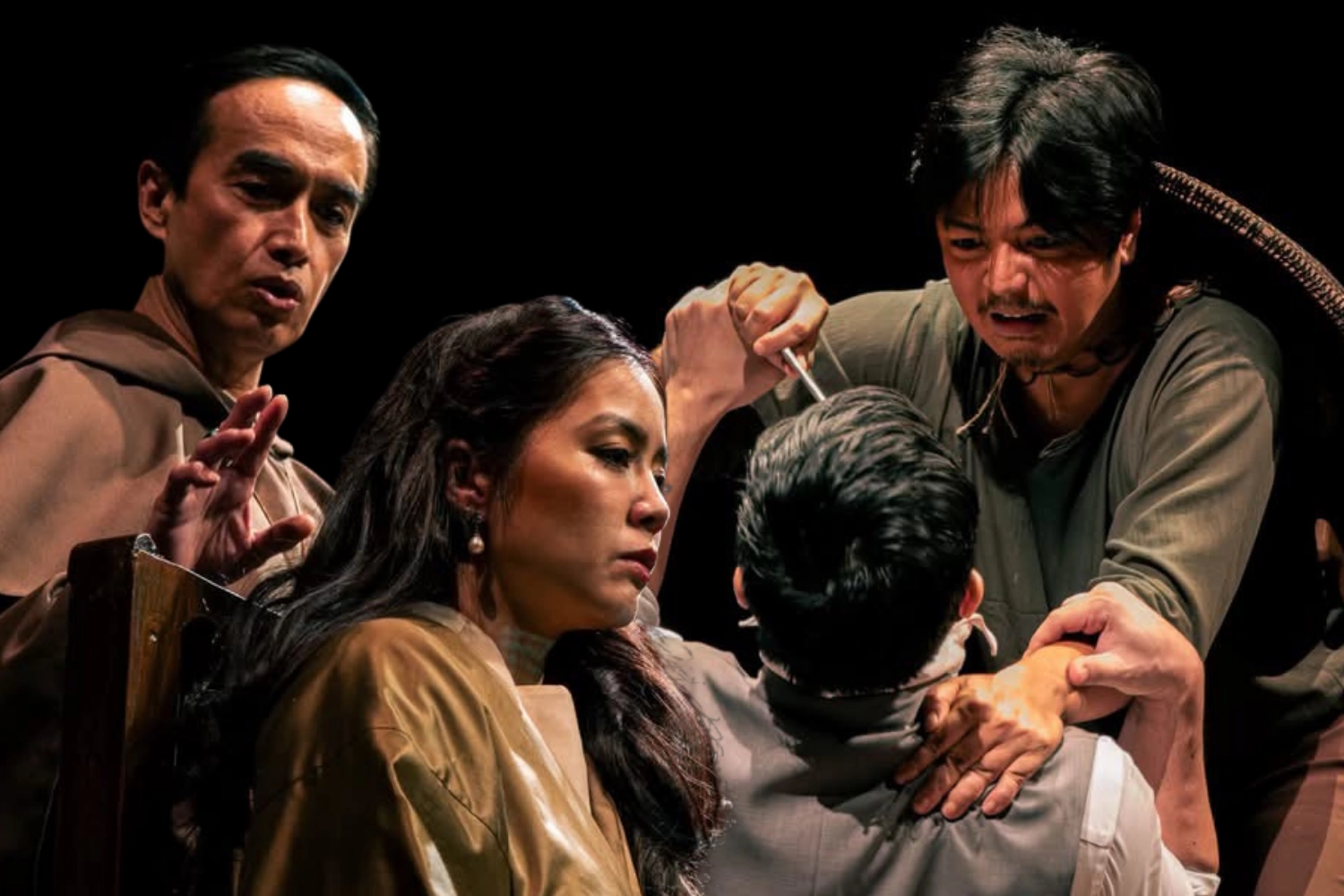
“Fiestas y Muertos,” a production of Dulaang Unibersidad ng Pilipinas, joins the list of the many adaptations of “Noli Me Tangere,” the epic novel of José Rizal which, in its relevance, refuses to die.
This production, as the title suggests, takes on the themes of inebriations and desolations. In execution, it manifests as a magic lantern in a dark night.
We witness shadowy images of the doomed town of San Diego whirling endlessly around a fire. We are mesmerized with ghosts of characters that continue to haunt the national psyche more than a hundred years since the novel’s publication.
How irritating that the “Noli” continues to mirror our times.
It makes me wonder whether our inability to escape its reality is because it keeps imprisoning us in our assessment of ourselves. Stated differently, would it be much better if in adapting the “Noli,” we begin to slowly break out of its stylistic clutches, polish the parts worn out because of overuse, make it breathe new air, and most importantly, impose an intentionality in recreating a new way of reading it. The idea is to make it less reverential and more in service of the future we envision for ourselves.
In some ways, this production does that with their focus on Pilosopo Tasyo—as a cranky old woman named Inay Dorang—anchoring its ideological heart. Because, yes, we need to be angry and get rid of a sh*tty government and its modern-day frailes and manyak saserdotes.
Other than that, this adaptation is genuinely faithful to Rizal’s novel capturing its comedy and satire, its earnestness and ironies, its melodrama and insanity. The “Noli” is a novel that I often go back to because of these reasons.
Obviously, it is a condemnation of the abuses of a colonial government. To me, its greatest accomplishment is in Rizal’s choice of characters and its orchestration of plot and the twists he renders in the most unexpected places.
The cast of “Fiestas y Muertos” are magnetic, true to Rizal, yet original in nuances. As Elias, Ross Pesigan stands out playing the character out of heartbreak and a heroism that is not manufactured. Where often the Elias character is played as a weak caricature of Bonifacio, Pesigan inhabits the character in its most basic human trait: an indio at the end of his rope.
The novel is episodic as it shifts points of view in every chapter—a literary device that, if not crafted well in dramatic form, can feel like a speed bump.
As a solution, the playwright in many scenes lifted some of the descriptive portions from the novel to create a sense of dramatic continuity. It works well with the scenes that show Sisa’s descent into madness or the monologues that reveal the backstory of the characters.
But some of the narration is repetitive and slows the action, while certain monologues feel overly earnest, losing their connection to the dramatic momentum of the scene. This is particularly apparent in moments when “the lesson” needs to be delivered.
Still, Peewee O’hara played an interesting Tasyo. Text-wise, her lecture to Ibarra as a substitute for a lecture to the audience read like a short essay on resilience.
On another point, Tasyo was established as the historian who recorded the story of San Diego and saw through the despicable system that held it together. Re-writing him as a woman signals an effort to inject new thought into the novel—an effort at conversation with the original.
And though there is an effort to weave her into the other parts of the narrative, Tasyo seems to disappear in the middle of the play and then again re-appear near the end. Here, I sense an effort and then a hesitancy in the adaptation of the original text.
But consider this: Her/his character holds the key to change. S/he writes in code to keep secrets away from the oppressors and develop the systems of resistance within her network. What dramatic payoff it could have been if the playwright also wrote a scene where her notes become part of the treasure Ibarra and Elias bequeath to Basilio and Salome at the end of the play.
In this production, Ms. O’hara is a presence as she opens the play in thunderstorm and lightning. I miss her character appearing in the end of the play saying something wonderful.
Some hope, perhaps, that memory will see us through because the “Noli” is a very, very sad novel. Rizal makes us empathize with these characters. And then, all of them dies—every single one of the characters I’ve learned to love dies!
I’ve had enough. And I longer want to feel sad each and every time I see it adapted on stage.
The “Noli” is a novel I read every 30th of December. This production reminds me to keep giving the book as a gift to every young person because it holds a powerful sadness that will want us to work for a world that we deserve.
But first, we have to destroy the evil magic lantern.
Editor's note
“Fiestas y Muertos” is directed by José Estrella and adapted by Andrew Estacio from the Filipino translation of the novel by National Artist for Literature Virgilio Almario.
The cast includes Jerom Canlas as Crisostomo Ibarra, Ross Pesigan as Elias, Justine Peña as Maria Clara, Elora Españo as Salome, Peewee O’Hara as Pilosopo Tasyo, and Jojo Cayabyab as Padre Damaso.
The play runs from Oct. 23 to Nov. 15 at the IBG-KAL Theatre at the University of the Philippines Diliman.
Tickets are available here.
READ:
‘Anino’ on stage: Trilogy of terror explores different forms of fear
Rito Asilo
October 26, 2026

My first 4DX movie experience got a little out of hand
Nikko Miguel Garcia
October 16, 2026
‘Little Big Star’ alum lands Best Performance nod for ‘& Juliet’ in Australia
Rito Asilo
October 13, 2026
Tags: Andrew EstacioCrisostomo IbarraDulaang Unibersidad ng PilipinasEliasElora EspañoFiestas y MuertosIBG-KAL TheatreInay DorangJerom CanlasJojo CayabyabJosé EstrellaJose RizalJustine PeñaMaria ClaraNoli Me TángerePadre DamasoPeewee O’HaraPilosopo TasyoRoss PesiganSalomeSan DiegoSisauniversity of the philippinesUP DilimanVirgilio Almario