The palm is native to the Philippines and other parts of tropical Asia and the western Pacific.
Imagine a palm that has stood for decades, surviving storms and droughts while generations pass beneath its enormous leaves.
Then, one day, something extraordinary happens.
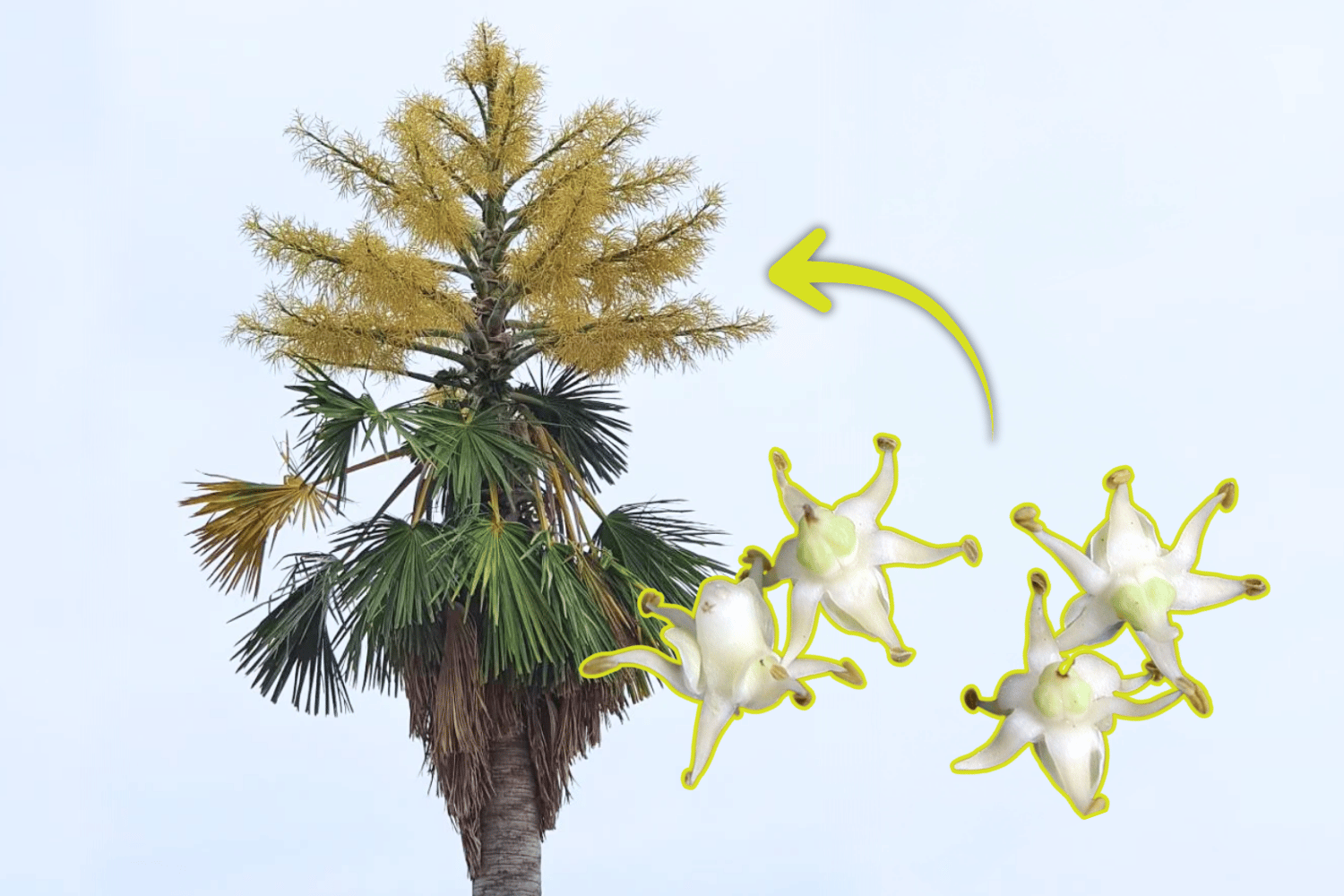
A towering cluster of millions of tiny flowers emerges from its crown. Fruits follow. And when it is all over, the palm dies.
This is the remarkable life cycle of the buri palm (Corypha utan), one of the Philippines’ most useful palms.
It blooms only once
Buri is monocarpic, meaning it reproduces only once in its lifetime. It can spend decades growing and storing energy before producing a massive terminal inflorescence several meters high.
The flowers eventually become thousands of fruits and seeds. Having poured its resources into this final reproductive effort, the palm gradually dies.
Unlike the coconut, which repeatedly flowers and fruits, the buri essentially spends a lifetime preparing for one spectacular finale.
A Philippine ‘tree of life’
Native to the Philippines and other parts of tropical Asia and the western Pacific, buri can grow into an imposing palm with a thick trunk and enormous fan-shaped leaves.
Filipinos have found uses for nearly every part of it.
Its leaves and stalks produce buri fiber, raffia and buntal. Buri is woven into mats, baskets and fans; raffia becomes flexible material for handicrafts; and fine buntal fiber is famously woven into traditional hats.
Its usefulness extends to food. Starch extracted from the trunk can be processed into landang, traditionally used in Visayan binignit. Buri sap can be fermented into tuba, made into vinegar or boiled into pakaskas, a traditional palm-sugar delicacy associated with Isla Verde, Batangas.
Its leaves have also been used for roofing, household products and palaspas for Palm Sunday.
Across Asia, Corypha palms also have a centuries-old connection to palm-leaf manuscripts, on which religious texts, literature and historical records were written before paper became widespread.
For decades, people can harvest and transform what the buri provides while the palm continues growing.
Then comes its grandest act.
It flowers once, produces the seeds of the next generation, and dies.
For the buri, blooming is not another season. It is the culmination of a lifetime.
READ: