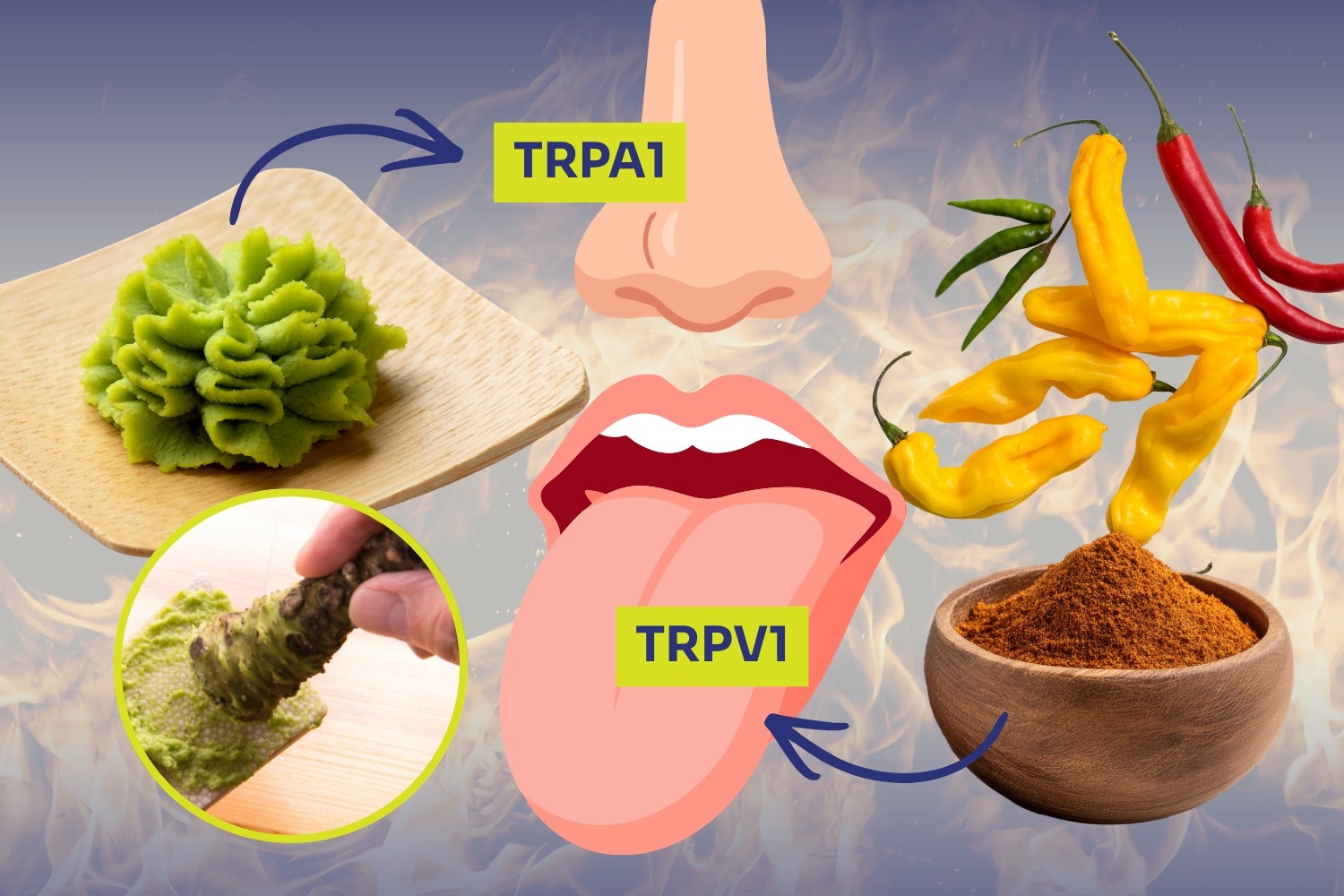
They each trigger two different receptors, but capsaicin from peppers stays on your tongue while AITC from wasabi goes straight to your nose. Photo illustration by Cas Aseoche
Curious about why you can sometimes handle the spice of peppers but not the heat of wasabi?
It all has to do with the different receptors on your tongue and nose that get triggered when you eat them.
For chillies, they have capsaicin, an oil that triggers a pain sensor on your tongue called the TRPV1 receptor. Meanwhile, wasabi and mustard have allyl isothiocyanate (AITC), an oil that quickly turns into gas and goes straight into your nose to trigger the TRPA1 receptor.
This is why your tongue burns when you eat peppers, but it feels like only your nose and throat heat up when you eat wasabi.
Wasabi usually becomes more alarming to those with nasal problems such as allergic rhinitis, whereas people who are sensitive to heat in general get the most affected by chili peppers. Those who suffer from both should be wary of both types of spicy foods, however.
Another usual spicy ingredient would be peppercorns, which bring out the alkaloid piperine. This one also triggers the TRPV1, similar to capsaicin.
So remember: While capsaicin and AITC are both oils, capsaicin stays on your tongue for that fiery taste, while AITC evaporates into gas to tickle your nose’s senses.
Wasabi and chilies developed spiciness as defense mechanisms, but don’t let that stop you from adding a kick to your meals.