Skip to content Skip to sidebar Skip to footer

A new generation of women writers is finding its roots. Through the zine “Salubong,” RUWA bridges the gap between urban artists and peasant women, proving that the fight for food security is a feminist frontier.

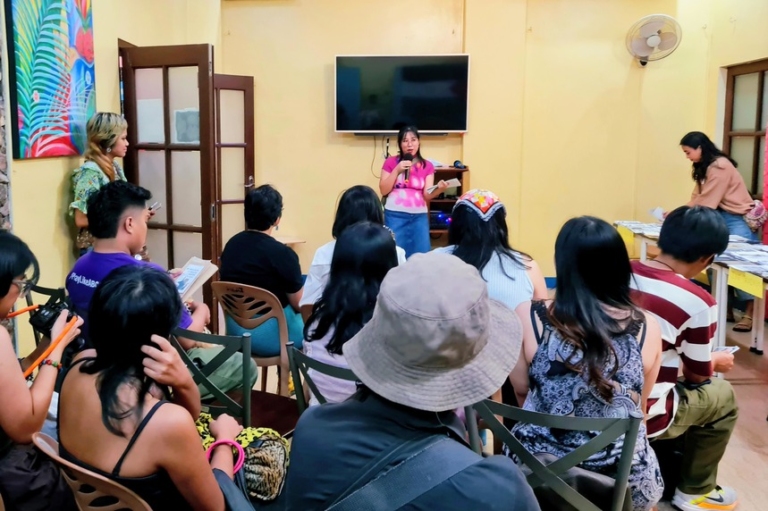
On a cool December evening, a room filled with writers, artists, and students is brimming with energy and ideas unique to the local indie press scene. At the 16th year of BLTX (Better Living Through Xeroxography), the air is thick with the scent of paper and purpose. A Palestinian flag hangs as a silent sentinel at the back; zines are traded like currency; an open library invites the quiet.

But tonight, the focal point isn’t just art for art’s sake. It is a “salubong“—a meeting point, which is also the title of the BLTX newest zine. Rural Women Advocates (RUWA), a volunteer group under the peasant women’s federation AMIHAN, is launching their latest zine, a compendium of poems and monochromatic illustrations printed via photocopying machine. 

In a country where the hands that harvest our rice are often the ones that go empty, this collection of poetry aims to do the impossible: bridge the widening gap between the urban consumer and the rural producer.


The great disconnect

Rice is the heart of the Filipino dining table, making up 50% of our typical meals, according to the 2023 National Nutrition Survey. Yet, the hands that feed us are starving. With national rice output stagnant since 2017 and a heavy reliance on imports, our agricultural backbone is fracturing.

For the average Metro Manila professional, the life of a peasant farmer feels like a distant, pastoral myth. But Pat Quintos, organizer and host of the launch, argues that this detachment is artificial—and dangerous.

“We seem to be detached, nahihirapan tayong kumonekt dun sa buhay natin sa buhay ng mga magsasaka,” Quintos explains. “Pero kung titignan mo kasi nang maigi, food producers sila. We need food everyday. Pero bakit tayo nahihiwalay?”

The separation isn’t just physical; it’s economic. Quintos points out that the high inflation hitting city dwellers is the direct sibling of the landlessness and exploitation facing farmers.

“Hindi lang nila laban, laban talaga natin,” Quintos stresses. “Kasi kung ang mga magsasaka ay malayang nakapagbubungkal, nakakapagpayabong ng mga pananim nila, direct effect ‘yan. Like right now, yung pagkain natin sobrang mahal. Kasi import dependent, export oriented tayo. Pero kung ang lupa ay mababawi ng mga magbubukid, walang interes ng mga bureaucrat-capitalist at ng mga imperiyalistang bansa: walang malaking patong, walang middleman.”
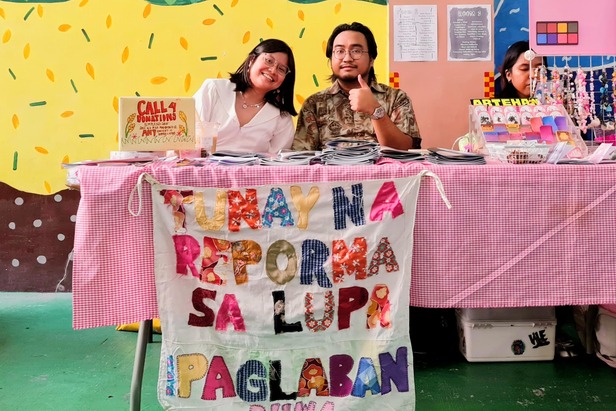
RUWA BOOTH (1)
Copies of the “Salubong” zine laid out for a new generation of readers. As organizer Pat Quintos notes, the ideas planted in these pages are meant to “propagate,” encouraging city-dwellers to re-establish their lost connection to the farmers who nourish the nation. This International Women’s Day, RUWA reminds us that every zine traded is a step toward a shared struggle.


The multiplier effect of art

In the academe, poetry can feel elitist. At a RUWA launch, it feels like a weapon. The theme of the zine, “Lupa Bilang Sangandaan” (Land as Crossroads), explores everything from nostalgic love to revolutionary optimism.

For Quintos, poetry is akin to a seed. It takes root in the reader and propagates. “Basically naman ang nilalagay mo sa tula mga ideya. Kumakalat siya. Kung anong nilalagay mo dun, nagpopropagate,” he says. He invokes the memory of the late Dr. Rafaat Alareer, the Palestinian professor killed by an Israeli airstrike in 2023, whose poem “If I Must Die” became a global anthem of resistance.

“Nung nasa pahina pa lang siya, may impact na siya. Pero nung namatay na rin yung writer, iba rin yung binigay niyang lakas sa mga taong lumalaban,” says Quintos.

By launching at BLTX, RUWA taps into a “multiplier effect.” The artists and students who buy the zine become vessels for the message.

“Mas broad yung mare-reach, kasi mas emotional yung art—marami kang mata-touch,” Quintos explains. “May multiplier effect rin yan… So may isa ka lang tao na ma-inspire sa tula mo, marami siyang pwedeng puntahan. Hindi siya exactly direct effect. Sanay tayo sa instant eh. Pak, instant effect! Pero may isa ka lang taong ma-touch, malayo na ang mararating mo.”

Quintos hopes the zine inspires city folks and urban artists and encourages them to re-establish their lost connection to farmers and the land that they till.

"Hindi lang nila laban, laban talaga natin." The launch of Salubong serves as a reminder this International Women’s Day that the fight for the land is a collective one. Through verse and voice, RUWA and its supporters dream of better worlds where no one—from the fields to the city—is left behind.


The uprooted and the remembered

Among the contributors is Gabe (a pseudonym), a creative writing graduate from UP Diliman who recently returned from postgraduate studies in London. Her poem, “Ilang Serye ng Pagsalubong,” draws a line between her own experience of being abroad and the forced displacement of Filipino farmers.

“Andun pa rin yung root na dati silang magsasaka, na uprooted sila from the land that they’re from. So doon rin galing na ako rin mismo nung lumabas ako ng bansa para mag-aral, na uproot rin ako in a way,” Gabe shares.

When asked about her inspiration for the poem, she recalls meeting members of the urban poor sector as well as overseas Filipino migrant youth and workers, many of whom come from farming backgrounds. 

She views her writing not just as “self-expression,” but as a directed call to action on both an individual and collective level.

“All expressions are political in nature. So parang ito, mas directed lang siya to a specific call to action. Call to action siya… how do you see your relationship to land? How do you see your relationship to other sectors in society that you may not necessarily be a part of, but that you will find that you are actually so connected to?”

Gabe stresses that poetry isn’t just about expression—she claims she has already moved beyond personal expression in writing. She is quick to emphasize, though, that poetry isn’t the solution to landlessness: “Ang lupa ay lupa, ang tula ay tula”—it can preserve a memory in an era of historical revisionism.

“In a time where everything is forcibly erased, there’s lots of historical revisionism; these are concrete texts and concrete proof that there exists a memory. It’s also a memory that I myself as an individual am not separate from the struggles of farmers.”

A song for “Balang Araw”

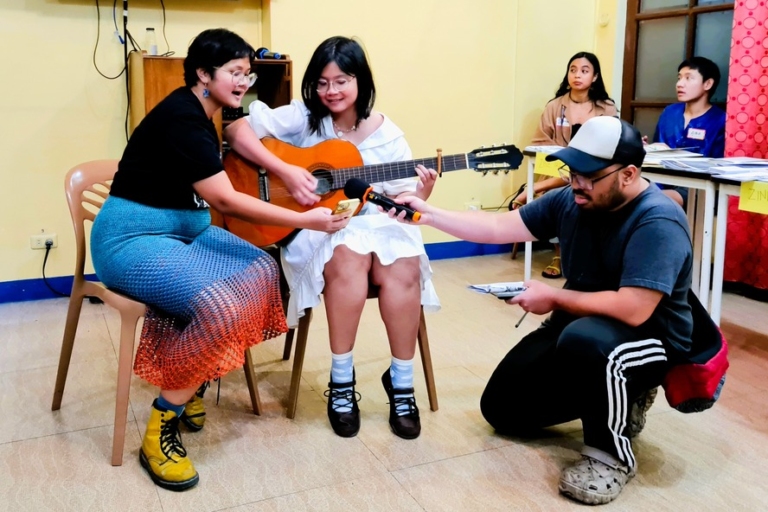
Gita, a teacher, and Sari, a theater actor, use music to break down the barriers of intimidating lectures. For RUWA, these cultural moments are essential for engaging the urban youth, helping them realize their societal role in amplifying the calls of peasant women who remain invisible in the city's rush.


As the evening winds down, the room softens. The “lectures” and statistics give way to the cultural—the “enganyo” (allure) that brings people in. Gita, a teacher, picks up a guitar. She notes that while lectures can sometimes be intimidating, art creates a “super open” space for the city youth to realize their societal role.

Alongside Sari, a theater actor, they lead the room in song. They sing “Balang Araw,” written by the late Ericson Acosta, an environmental activist and poet who was extrajudicially killed three years ago.

“Lahat ng ito, lahat sa atin ‘to balang araw,” they sing.

It is a haunting coda to a night of “salubong.” Through the pages of a photocopied zine, the city has met the country. And in that meeting, the struggle for land becomes a shared song for a better world.

Here, Gabe’s words echo memorably: “Dream better worlds. Dream better worlds where we’re all included and no one’s left behind.”

“In a time where everything is forcibly erased, there’s lots of historical revisionism; these are concrete texts and concrete proof that there exists a memory.