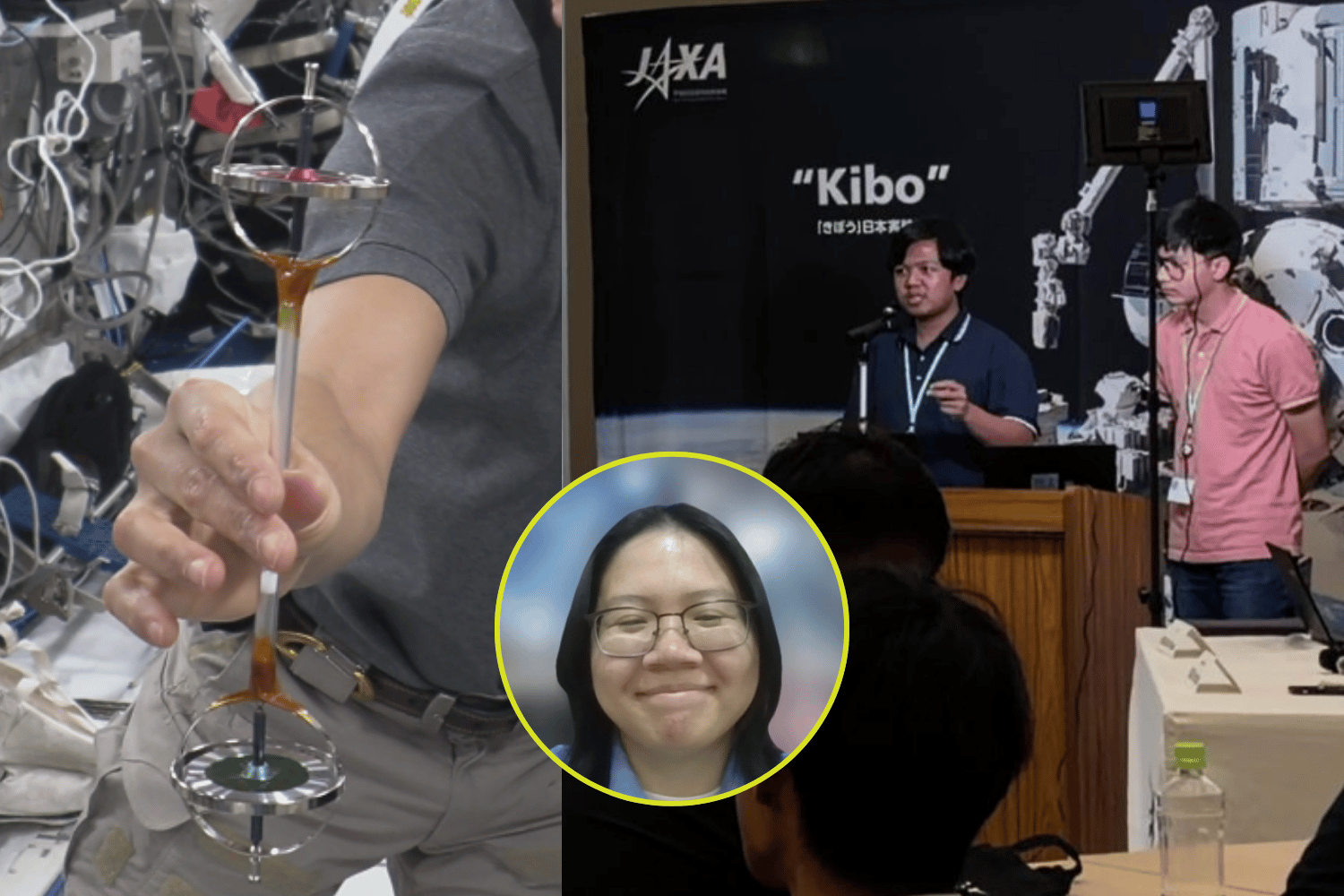
Possible steering tech for future spaceships designed by Filipinos.
The “Double Gyroscope” experiment, designed by third-year Rizal Technological University (RTU) astronomy students majoring in astrophysics—Christopher Tumamac, Ryan Andrew Doña, and Rose Ann Cezar—was successfully executed inside the ISS’ Kibo module by NASA Astronaut Christopher Williams as reported by Philippine Space Agency (PhilSA) yesterday.
Out of 89 grueling nationwide proposals, their concept became the official entry for the Japan Aerospace Exploration Agency’s (JAXA) 2025 Asian Try Zero-G competition, beating out regional peers to be tested live in orbit.
What was the experiment about?
The RTU team wanted to observe how spinning objects behave when they are completely unbothered by Earth’s gravity. They placed two gyroscopes—spinning devices used to maintain balance and direction—at the end of a stick.
The team hypothesized that if the two gyroscopes spun in completely opposite directions, their physical motions would cancel each other out in a weightless environment, creating a perfectly stable, motionless system.
However, if they spun in the same direction, the combined energy would create an ultra-stable shield resistant to external disturbances. Astronaut Williams conducted 11 rigorous tests on the device while the students watched the livestream directly from the JAXA Tsukuba Space Center in Japan.
Why it matters?
The double gyroscope demonstrates the foundational physics behind spacecraft orientation—essentially how satellites, rovers, and spaceships control which way they face in the vacuum of space. By mastering how internal spinning devices (like reaction wheels) manipulate stability, scientists can build spacecraft that rotate and navigate smoothly without relying on limited, heavy, and expensive fuel-powered thrusters. These Pinoy students are contributing direct, observable data to the global blueprint of fuel-free space navigation.
For decades, the global narrative around the Philippines focused on labor export; today, we are exporting design concepts that would shape future spaceships.
Since 2022, Filipino students have consistently qualified as finalists in this space derby, proving that our local talent pool can stand shoulder-to-shoulder with Asia’s tech giants. Backed by PhilSA, the Philippines is transitioning into a true space-faring nation, showing the world that anyone can become an astronaut.
If you are a student, a young researcher, or a dreamer with a notebook full of physics questions, don’t let your ideas stay grounded. Head over to https://philsa.gov.ph/ to check out PhilSA’s youth outreach programs, scholarship grants, and upcoming space competitions.