The results demonstrated nata de coco’s potential as a locally available raw material for forward-osmosis membranes, researchers say.
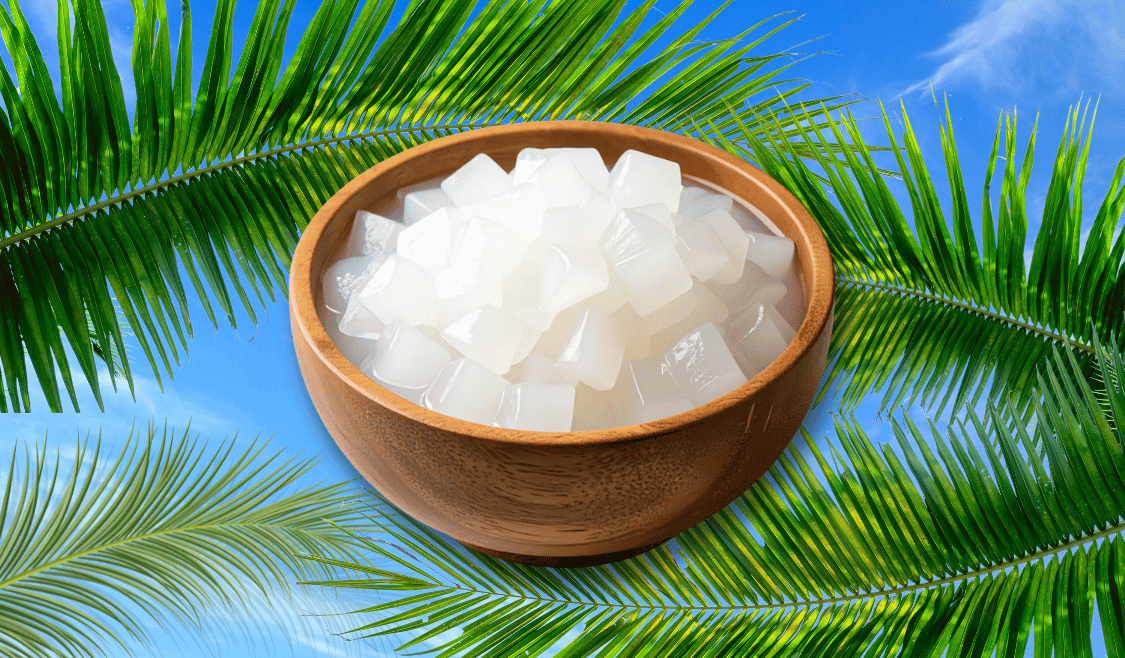
Nata de coco may be best known as the chewy, translucent cubes floating in fruit salad, halo-halo and bottled drinks. But Filipino researchers have demonstrated that the humble coconut product has another, far more surprising use: it can be turned into a membrane capable of removing salt from water.
Researchers from Malayan Colleges Laguna, now Mapúa Malayan Colleges Laguna, University of the Philippines Los Baños and De La Salle University developed a forward osmosis membrane using nata de coco as its primary raw material. Their results were published in the journal Taiwan Water Conservancy in 2020.
The idea takes advantage of what nata de coco actually is.
Nata de coco is produced through the fermentation of coconut water by bacteria, traditionally identified as Acetobacter xylinum, resulting in bacterial cellulose. Unlike the sweetened nata cubes people eat, the researchers worked with this cellulose material and modified it for use as a filtration membrane.
The scientists combined the bacterial cellulose film with sodium alginate and used calcium chloride to cross-link the material, creating a composite membrane. They then tested it in a laboratory-scale forward osmosis system designed for desalination.
Forward osmosis uses a difference in solute concentration to draw water across a semipermeable membrane. The membrane allows water to move across while restricting much of the dissolved salt.
And the nata de coco membrane actually worked.
The researchers’ best-performing setup recorded 88.39 percent salt rejection and a water flux of 4.01 liters per square meter per hour. A commercial cellulose tri-acetate membrane used as a benchmark achieved 100 percent salt rejection and a higher water flux.
That means the experimental nata de coco membrane was not yet able to match the commercial membrane. But researchers said the results demonstrated its potential as a locally available raw material for forward-osmosis membranes.
The project was conducted from April 2017 to March 2018 with support from the Department of Science and Technology and its Philippine Council for Industry, Energy and Emerging Technology Research and Development. It was led by Dr. Liza Bautista-Patacsil, with researchers including Mayzonee Ligaray, Ramon Christian Eusebio, Aileen Orbecido and Arnel Beltran.
Further Philippine research has also explored modified nata de coco membranes, including acetylated nata de coco bacterial cellulose for forward-osmosis desalination.
The findings remain research rather than proof that nata de coco can already replace commercial desalination membranes at scale. Questions involving durability, production cost, long-term performance and large-scale deployment would still have to be addressed.
Still, the research presents an intriguing possibility for a country surrounded by seawater and rich in coconut resources: one of the Philippines’ most familiar dessert ingredients could provide the raw material for technology designed to produce cleaner water.
From fruit salad to water filtration, nata de coco may have more potential than anyone expected.
READ: