
Price headlines of up to ₱6 million per kilo have captured attention, but long timelines, regulatory complexity, and an untested local ecosystem suggest the real business story is far less straightforward.
Interest in agarwood farming has been building in the Philippines as global demand for the resinous wood continues to circulate through agricultural circles, investment seminars, and online promotions that present it as a high-value crop capable of turning idle land into long-term wealth.
Some promoters have even branded agarwood as ‘liquid gold,’ pointing to claims that premium-grade processed material can fetch as much as ₱6 million per kilo. The appeal is easy to understand in a country where farm incomes remain unpredictable and production costs continue to rise, but the conversation around it has also become increasingly shaped by projections that deserve closer examination.
The economics of resin
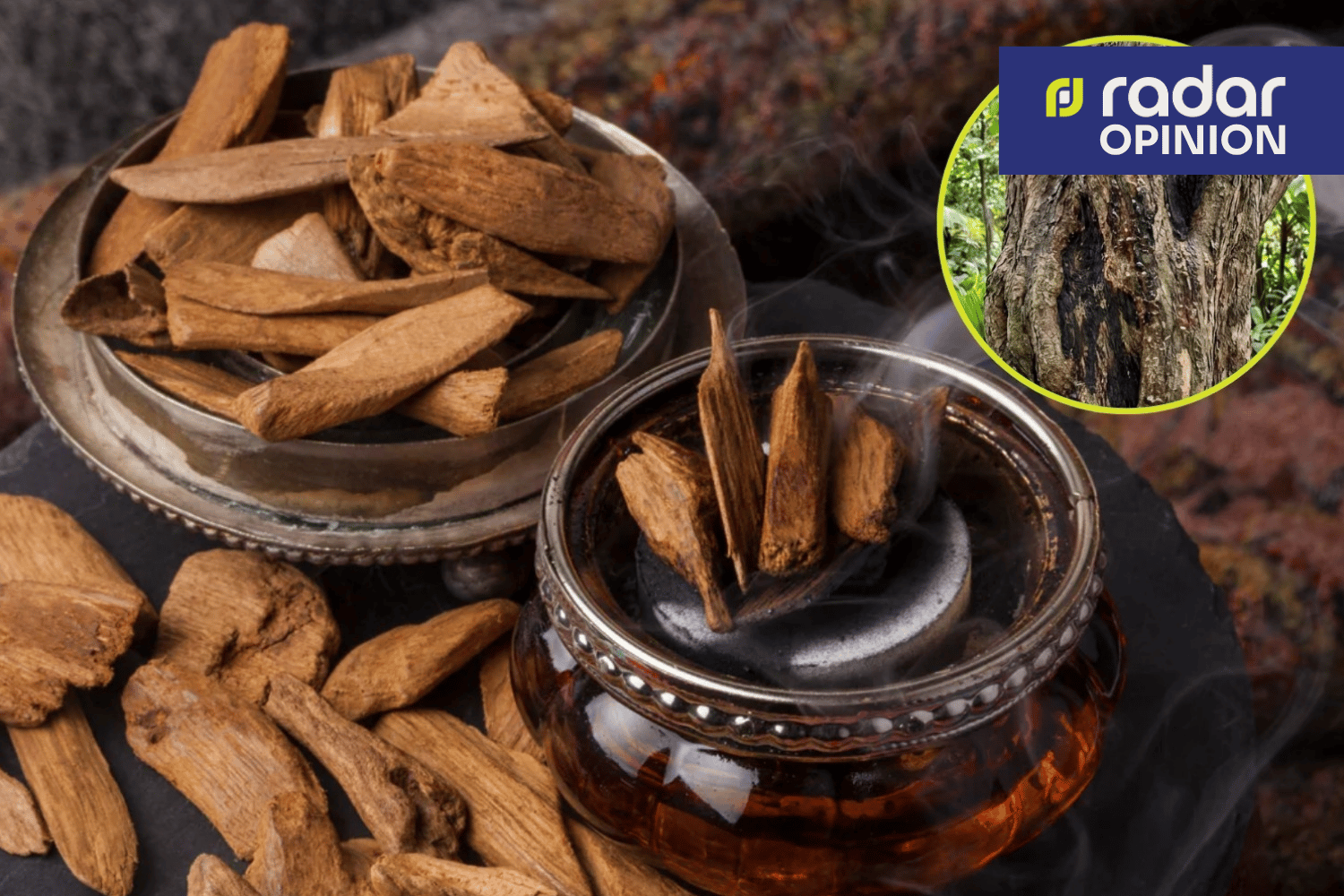
Agarwood is a real commodity with an established international market, particularly in parts of the Middle East and Asia where it is processed into incense, oils, and luxury fragrances used in religious and cultural practices. Its value comes from the dark aromatic resin that forms in Aquilaria trees under specific conditions, usually after natural infection or deliberate injury to the tree.
Those eye-catching figures, however, are typically tied to highly graded processed resin or oil under specific market conditions, not guaranteed farmgate prices for raw wood or standing trees. What is less straightforward is not the product itself, but the path from seedling to sale, especially for growers being encouraged to enter the sector without a fully developed local industry behind them.
Unlike traditional Philippine crops such as rice, coconut, banana, coffee, or cacao, agarwood does not yet operate within a mature domestic value chain. There is limited large-scale processing capacity in the country, no widely accepted grading system that provides consistency in pricing, and no deeply established export infrastructure that small farmers can depend on.
Much of the current interest is driven instead by foreign price references and long-term yield assumptions that may or may not align with actual market access when harvest time arrives decades later.
That becomes even more important in a market where the most widely repeated number is often the ₱6 million headline, while far less attention is given to grading standards, processing costs, resin induction, rejection rates, export compliance, and whether small growers can realistically access the same premium buyers being used in promotional materials.
The regulatory minefield
Regulation adds another layer of complexity. Because Aquilaria species are considered threatened in the wild, propagation, transport, and commercial trade are closely monitored under Republic Act 9147, or the Wildlife Resources Conservation and Protection Act. Legitimate growers must navigate a long list of documentary requirements that may include nursery accreditation, transport permits, export clearances, and proof of land ownership or financial capacity before products can legally move through the supply chain.
This difference between projection and execution is where caution becomes necessary. Many of the business models being presented to prospective growers rely on timelines that stretch 15 to 30 years before meaningful returns can be realized. That alone is not unusual in forestry-based investments, but it becomes more complicated when land that could otherwise support food production is converted into monocrop plantations based on anticipated rather than secured demand.
The concern is not limited to financial risk. At scale, widespread agarwood cultivation could change land use patterns in ways that reduce agricultural diversity, particularly if farmers begin replacing existing fruit-bearing or food-producing crops in pursuit of higher theoretical returns.
In practical terms, every hectare committed to a long-maturity tree crop is land that may remain commercially locked for years, with no guarantee that projected export prices today will still hold by the time harvest and resin induction become commercially viable.
The Philippines has seen versions of this cycle before, where enthusiasm for a high-value export crop eventually gave way to market corrections or structural changes that left some producers exposed.
Past mistakes
The coffee industry is often cited in this context. The Philippines once ranked among the world’s leading coffee exporters, but production declined after disease outbreaks in the late 19th century and later faced renewed pressure when global pricing structures changed in the late 1980s and early 1990s. Some growers eventually moved into other crops when returns weakened. The lesson was never that coffee had no future. The lesson was that agricultural markets can change much faster than permanent crops can mature.
That history deserves attention not as an argument against innovation, but as a reminder that long-term profitability depends on far more than planting a promising species. It depends on stable demand, processing capability, transparent regulation, reliable export channels, and buyers who will still be there years from now.
Agarwood may eventually become a viable niche for the Philippines, particularly if supported by credible regulation, transparent sourcing systems, and proven access to international buyers. At its current stage, however, it remains an industry built as much on projections as on proven local outcomes.
The more urgent question is not whether agarwood can be valuable but whether the ecosystem needed to unlock that value is already in place or whether many are being asked to commit land, capital, and decades of patience based largely on projections that have yet to be fully tested in the Philippine market.
It’s being called ‘liquid gold.’ Agarwood prices reach ₱6 million per kilo as Filipino farmers shift to high-value Aquilaria farming, but anyone doing this should proceed with lots of caution.
READ:

OPINION: Who actually gets access to cheaper electricity?
Kenneth M. del Rosario
April 16, 2026

OPINION: Overpackaging is the quiet culprit behind the plastic crisis we live in
Matahari
May 5, 2026

OPINION: PhilHealth paid ₱3.5B for dengue in 2024
Nikko Miguel Garcia
May 6, 2026
Tags: Aquilaria malaccensis cultivation PhilippinesDENR agarwood permit requirements RA 9147illegal agarwood trade penalties PhilippinesJohn Lloyd Aleta industry reportLapnisan agarwood farming Philippinesluxury fragrance oud market trends 2026Philippine agarwood price per kilo 2026Wildlife Farm Culture Permit agarwood