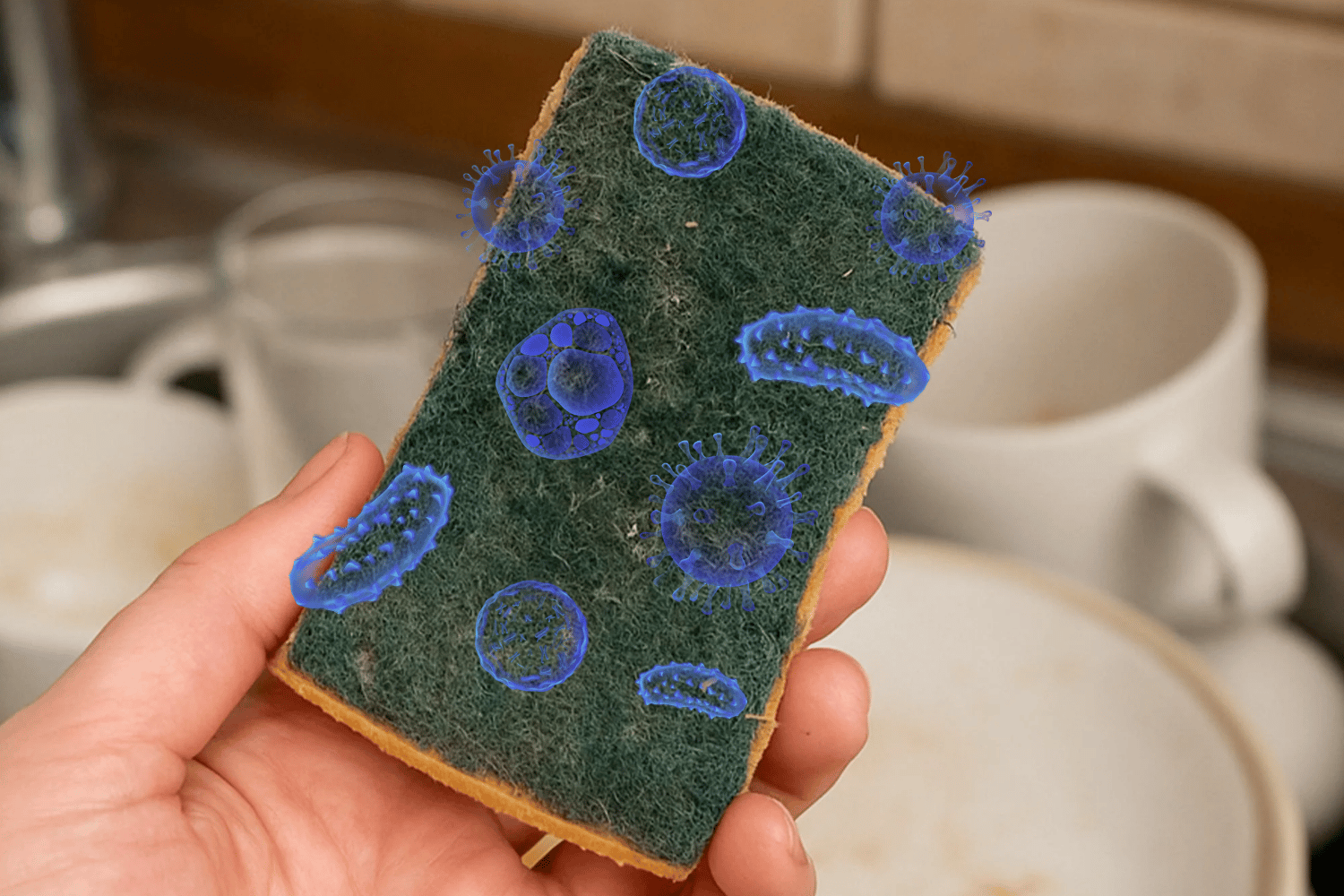
It can carry microorganisms around the kitchen instead of removing them.
You finish washing the dishes, wipe the sink, rinse the sponge, squeeze it dry—or at least you think you do—and leave it beside the faucet.
The kitchen looks clean.
But sitting quietly beside your sink may be one of the most bacteria-packed objects in your home.
Microbiological studies have shown that kitchen sponges can harbor extraordinarily dense communities of bacteria because they offer almost everything microbes need: moisture, warmth, nutrients from food residue, and countless tiny spaces in which to grow.
And unlike the toilet seat, the sponge gets rubbed directly onto the plates, glasses and utensils you use for eating.
Billions of bacteria can live inside it
One of the most cited studies on kitchen sponges, published in Scientific Reports in 2017, examined used sponges from German households using genetic sequencing and microscopic imaging.
Researchers found bacterial densities reaching about 54 billion cells per cubic centimeter in portions of the sponges.
The study revealed an incredibly diverse bacterial ecosystem packed into something most of us casually handle several times a day.
This is why a sponge doesn’t have to stink, discolor or fall apart before it becomes heavily colonized.
To bacteria, those little holes aren’t holes.
They’re prime real estate.
Why sponges are so good at growing bacteria
Think about what happens after dinner.
Bits of rice, sauce, meat juices, grease and other organic matter become trapped inside the sponge. You rinse it, but microscopic food particles can remain.
Then you leave it damp overnight.
The porous structure retains water while providing an enormous internal surface where microorganisms can survive and multiply. The next morning, you use that same sponge again.
Then again at lunch.
Then again at dinner.
A sponge therefore doesn’t merely pick up bacteria. Its physical structure can create an ideal environment for them.
Not every bacterium is dangerous
There is an important distinction often lost in viral warnings about the “dirtiest thing in your house.”
Lots of bacteria does not automatically mean lots of dangerous pathogens.
The 2017 German study found enormous bacterial populations, but that doesn’t mean every sponge is crawling with Salmonella or E. coli. Many bacteria found in household environments are harmless, and the actual risk depends on what organisms are present and how the sponge is being used.
The more practical concern is cross-contamination.
Use a sponge on a surface contaminated by raw chicken, for example, and then wipe another kitchen surface with it. The sponge can become a vehicle carrying microorganisms around the kitchen instead of removing them.
Suddenly, “cleaning” can mean spreading.
Can you just microwave it?
This is where kitchen folklore becomes complicated.
Microwaving, boiling or dishwashing a sponge can substantially reduce microbial populations under appropriate conditions. But these methods shouldn’t be treated as a magical reset button that makes an old sponge microbiologically new again.
The 2017 study found that regularly sanitized sponges did not necessarily contain fewer bacteria overall than unsanitized ones. Researchers suggested that more resistant bacteria may survive sanitation and rapidly recolonize the available space.
That does not mean microwaving literally creates mutant “superbugs,” as some dramatic online explanations claim. It means repeated home sanitation may not reliably solve the fundamental problem of an old, heavily colonized sponge.
Maybe the better answer is a brush
Research comparing kitchen sponges and dishwashing brushes has found that bacteria such as Salmonella can survive better in sponges, while brushes tend to dry more quickly—a major disadvantage for bacteria that thrive in moist environments.
That makes a dish brush an attractive alternative, particularly when it is allowed to dry properly between uses.
If you’re sticking with the familiar sponge, don’t treat it like a permanent kitchen appliance. Replace it regularly, especially when it becomes dirty, develops an odor, begins deteriorating or has been used on potentially contaminated surfaces.
And don’t wait for your nose to tell you something is wrong.
Because that innocent-looking sponge beside your sink may already be far dirtier than it looks.
READ:
Philippine beaches littered with 188 discarded vapes in Western Visayas cleanup
Kenneth M. del Rosario
September 23, 2026
SM Cares brings biggest mall-led coastal cleanup yet to 32 malls nationwide
radar Business
September 8, 2026

Hanz on radar: Why a clean desk is your best career tool this April 13
Master Hanz Cua
April 13, 2026