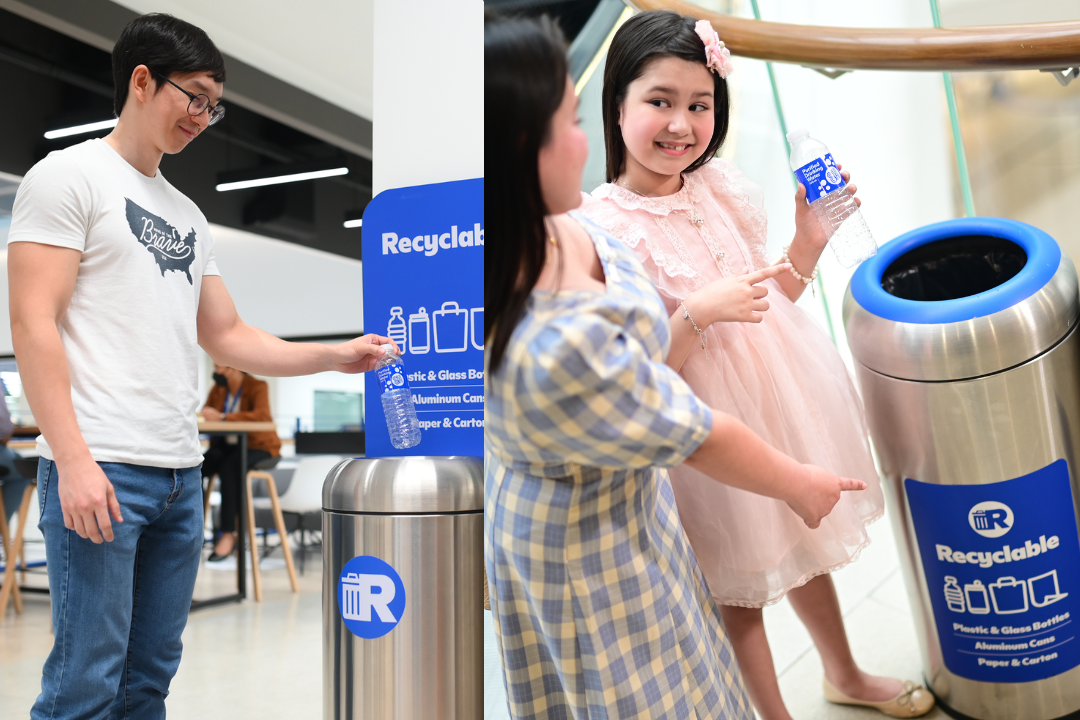
Under the SM Green Movement, proper sorting of bottles, cans, and cartons supports circular economy goals.
When visiting SM Supermalls, the trash bins form part of a broader push to support a waste-free initiative. Under the SM Green Movement, the Recyclable-Disposable-Compostable (RDC) bins are designed to recover reusable resources while keeping waste out of landfills and oceans through structured waste segregation.
Understanding recyclables
At its core, recyclables are grouped into three categories: Bottles, Cans, and Cartons. Each can go beyond single use and be returned to manufacturers for processing and reuse:
Bottles – These can be glass or plastic (PET). Glass bottles can be recycled indefinitely and are returned to bottlers such as San Miguel Yamamura and Asia Brewery Incorporated to be washed and reused for beverages. PET bottles are collected by partners like Coca-Cola’s PETValue and Nature Spring’s NS Sustainability Solutions, where they are either turned into new beverage bottles or processed into polyester for textile production.
Cans – Made of tin or aluminum, cans are recyclable materials that can be reused multiple times. Recycling cans helps lower energy consumption for manufacturers compared to producing new ones from raw materials.
Cartons – Widely used in the beverage sector, cartons are sourced locally and remain cost-efficient. Even when recycled, they retain value, as producing paper products from recycled cartons requires only around 10% new material.
Closing the loop on recyclables
High-value recyclables are often lost when not properly segregated. Through the use of designated recyclable bins, these materials can be recovered and reintroduced into the production cycle through partner facilities.
A circular system becomes more viable when waste is sorted at the source. With consistent use of RDC bins, waste segregation is positioned as a shared responsibility between operators and consumers, supporting broader environmental targets while reducing landfill dependence.
Every discarded soda bottle tells a story of potential, waiting to be reborn as a new container or a piece of textile.
READ: