It’s said to resemble a folded, used sanitary napkin.
A few hours after a hearty sinigang na buto-buto your late Lola cooked, she’d ask you to run to the bakery. “Bumili ka ng walong pan de regla sa panaderya. Meryenda natin.”
You’ve heard the word before—your Ate or Tita saying it in passing, usually in frustration—but you never quite knew what it meant.
You take the barya from your Lola and, before you head out, she slips in a little extra.
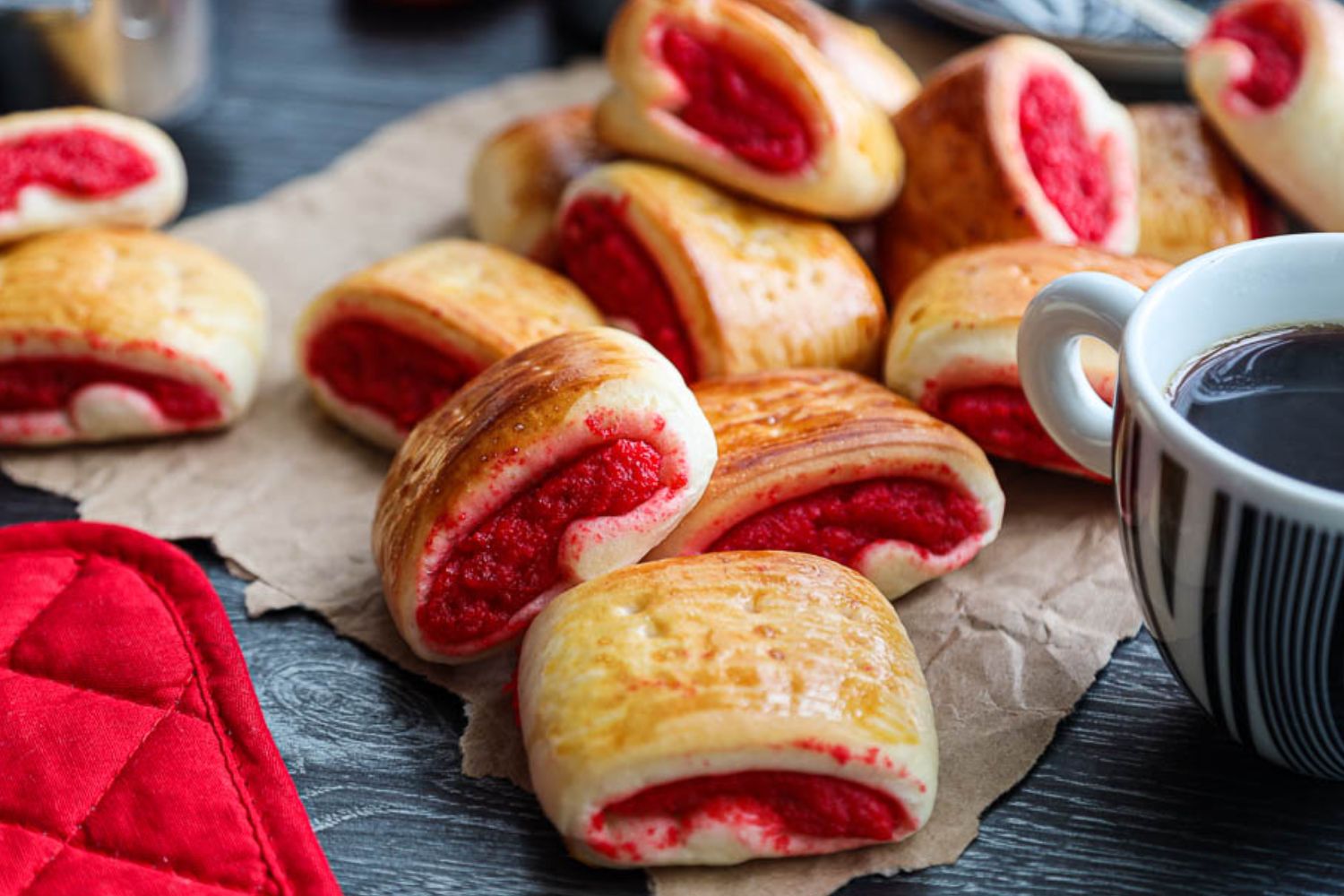
At the panaderya, you stand before a glass display taller than you. Among the rows of golden-brown bread, one stands out: soft rolls split open and filled with something bright red, almost pink. Before you can even say what you came for, the tindera already knows.
Some time later, your science teacher says it again, during a lesson on the female reproductive system. Most of your classmates erupt in laughter. Others fall quiet, a few visibly uneasy.
That’s when it hits you: your favorite pan de regla has always had a name—and an appearance—never meant to be taken so innocently.
Food writer Amy Uy, in “Panaderia: Philippine Bread, Biscuit and Bakery Traditions” (co-authored with Jenny Orillos), explains that pan de regla is called as such because it resembles a folded, used sanitary napkin. But she also notes that “regla” is Spanish for “ruler,” which bakers supposedly once used to measure the flat dough.
Moreover, the name isn’t singular. Across the country, the bread goes by 14 different names.
Uy says one of them is “kalihim,” as panaderos have a “lihim” or secret: the pink filling is made from old breads, torn and mixed with butter, eggs, sugar, red food coloring, and a touch of vanilla.
Elsewhere, the name is more provocative. Cebuanos call it “pan borikat,” Ilonggos “pampam,” and Marikeños “belyas”—all slang for prostitute. Batangueños call it “pulang kiki,” a crude reference to female genitalia.
Other regions take a different route, according to Uy. Some Quezon City bakeries call it “floorwax,” Iloilo “catalugan,” Pampanga “everlasting,” Bicol “ligaya” (happiness), Ilocos Sur “balintawak” (woman’s kerchief), and Ilocos Norte “lahi” (race). One Kidapawan bakeshop even calls it “lipstick.”
For something you grew up eating without a second thought, pan de regla has always been nakakaloka. Yet it tastes exactly how you remember it: soft and slightly chewy, with a sweet, buttery center that melts in your mouth. It’s the kind of meryenda you never quite outgrow.