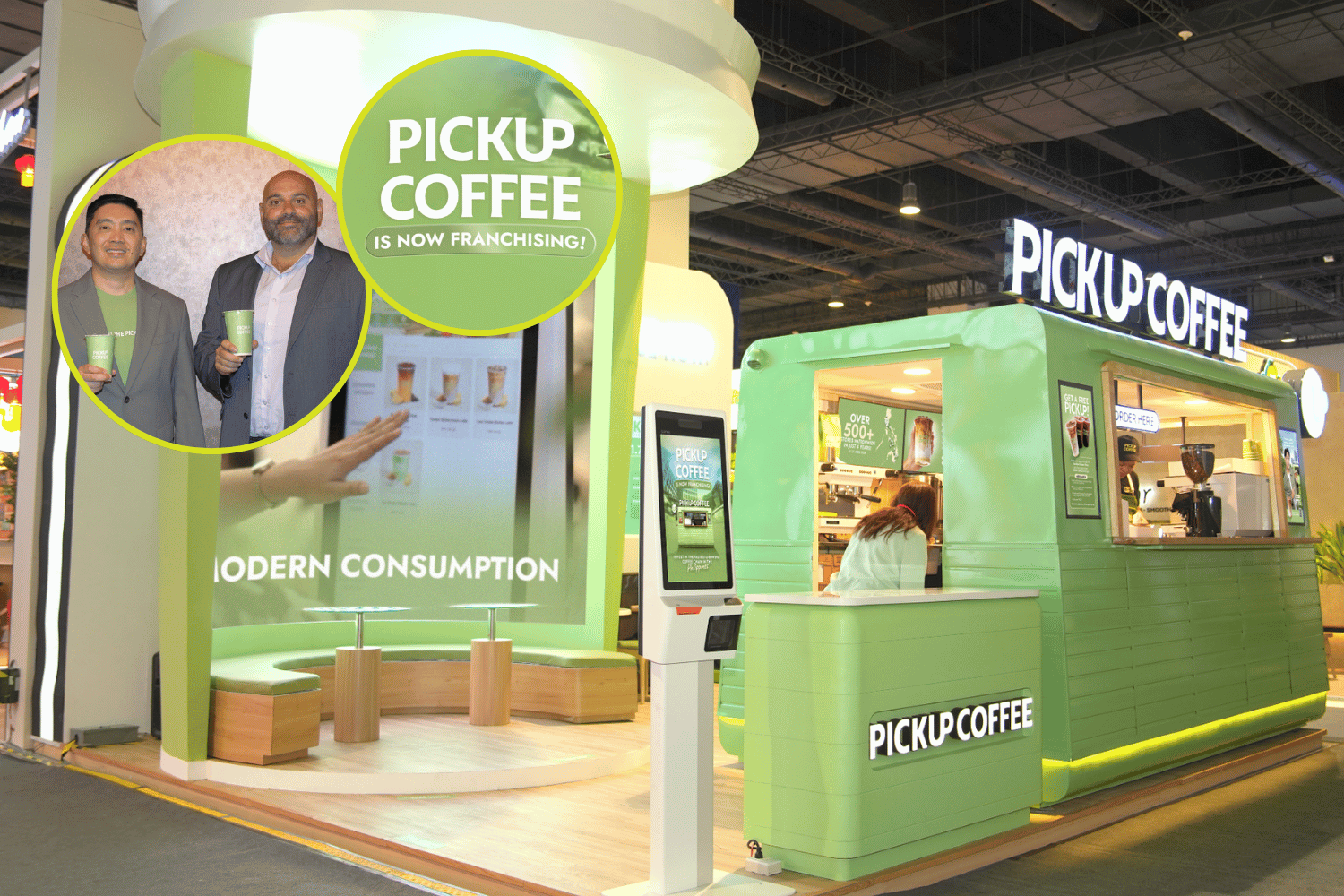
The fast-growing Filipino brand is using machine learning to guide expansion as it scales beyond 500 stores nationwide.
Homegrown brand Pickup Coffee has opened franchising for the first time, as artificial intelligence takes on a central role in deciding where franchise stores will be located and how the brand expands nationwide.
The move comes after the fast-growing chain scaled to more than 500 stores in under four years, built on a dense, low-cost model that often places branches within close proximity of one another to maximize convenience and daily demand.
Instead of relying on fixed distance rules, the company said it now uses machine learning systems to evaluate potential sites for both company-owned and franchise stores. These models factor in traffic flow, competitor presence, and internal performance data, with management citing roughly 75% confidence in projected revenue outcomes before a store is built.
Franchising, in this setup, becomes less about opening access to ownership and more about plugging new partners into an already data-driven expansion engine.
Investment requirements range from about ₱1.7 million for kiosk formats to as much as ₱4 million for larger stores, with projected payback periods of 18 to 24 months under ideal conditions. Site approval, however, remains tightly controlled, using the same internal modeling framework that governs company-owned store expansion.
“Basically, we plug the location into the model and it tells us if it works or not,” PICKUP COFFEE country president and CEO Rami Chahwan said, referring to the company’s data-driven site selection system.
He added that franchising is meant to complement, not replace, the company’s expansion strategy. “It’s not about slowing down what we’re doing. It’s about reaching more places faster, with the same discipline behind every store,” he said.
Company executives have also indicated that franchise outlets will likely remain capped at 20% to 25% of total stores, ensuring that the core network remains company-operated while external partners support scale.
Franchising is now open, but the geography of growth is increasingly shaped by algorithms rather than intuition.
READ: