
Rappler journalists defend paywalls after criticism sparks debate over the cost of quality news.
The growing debate over paywalls and the future of journalism has spilled onto social media, with veteran journalists defending subscription-based news after criticism that charging for information contributes to the country’s “media crisis.”
The discussion was triggered by a Facebook post from Katrina Stuart Santiago, who criticized Rappler’s subscription service, Rappler+, which charges at least ₱249 a month for premium content.
“I guess to be at the forefront of change you need to be in an echo chamber for clarity, courage, and connection. AND you need to spend at least Php249 a month for ‘premium’ journalism,” Santiago wrote.
She added, “Galit na galit tayo sa disinformation pero yung information lalagyan niyo ng paywall,” using the hashtag #MediaCrisis.
Rappler journalist Gemma Bagayaua Mendoza responded by arguing that subscription fees help sustain newsrooms that invest in in-depth reporting while remaining editorially independent.
“Girl, if you can afford to buy coffee at Starbucks, hindi mo dapat ipagdamot ang P249 sa mga newsrooms that are trying to cover corruption and important social issues with rigor and depth while staying editorially independent,” Mendoza wrote.
She clarified that only a small portion of Rappler’s stories are behind a paywall.
“VERY FEW Rappler stories require a paywall. Yung mga select na exclusives lang. The rest of the information on our website is AVAILABLE FOR FREE,” she said.
Mendoza also explained that fact-checks remain freely accessible and that some registration requirements were introduced because AI companies have been scraping news content without permission or compensation.
Joining the discussion, Rappler executive editor Paterno Esmaquel II stressed that operating a newsroom requires significant financial resources, especially as advertising revenues increasingly shift to social media platforms.
“Running a newsroom costs millions of pesos, and many advertisers have been choosing Facebook and YouTube over traditional news,” Esmaquel wrote.
He added that Rappler’s subscription model is designed to reduce dependence on vested interests.
“Rappler is not asking money from politicians or businessmen with self-serving interests. Rappler is seeking the support of citizens who understand that truth-telling is a collaborative effort between newsrooms and their communities,” he said.
Esmaquel also emphasized that subscription-only content makes up only a small fraction of the publication’s output.
“Around 90% of Rappler content can be accessed for free, without a Rappler+ subscription,” he said. “I think seeking readers’ support for a little content is fair.”
The exchange has reignited a broader conversation about how news organizations can remain financially sustainable as traditional advertising revenues continue to decline.
Across the world, many digital newsrooms have adopted paywalls to diversify their income and reduce dependence on advertising. Subscription revenue has become an increasingly important source of funding for investigative journalism, foreign coverage, and long-form reporting that require significant time and financial resources.
Media analysts note that running a newsroom entails substantial operational costs beyond reporters’ salaries, including editors, photographers, videographers, producers, fact-checkers, legal support, technology infrastructure, cybersecurity, web hosting, content management systems, office expenses, and field reporting costs.
Supporters of paywalls argue that these expenses make reader subscriptions one of the few viable ways for independent news organizations to survive while maintaining editorial independence.
Critics, however, contend that placing quality journalism behind a paywall risks widening the information gap by limiting access to verified reporting, especially for readers who cannot afford multiple digital subscriptions.
To balance sustainability with public service, many news organizations use “freemium” models, keeping breaking news, public advisories, and fact-checks free while reserving exclusive investigations, in-depth analyses, and special features for paying subscribers.
The online exchange reflects a dilemma confronting newsrooms worldwide: how to keep journalism financially alive in an era when audiences expect information to be free, advertising revenues are shrinking, and technology companies increasingly profit from news content without directly funding its production.
READ:

Philippine literature and journalism mourn the passing of writer and art critic Amadis Ma. Guerrero
radar Lifestyle
May 14, 2026

Cosmo PH apologizes for inaccuracies in BINI tour report
Denchelle Castro
July 10, 2026
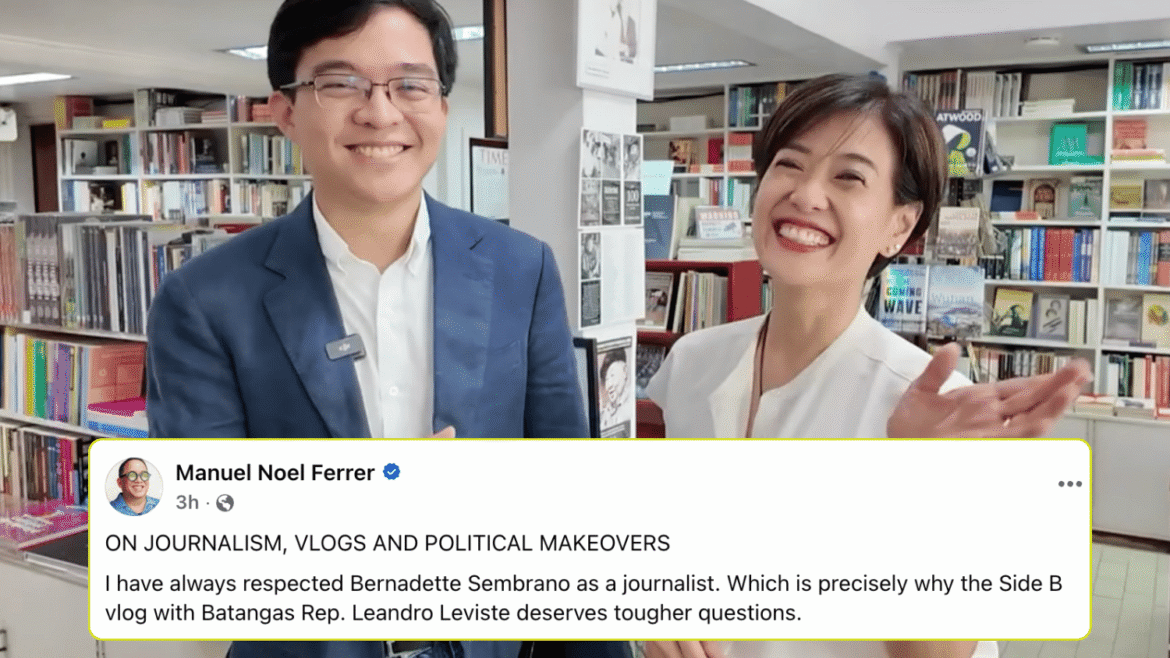
Bernadette Sembrano urged to address deleted Leviste vlog
Marinel Cruz
July 13, 2026