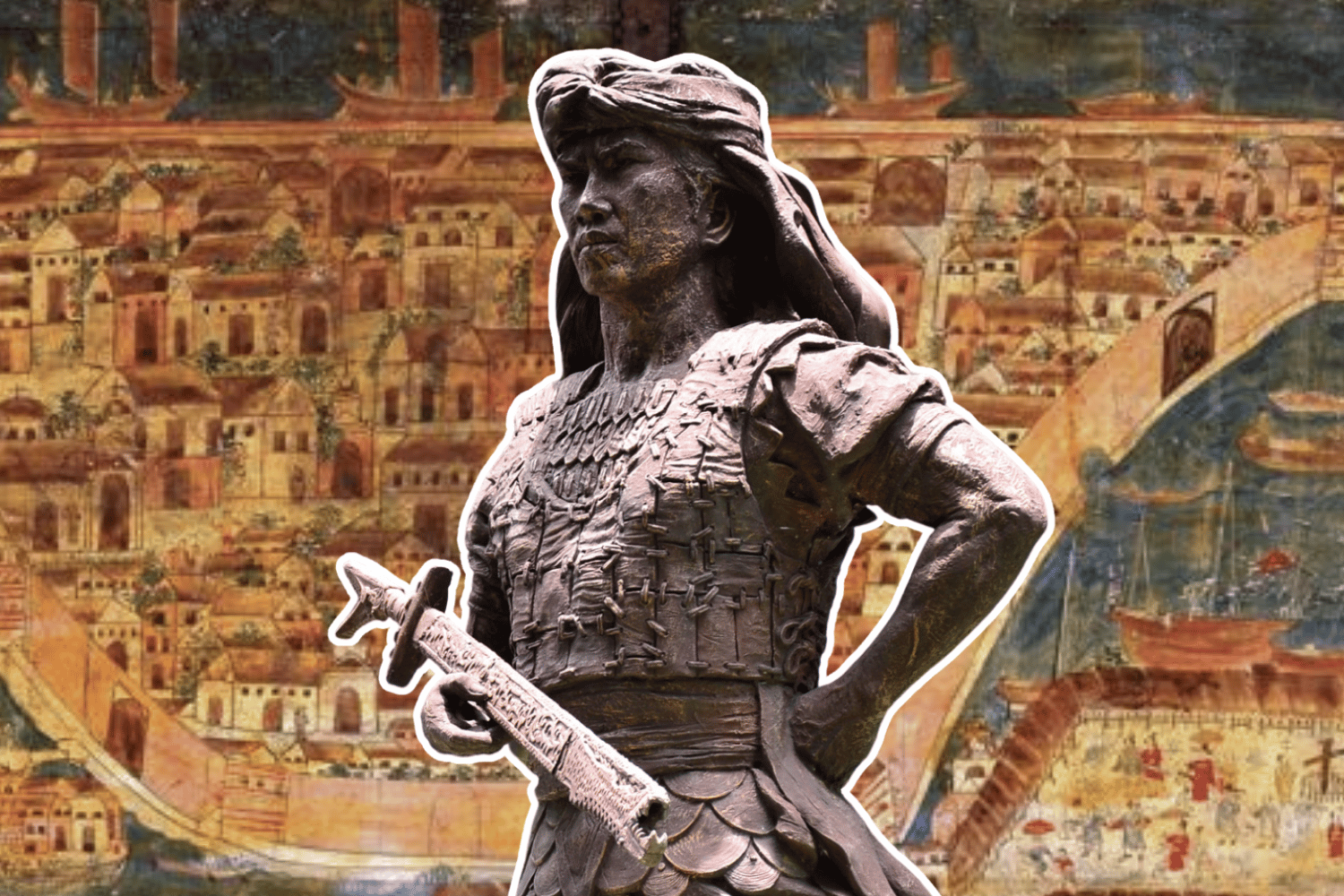
The massive walls of Intramuros rose around the fort to protect Spain’s new colonial capital.
Imagine walking through the stone walls of Intramuros, snapping photos at Fort Santiago, and tracing the footsteps of José Rizal. Now imagine this: long before the Spaniards built any of it, you were actually standing on the former seat of power of an independent kingdom.
Before Intramuros became the famed Walled City, the site was home to the fortified kota of Rajah Sulayman, the ruler of the thriving pre-colonial Kingdom of Maynila.
Far from being a simple village, Maynila was already a wealthy trading center at the mouth of the Pasig River, welcoming merchants from China, Brunei, and other parts of Southeast Asia. At its heart stood Rajah Sulayman’s fortified compound, protected by thick earthworks and towering palisades made from bamboo and coconut log stakes.
The fortress was armed with bronze cannons called lantakas, crafted by the legendary blacksmith Panday Pira. Early Spanish chroniclers also described the compound as containing large wooden buildings filled with porcelain, iron, trade goods, and even stores of gunpowder—evidence that the Kingdom of Maynila was prosperous and well-defended long before Spain arrived.
But that kingdom would soon disappear.
In 1570, Spanish forces under Martín de Goiti first attacked Maynila. Spanish accounts claim that they burned the city—and even took the lantakas. But other historical analyses suggested that the natives, rather than let their stronghold fall into enemy hands, burned it themselves—a common military tactic at the time.
A year later, conquistador Miguel López de Legazpi returned with a much larger force. Rajah Sulayman and his allies fought back but were ultimately defeated. On June 24, 1571, Legazpi founded the new Ciudad de Manila, the capital of the Spanish East Indies.
The Spaniards then cleared the remains of Rajah Sulayman’s kota and built their own military fort directly over the site. That wooden fort would later become the stone fortress now known as Fort Santiago, named after Saint James the Great. The name refers to Santiago Matamoros (“Saint James the Moor Slayer”), a legendary Spanish depiction of the apostle as a warrior and an important symbol during Spain’s campaigns against the Moors.
The massive walls of Intramuros, meanwhile, rose around it to protect Spain’s new colonial capital.
Fort Santiago would serve as the military headquarters of the Spanish, British, Americans, and Japanese during their rule in the Philippines. It was also where the American flag was first raised on Aug. 13, 1898, marking the start of American colonial rule. During World War II, the Japanese military police used the fort as a prison, where hundreds were detained and tortured.
In other words, one of the Philippines’ most iconic Spanish landmarks literally stands on top of the political and military heart of the pre-colonial Kingdom of Maynila.
Today, only a subtle reminder of that kingdom remains.
Inside Fort Santiago stands the Rajah Sulayman Theater, a former Infantry Quarters that was destroyed during the Battle of Manila in 1945. National Artist for Architecture Leandro Locsin restored the structure in 1967 and transformed it into an open-air theater for the Philippine Educational Theater Association. It served as PETA’s performance venue until the group moved to its new theater in Quezon City in 2005.
Intramuros also features murals of Rajah Sulayman, a reminder that the last ruler of Maynila once ruled from a fortified compound on the same ground centuries before the Spanish built the Walled City.
So the next time you stroll through Intramuros, remember this remarkable piece of history: beneath the cobblestones and colonial walls once stood the fortress of Rajah Sulayman, where the rulers of the Kingdom of Maynila governed long before the Spanish conquest.
READ:
The darkest secrets behind Juan Luna’s masterpieces
Top Dagohoy
July 22, 2026

Local artist reimagines the Hilario Sunico House
Mianne Cudal
June 20, 2026
These six iconic Philippine landmarks are gone forever
Top Dagohoy
July 24, 2026