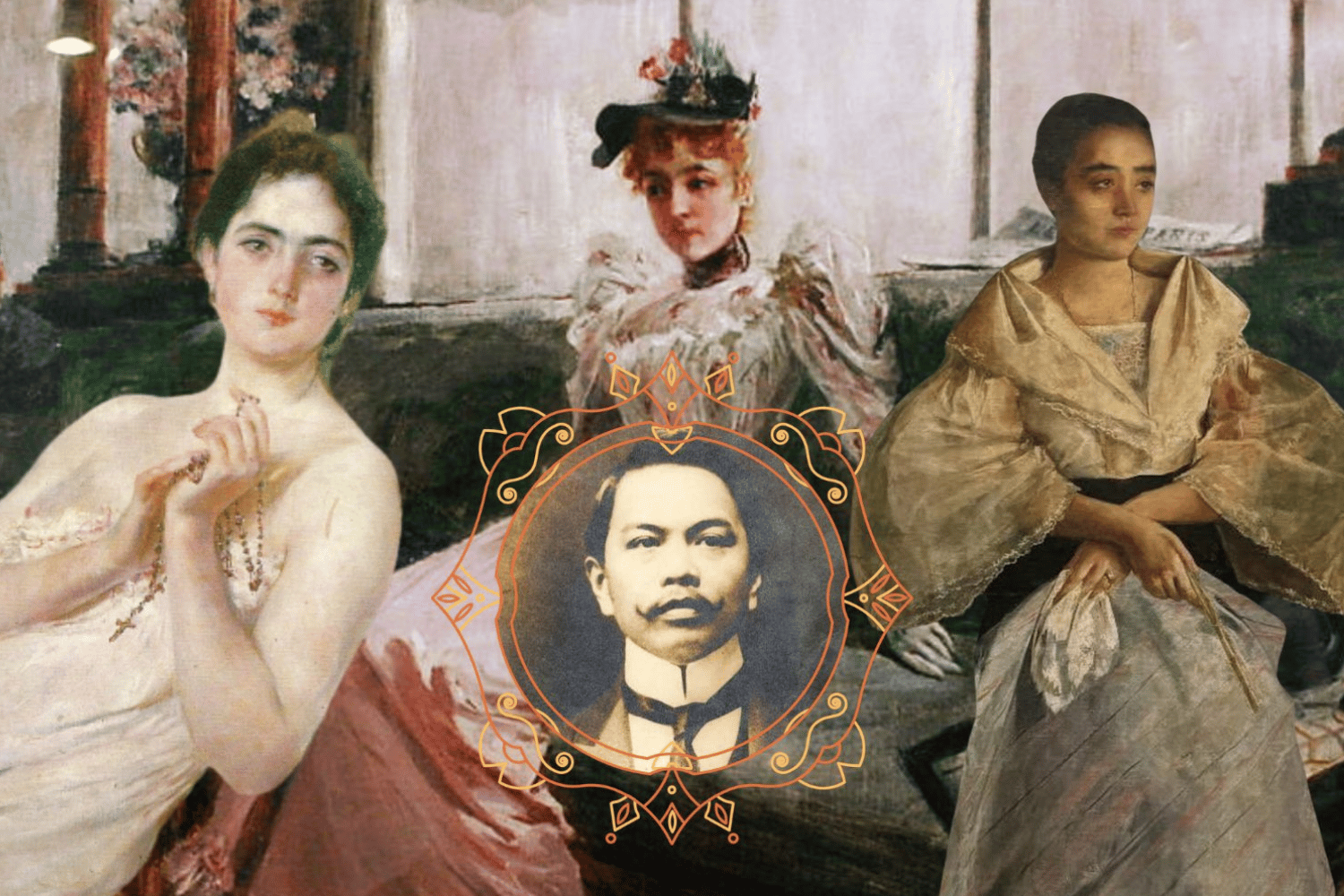
Rather than offer answers and explanations, these three paintings continue to invite questions from the art community.
Most Filipinos know Juan Luna as the genius behind “Spoliarium.” Fewer know that some of his other masterpieces have become the subject of murder mysteries, urban legends, and historical puzzles that remain unsolved more than a century later.
From a portrait rumored to be cursed to a painting believed to hide a revolutionary message, Luna’s works continue to fascinate not only art lovers but also historians searching for answers.
The painting haunted by a murder
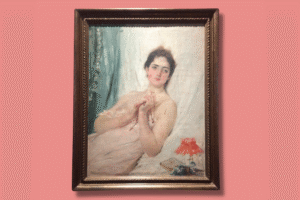
At first glance, “Portrait of a Lady”—also known as “Mi Novia”—looks like an elegant portrait of a woman resting in bed while clutching a rosary. The woman has long been speculated to be Maria de la Paz Pardo de Tavera, Luna’s wife. But historical photographs have cast doubt on that theory. Historian Vic Torres said Luna may have painted his own “version” of Paz—or it may not be her at all.
In 1892, Luna shot and killed Paz and her mother in their Paris home after a violent outburst fueled by jealousy. Historians believe the portrait was painted around the same period, forever linking the artwork to one of the darkest chapters in the artist’s life.
Over time, stories spread that several of the painting’s owners suffered financial ruin, family tragedies, or serious illnesses, earning it a reputation as the Philippines’ most infamous “cursed” painting. While there is no historical evidence proving the curse, the legend has become part of the artwork’s enduring mystique.
Today, the painting is part of the National Museum of Fine Arts.
The painting with a hidden message
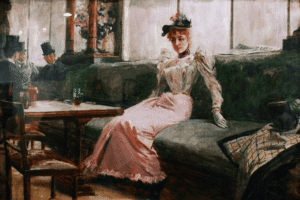
At first glance, “The Parisian Life” appears to be nothing more than a fashionable Paris café scene.
Look closer, however, and historians believe there’s much more happening.
The three men in the background have long been identified as José Rizal, Dr. Ariston Bautista Lin, and Juan Luna himself. More intriguingly, some art historians argue that the seated woman’s silhouette subtly resembles the shape of the Philippine archipelago. Others interpret the dark ribbon around her neck as a symbol of Spain’s grip on the country, suggesting the painting quietly expressed nationalist sentiments just a few years before the Philippine Revolution.
Whether these details were intentional or coincidence remains one of Philippine art history’s most enduring debates.
The Philippines’ own ‘Mona Lisa’
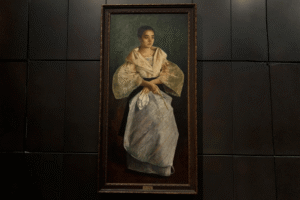
Among Luna’s portraits, none has inspired more speculation than “Una Bulaqueña.”
Often called the “Mona Lisa of the Philippines,” the painting captivates viewers with the quiet expression of a Filipina dressed in an elegant baro’t saya.
But who she really was remains a mystery.
Some historians believe the model was Emiliana Trinidad of Bulacan. Others have suggested she may have been connected to revolutionary hero Emilio Jacinto. Another long-standing theory claims she was a woman who rejected Luna’s romantic advances. More than a century later, none of these identities has been conclusively proven.
Unlike “Spoliarium,” whose story is well documented, these three paintings continue to invite questions rather than provide answers. Their mysteries—whether rooted in historical fact, artistic symbolism, or enduring folklore—have become part of their legacy, proving that sometimes the most captivating part of a masterpiece isn’t what the artist painted, but what history never fully explained.