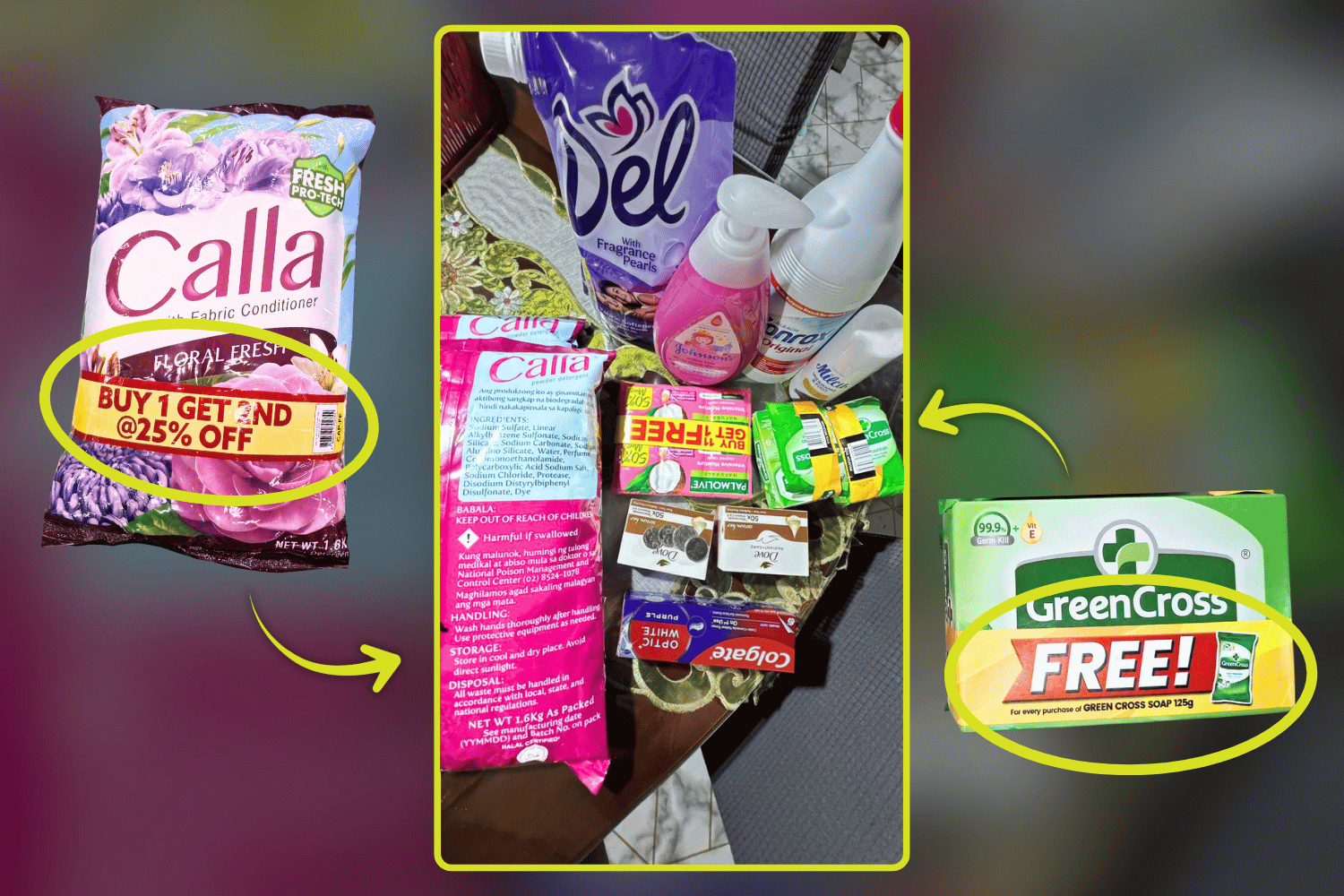
The post omitted visible details from its own photos—particularly the promotional stickers.
A Threads post accusing Puregold of denying a senior citizen discount has generated outrage online. But a closer look at both the Department of Trade and Industry (DTI) rules and the photos uploaded by the poster tells a very different story.
The post presents itself as a consumer rights exposé. In reality, it leaves out crucial information that completely changes the context.
The biggest omission: The items were already on promo
The most glaring problem with the post is that it never tells readers that some of the featured products were already under store promotions.
Yet the photos themselves reveal exactly that.
One pack of Calla detergent clearly carries a “Buy 1 Get 2nd at 25% Off” promo sticker. Another Green Cross soap box prominently displays a FREE promotional offer.
Under the DTI-DA-DOE Joint Administrative Order No. 24-02, senior citizens are not entitled to stack discounts on grocery purchases.
Instead, they are given a choice:
- take the 5% senior citizen discount, or
- avail of the store promotion, whichever provides the greater benefit.
In this case, a 25% promotional discount is obviously worth far more than a 5% senior citizen discount.
Presenting the transaction as if the discount was illegally denied—while leaving out that the products were already on sale—creates an incomplete and potentially misleading narrative.
Not everything in a grocery is a “basic necessity”
The post also repeatedly claims that items such as detergent, soap, toothpaste, and similar household products should automatically qualify for the senior citizen grocery discount.
That is not how the law works.
radar checked and was informed that DTI does not grant 5% discount on every supermarket purchase.
Only products classified as Basic Necessities and Prime Commodities (BNPCs) qualify.
For example:
Covered
- Laundry detergent soap
- Bath soap
- Rice
- Fresh meat
- Fresh vegetables
- Bread
- Cooking oil
- Sugar
- Eggs
Not automatically covered
- Fabric conditioner
- Soft drinks
- Snacks
- Alcoholic beverages
- Luxury or specialty products
- Various household items outside the BNPC list
One of the products highlighted in the post is fabric conditioner.
Fabric conditioner is not classified by the DTI as a basic necessity entitled to the 5% grocery discount.
Simply buying it inside a supermarket does not make it eligible.
The law is product-based—but still has limits
The Threads post is correct on one point.
The DTI indeed states that eligibility depends on the product classification, not merely on whether an item carries a premium brand.
A branded bath soap, for example, can still qualify because regular bath soap is listed as a prime commodity.
However, that does not mean every branded household product automatically becomes discount-eligible.
The product must first belong to one of the categories recognized under the BNPC list.
Promotions are not a violation
The post suggests that giving only a promotional discount instead of the senior discount is illegal.
The DTI rules say otherwise.
For BNPC grocery purchases already under a promotional sale, senior citizens are entitled to choose whichever discount is higher. The law does not allow both discounts to be applied simultaneously.
A 25% promotional offer therefore already exceeds the statutory 5% grocery discount.
Be careful with viral “fact-checks”
Consumer rights deserve to be protected, and businesses should absolutely be held accountable when they violate the law.
If a store incorrectly classifies products, refuses valid discounts, or charges prices different from shelf tags, consumers have every right to question it and file complaints.
But that same standard should apply to other click bait or rage bait social media posts.
In this case, the post omitted visible details from its own photos—particularly the promotional stickers—and blurred the distinction between products that are legally covered by the DTI’s Basic Necessities and Prime Commodities list and those that are not.
The result is a narrative that encourages outrage while leaving readers without the complete legal picture.
Knowing consumer rights also means knowing their limits. A missing fact can completely change the story.
READ:

House bill seeks 20% discount on mobile load, internet services for students
Justin Aquino
June 22, 2026
Expired discount tag, full amount at checkout? The lower price wins
Annie Azucena
July 9, 2026
Huge discounts on school supplies await you on these legacy paper shops in Binondo
Walter C. Villa
June 1, 2026