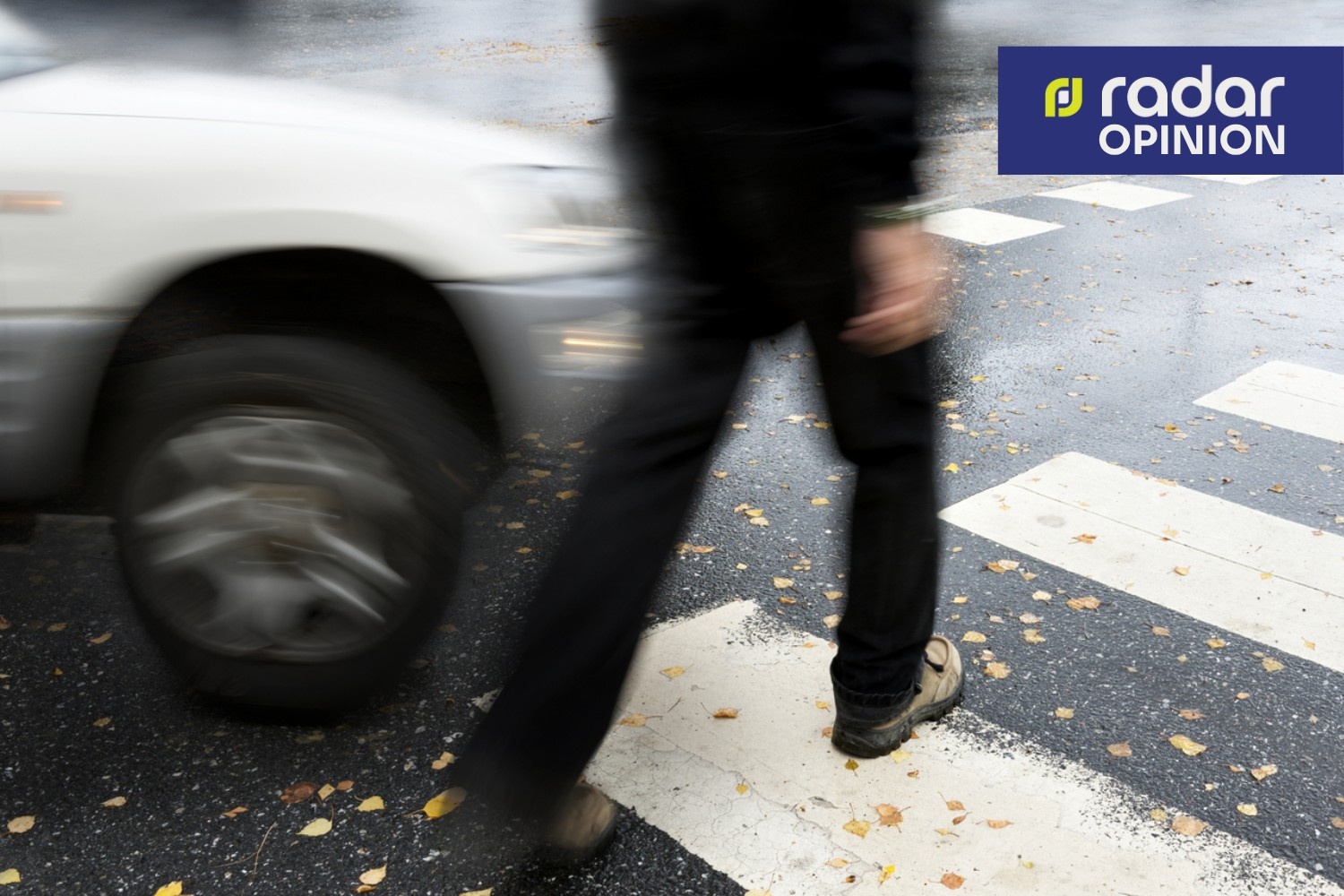

In the Philippines, enforcement is inconsistent and road behavior develops differently.
Pedestrian lanes in the Philippines often feel like they exist more in theory than in practice. They are there, clearly marked on the road, but the way they are treated by many motorists makes you wonder if they carry any real weight at all. In many cases, they feel less like a rule and more like a suggestion, and that alone already says something is off.
As someone on the road all the time both as a driver and a pedestrian, I’ve seen many instances where vehicles do not even slow down properly when people are already stepping into, or clearly about to step into, the pedestrian lane.
The level of disregard toward pedestrian lanes is impossible to miss, as if something as simple as crossing the street turns into a risky guessing game rather than a basic right of way.
There is also a certain impatience that shows up in everyday behavior on the road, from engines revving right before the light turns green to vehicles inching forward as if a few seconds of waiting is already too much. It creates an environment where movement is constant, but awareness of others is often secondary.
To put things in perspective, it is not like this in many other countries. In places such as Japan, the United States, or Singapore, pedestrian lanes are treated with a level of clarity that removes all guesswork. Cars stop well before the crossing, making it immediately clear that they are yielding to people on foot.
I remember crossing a street in Singapore with a group of local friends when I instinctively raised my hand toward an approaching car, a habit that many Filipinos would probably recognize. The driver stopped, of course, but what caught my friends’ attention was the gesture. They laughed and asked what I was doing. Did I have some kind of superpower that made cars stop? The joke landed because, for them, no signal was needed. For me, it had become instinct.
That difference comes from more than a single factor, and it is not as simple as saying drivers in one place are better than drivers in another. It is shaped by how rules are enforced, how consistently they are reinforced, and how long people have been conditioned to treat them as non-negotiable.
In places where pedestrian priority is taken seriously, enforcement is visible and consistent enough that it becomes routine. People learn early on that stopping is expected, not optional, and that habit holds because there are real consequences when it is ignored. Over time, that consistency shapes behavior even when no one is watching.
In contrast, where enforcement is inconsistent—such as in the Philippines—road behavior develops differently. Drivers learn to read situations rather than rely on fixed expectations, and pedestrians learn to adjust in real time instead of depending on right of way. Over time, people develop an informal sense of which rules are strictly enforced and which ones can be stretched.
Pedestrian lanes often end up in that space where the rule exists but compliance depends on circumstance.
With the way many motorists treat pedestrian lanes in this country, you’d think they don’t know what they are or what they’re for. I’d like to believe they do. Otherwise, that opens up an even bigger problem.
BGC works differently. Pedestrian lanes there tend to be taken more seriously, not because the markings are different, but because behavior is shaped by something immediate and visible. Traffic enforcers are present and quick to respond to violations. Public utility jeepneys and buses, which are often among the most frequent offenders elsewhere, are also largely absent from many of its roads.
The result is a road environment where behavior changes when drivers know they are being watched. You see it in how vehicles slow down earlier, how they stay behind the line, and how crossings are treated with more care—at least most of the time.
Respecting a pedestrian lane should be the easiest thing to do, and the simplest way to show that you value other people’s space, their right of way, and their safety. At some point, everyone becomes a pedestrian, which is why it makes more sense to build a road culture that consistently gives way rather than one that treats stopping as optional.
In the end, it only takes a second or two to stop properly at a crossing. That should not require debate or interpretation on the road.
And yet, it still does.
As to what it would take to change all this, it is less about new rules and more about actually following the ones that are already there, every time, without exception.
That’s the point.
READ:

OPINION: Smoking areas were supposed to be a good thing. Are they really?
Kenneth M. del Rosario
May 31, 2026
OPINION: If smoking is dangerous, why are cigarettes still so easy to buy?
Kenneth M. del Rosario
June 14, 2026