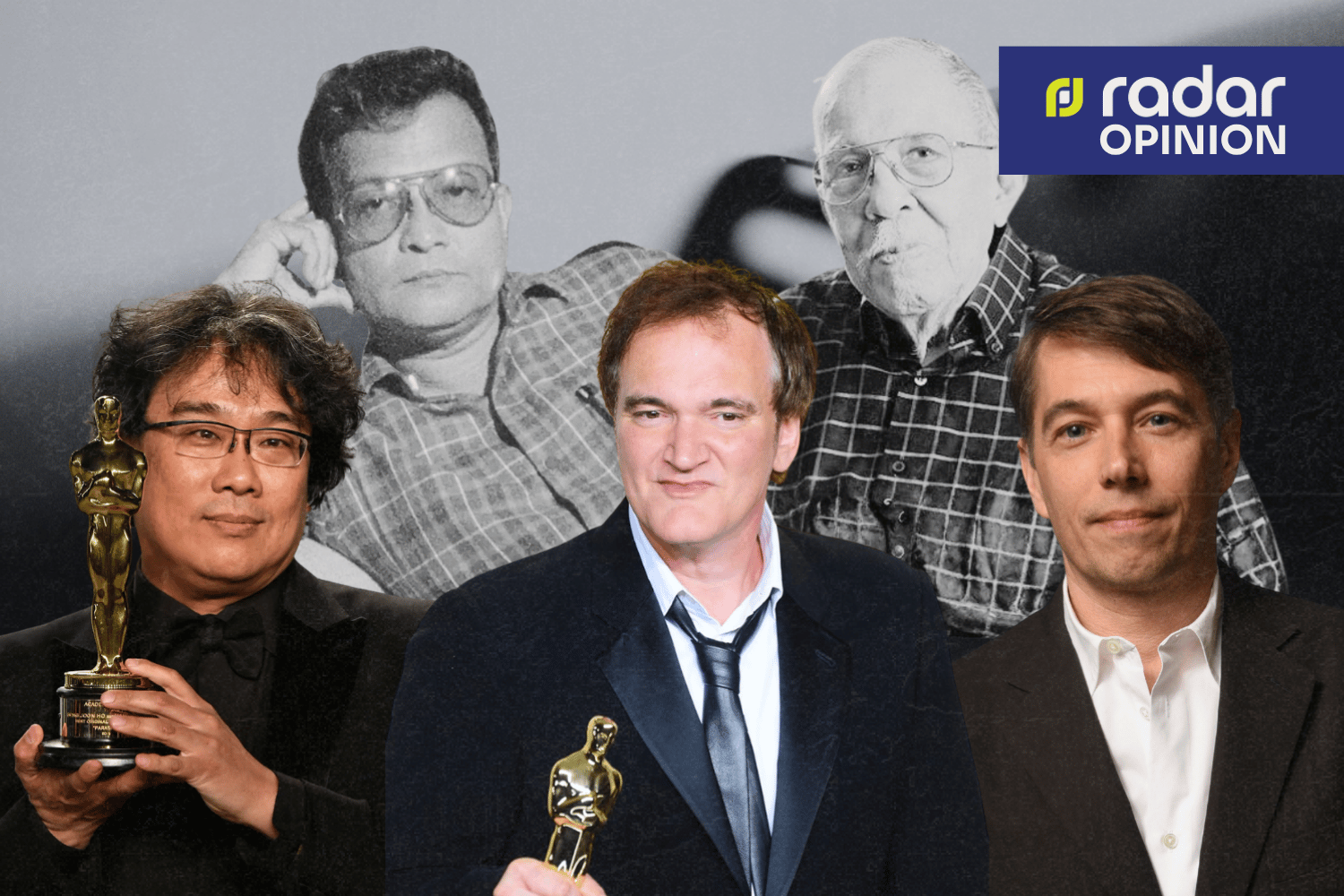
Global film legends study, praise, and draw deep inspiration from master Filipino filmmakers.
It has become almost reflexive for some Filipino moviegoers to dismiss local cinema as repetitive, inferior or simply not worth watching.
Yet some of the world’s most respected filmmakers have said something remarkably different. They have watched Filipino films, studied them and openly admired the directors behind them.
Bong Joon-Ho studies Brocka
Long before “Parasite” made history at the Academy Awards, South Korean filmmaker Bong Joon-ho was studying National Artist Lino Brocka.
“When I was in university, I was a huge fan of Edward Yang and Hou Hsiao-hsien,” Bong recalled in an interview. “And also Lino Brocka—he was a strong master. He made such powerful films.”
Bong said he encountered Brocka’s work through his university cinema club and did more than simply enjoy the movies.
“I analyzed them to figure out how those films were, rather than just purely enjoying them,” he said.
Brocka’s “Maynila sa mga Kuko ng Liwanag,” with its portrait of poverty, exploitation and class inequality, belongs to the socially conscious Asian cinema that Bong himself would later explore in films such as “Parasite.”
Tarantino grew up on Filipino movies
Quentin Tarantino’s fascination lies in a very different corner of Philippine cinema: the B-movies and exploitation films of filmmakers such as Eddie Romero and Cirio H. Santiago.
During his 2007 visit to Manila, Tarantino recalled watching Romero’s “The Twilight People” when he was only seven years old.
Meeting Romero decades later was particularly significant for Tarantino, who regarded the Filipino filmmaker not merely as part of Philippine film history but as part of world cinema history.
Tarantino has also spoken enthusiastically about Santiago and Filipino genre movies—films that could easily be dismissed locally as cheap entertainment but became part of the cinematic education of one of Hollywood’s most recognizable auteurs.
Sean Baker was ‘blown away’
More recently, “Anora” director Sean Baker had similarly enthusiastic words for Brocka after watching the restored “Bona” at Cannes in 2024.
“I was blown away,” Baker said. “It’s a powerful film. It’s a very powerful film.”
He was equally impressed by National Artist Nora Aunor: “The lead, Nora, is incredible in it.”
Baker had already watched “Insiang,” “Maynila sa mga Kuko ng Liwanag” and “Cain and Abel.” His attraction to Brocka’s work was not accidental.
“Why I’m drawn to him is because we both work in social realism,” Baker explained, adding that tackling such subject matter through Brocka’s kind of filmmaking was “right up my alley.”
The cinema we sometimes fail to see
None of this means Philippine cinema should be immune from criticism. The industry has produced formulaic and forgettable movies. But so has Hollywood. So has South Korea. Every functioning film industry produces both disposable entertainment and exceptional work.
The mistake is allowing the weakest commercial movies to define an entire national cinema.
Philippine cinema is also Brocka’s “Maynila sa mga Kuko ng Liwanag” and “Insiang,” Mike de Leon’s “Itim,” and the genre filmmaking of Romero and Santiago.
Perhaps familiarity makes these films easier for us to underestimate. We recognize the language, streets, poverty, humor and melodrama and sometimes mistake familiarity for inferiority.
Meanwhile, filmmakers thousands of kilometers away see something else.
Bong Joon-ho didn’t merely watch Brocka. He studied him. Sean Baker said he was “blown away” by “Bona.” Tarantino grew up watching Filipino genre films.
Maybe Philippine cinema doesn’t need foreign validation to prove its worth.
But when some of the world’s finest filmmakers find something in our cinema worth studying, preserving and learning from, perhaps Filipinos should think twice before dismissing it.
READ:

FIlmmaker Pedring Lopez says PH cinema needs a sustainable business model
Top Dagohoy
August 23, 2026

These five authors defined Tagalog romance across generations
Top Dagohoy
August 15, 2026

9 Filipino novels that deserve to become movies
Top Dagohoy
August 5, 2026