There’s a scientific reason why.
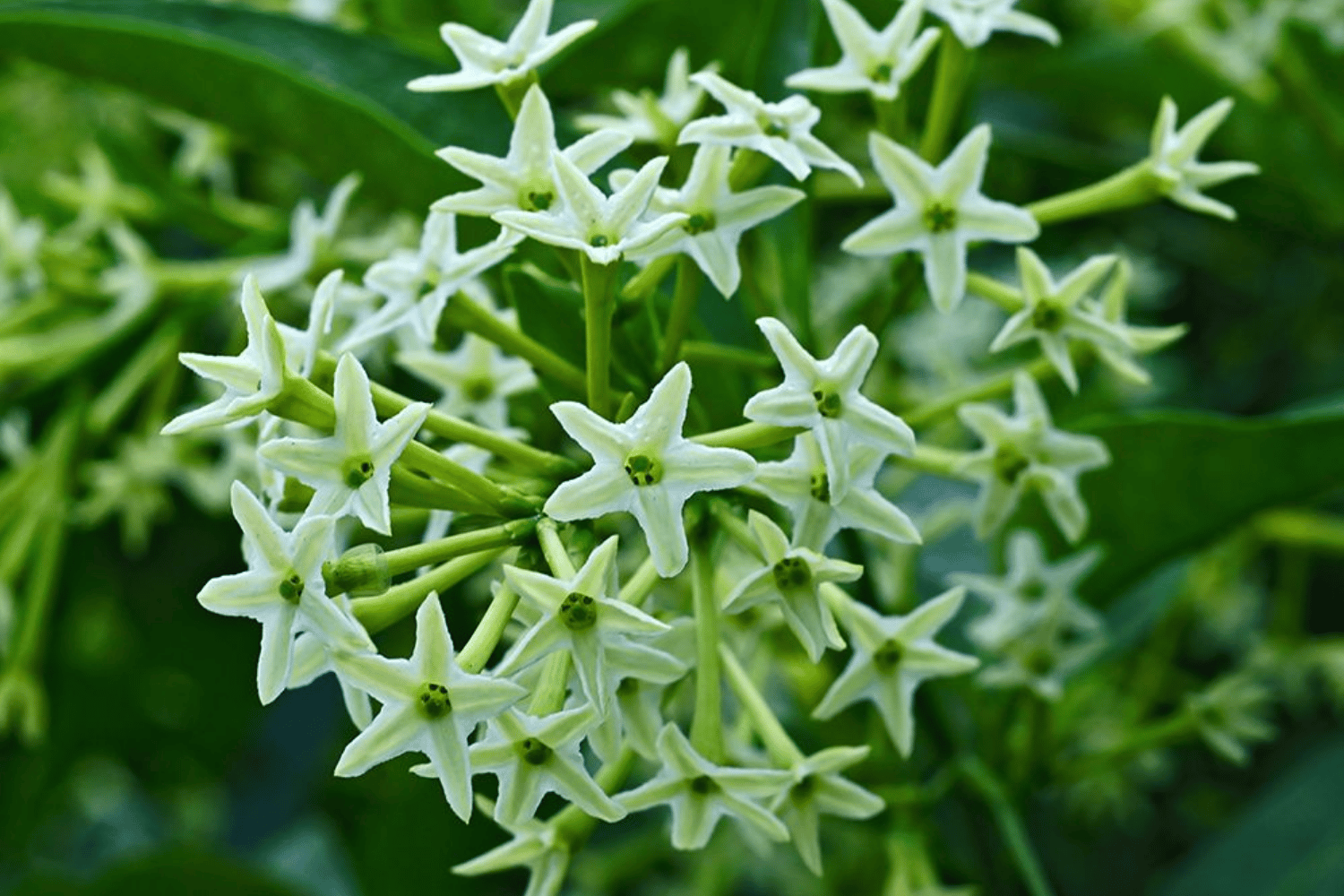
It’s late at night. The windows are open, the street has gone quiet, and suddenly a powerful sweet fragrance drifts into the house. You look outside, and there it is: the unassuming dama de noche filling the neighborhood with perfume.
Come morning, however, that intoxicating scent has practically disappeared.
It isn’t your imagination.
Dama de noche (Cestrum nocturnum), literally “lady of the night,” is famous for dramatically intensifying its fragrance after sunset. And the plant’s peculiar schedule is largely about reproduction.
It’s calling nighttime pollinators
Flowers don’t produce fragrance simply to smell good to humans.
Floral scents are made from volatile organic compounds, or VOCs, that evaporate into the air and function partly as chemical signals to potential pollinators.
Dama de noche is adapted for nighttime pollination, particularly by moths. Rather than continuously pumping out its strongest fragrance throughout the day, its scent production and release follow a circadian rhythm, becoming much more intense after dark when nocturnal pollinators are active.
Think of it as biological advertising with very specific business hours.
Why such a strong smell?
During the day, bees, butterflies and other pollinators can use bright colors and visual patterns to locate flowers.
At night, vision becomes less useful.
Dama de noche compensates with smell. Its small tubular flowers are pale greenish-white rather than spectacularly colorful, but their nighttime fragrance can travel through the surrounding air and help guide insects toward them.
That explains why a relatively ordinary-looking shrub can seemingly perfume an entire garden after sunset.
The plant has its own body clock
The change isn’t merely caused by cooler nighttime temperatures.
Like humans, plants possess internal biological clocks. Their circadian rhythms regulate processes including leaf movement, photosynthesis, flower opening and the production and emission of scent compounds.
For dama de noche, darkness effectively signals that its prime pollination period has arrived.
The fragrance rises. Morning comes. The chemical broadcast declines.
Producing these compounds also requires resources, so synchronizing their strongest release with the period when useful pollinators are around makes biological sense.
It’s not the only night perfumer
The same strategy appears in other fragrant plants familiar to Filipinos.
Sampaguita (Jasminum sambac) can smell particularly intense around evening and early morning, although it remains fragrant outside those hours.
Night-blooming cereus, meanwhile, takes the strategy to an extreme. Its spectacular pale flowers open at night, release a strong fragrance and have only a brief window in which to attract nocturnal pollinators before the bloom fades.
White or pale flowers and powerful fragrances are recurring features among many night-pollinated plants.
They don’t need to put on a colorful show under the sun.
They need to be found in the dark.
So the next time the unmistakable perfume of dama de noche suddenly enters your bedroom late at night, remember: that fragrance isn’t really meant for you.
You just happened to intercept a botanical message being sent into the darkness.
READ:

Bela Padilla jokes Maricel Soriano is her ‘date’ as rumored BF brings flower
Kiko Escuadro
September 7, 2026

The santan flowers you played with as a kid can actually be eaten
Top Dagohoy
July 25, 2026
Newly discovered Philippine flower named after Lea Salonga
Top Dagohoy
July 24, 2026