World-class islands and hospitality aren’t enough when high costs, extra transfers, and neighboring beaches offer easier alternatives.
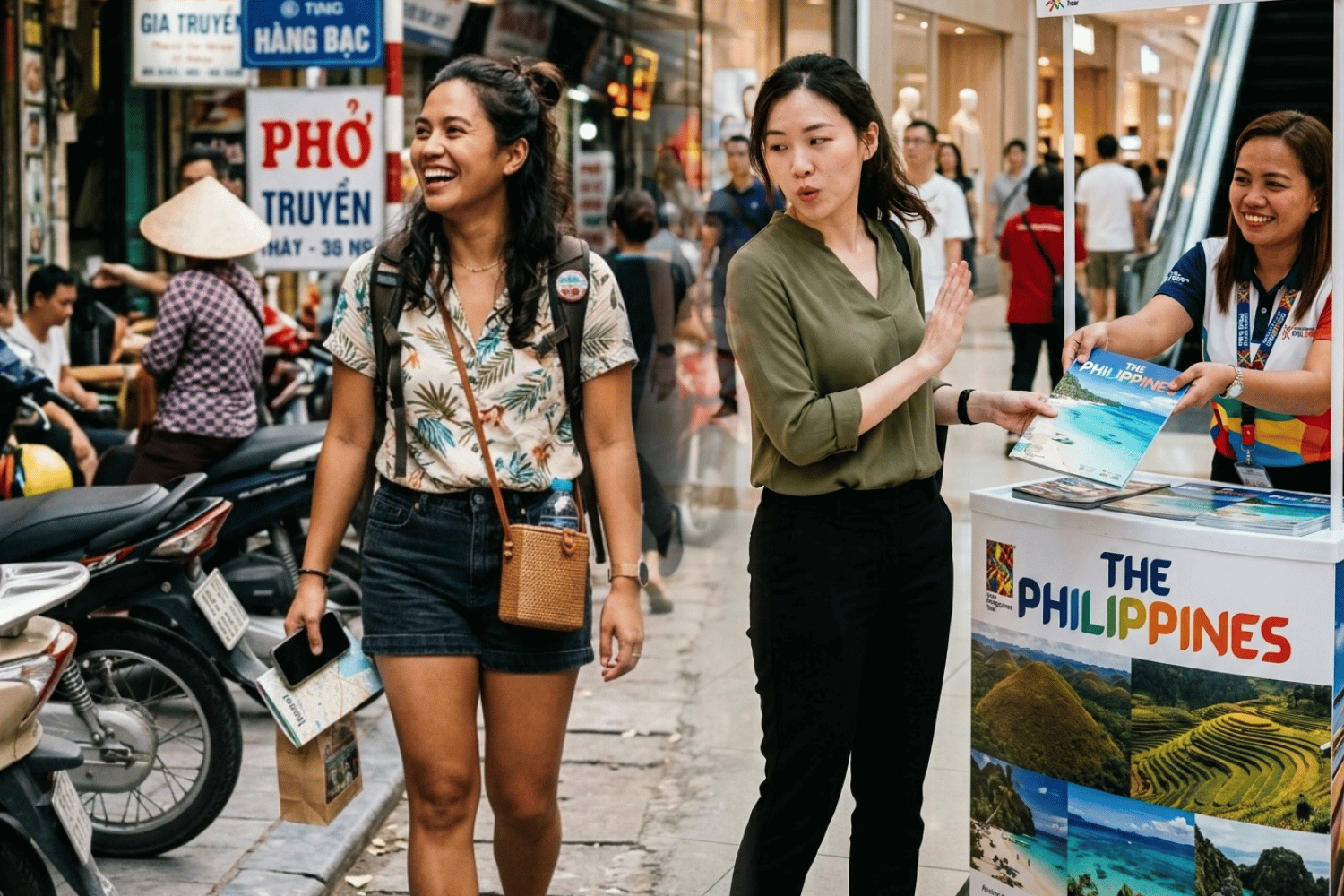
Walk through Bangkok, Bali or Ho Chi Minh City during a long Philippine weekend and hearing Filipino conversations hardly feels unusual.
Cheap flights, affordable hotels and food, efficient transport and an endless stream of things to do have turned our Southeast Asian neighbors into almost default international vacations for Filipinos.
But where are the Thais, Vietnamese and Indonesians vacationing in the Philippines?
Not here, at least not in comparable numbers.
The numbers reveal just how lopsided the exchange is.
In 2024, 598,124 Filipinos visited Thailand. In the opposite direction, only 45,896 Thai visitors came to the Philippines—a gap of roughly 13 to one.
Vietnam tells a similar story. It welcomed 265,947 Filipinos in 2024, while the Philippines received only 58,098 Vietnamese visitors.
Indonesia received 239,714 visitors from the Philippines that year. Only 57,085 Indonesians came the other way.
Put another way, Filipinos visited Thailand, Vietnam and Indonesia about 1.1 million times in 2024. Combined arrivals from those three countries to the Philippines totaled only around 161,000.
Why?
The explanation may have less to do with what the Philippines has than with how difficult—and sometimes expensive—it can be to experience it.
For a Filipino, Bangkok is already the destination. So is Hanoi or Ho Chi Minh City. Fly into these cities and an entire tourism ecosystem of trains, buses, hotels, restaurants, markets, heritage sites and attractions is immediately accessible.
The Philippines works differently.
Landing in Manila may only be the beginning. Want El Nido? Siargao? Coron? Bohol? Boracay? The traveler may need another flight, ferry or lengthy land transfer.
That geographical disadvantage cannot simply be marketed away.
Then comes price.
Thailand and Vietnam are not merely beautiful. They are highly competitive tourism machines, offering accommodation, food, transportation and attractions at prices that can be difficult for the Philippines to match.
The challenge becomes even bigger when courting Southeast Asians.
Imagine an Indonesian deciding where to spend a four-day holiday. The Philippines can offer spectacular islands—but Indonesia already has Bali, Lombok and thousands of islands of its own. A Thai traveler already has Phuket, Krabi and Koh Samui.
Selling another tropical beach therefore requires a compelling reason to get on another plane.
The Philippines cannot rely indefinitely on telling ASEAN travelers that our beaches are beautiful. Their beaches are beautiful, too.
Thailand and Vietnam also offer something harder to duplicate: tourism density. Within one trip, visitors can combine food, shopping, heritage, nightlife, cities and nature without repeatedly flying between destinations.
This suggests that the Philippine problem is partly one of positioning.
To many international travelers, Philippine tourism remains strongly associated with beaches and islands. But those are precisely the products Southeast Asia has in abundance.
What distinguishes the Philippines more sharply—its Hispanic-Asian history, indigenous cultures, festivals, diving, music, contemporary art, English-speaking environment and distinct regional cuisines—has arguably been less successfully packaged into a compelling ASEAN proposition.
Then there is visibility.
The Philippines competes against neighbors with bigger tourism promotion resources and globally established destination brands. Thailand has spent decades turning Bangkok, Phuket and Chiang Mai into tourism brands in themselves. Indonesia has Bali. Vietnam has aggressively expanded international connectivity while promoting Hanoi, Ho Chi Minh City and Da Nang.
And the gap may be getting harder to ignore.
Vietnam welcomed 482,173 Filipino visitors in 2025—an extraordinary 81 percent increase from 2024. Filipinos have become one of Vietnam’s fastest-growing tourism markets.
The traffic is clearly moving.
Just not equally in both directions.
None of this means Philippine tourism has nothing to offer. Quite the opposite. Few countries can match its combination of islands, biodiversity, diving, culture and hospitality.
But tourism is not simply a beauty contest.
Filipinos already understand why Bangkok, Bali, Hanoi and Ho Chi Minh City are worth visiting.
The bigger challenge is making a Thai, Vietnamese or Indonesian traveler look at Manila, Cebu, Iloilo, Bohol or Palawan and feel the same urgency.
Because having something beautiful is only the beginning.
People still have to believe it is worth the flight, the transfer, the cost—and the trouble.
READ:

ANALYSIS: Boracay opens its first hotel casino today. Can the island handle the growth?
Kenneth M. del Rosario
September 16, 2026
Can domestic tourism finally deliver on its promise to local businesses?
radar Business
June 29, 2026
ANALYSIS: Singapore formalized hawkers. Can Manila do the same for karinderya?
Kenneth M. del Rosario
August 2, 2026