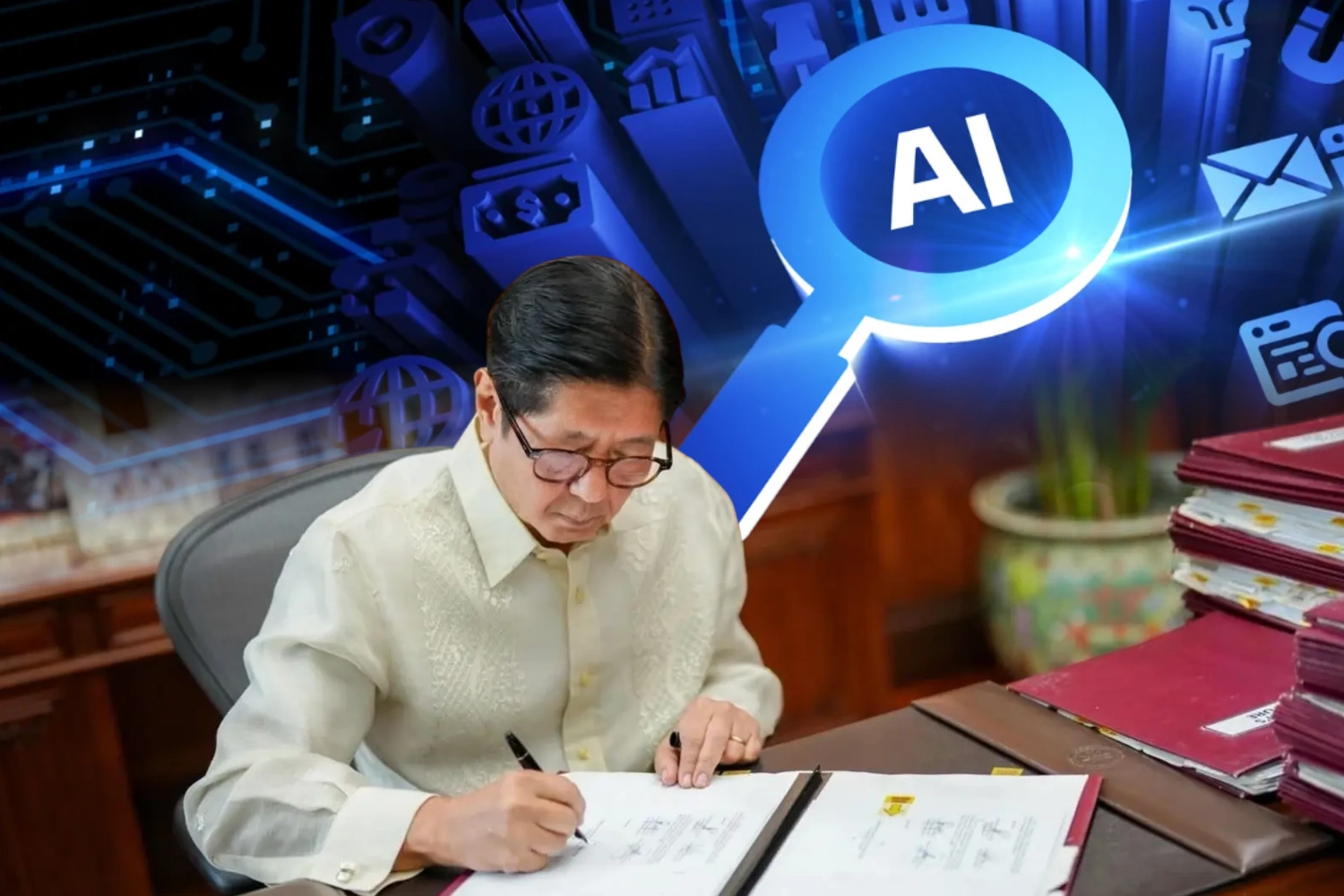
President Ferdinand Marcos Jr. has ordered the creation of a National Artificial Intelligence Council (NAIC), establishing a government-wide system to oversee the development, deployment, and responsible use of artificial intelligence in the Philippines.
Under Executive Order No. 131, signed on November 12, 2026, the administration formally adopted the Philippine AI Governance Framework as the country’s national strategic guide for AI policies, regulatory coordination, institutional development, and capacity-building.
The move comes as artificial intelligence increasingly transforms workplaces, education, businesses, and government services, raising concerns about data privacy, cybersecurity, misinformation, and potential job displacement.
New National AI Council
The newly created NAIC will be chaired by the Executive Secretary, with the Secretary of Economy, Planning, and Development serving as vice chairperson.
Its members include the heads of the DICT, DOST, DTI, DOF, DepEd, DOLE, DBM, CHED, and TESDA, alongside one private-sector representative appointed by the President.
The council will coordinate government AI initiatives, recommend regulatory and legislative measures, and address emerging risks associated with the technology.
It will also recommend safeguards for workers and learners affected by AI-driven transitions.
Four pillars of AI governance
The executive order identifies four interconnected elements of the national framework:
- Ethics and Principles: Promoting transparency, accountability, fairness, human-centered development, security, and safety.
- Standards and Assurance: Establishing technical standards, testing, evaluation, and safeguards for trustworthy AI systems.
- Risk-Based Policy Toolkit: Developing regulatory approaches proportionate to the risks associated with different AI applications.
- Enabling Resources: Strengthening research, infrastructure, workforce capabilities, data governance, and investments.
AI education and jobs
The order also calls for a national AI competency and digital workforce development program, alongside AI education, digital literacy, and scholarship initiatives.
Technical working groups will develop plans for AI research, infrastructure, institutional strengthening, and investments.
The government also intends to encourage private-sector participation, including opportunities for startups and small businesses.
Regular monitoring required
The DICT will establish a digital platform to monitor implementation, while the NAIC must submit quarterly progress reports to the President.
The framework will undergo review at least once every two years to keep pace with technological developments.
The order takes effect immediately upon publication in the Official Gazette or a newspaper of general circulation.
While the executive order establishes a national governance structure, it does not itself impose a blanket ban on particular AI applications or create a new set of criminal penalties.
Instead, it lays the groundwork for coordinated government policies intended to encourage AI innovation while protecting public welfare, workers, and consumers.